

Former Al-Qaeda spokesman living in £1m house in London: Report

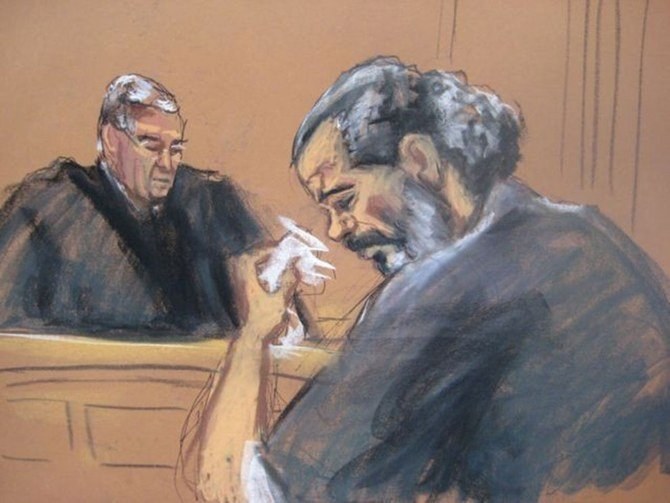
Adel Abdel Bary, 60, seen here in a court sketch, was convicted of terror offenses for his role in Al-Qaeda’s 1998 attacks on US embassies in Kenya and Tanzania that killed 224 people. (Reuters)
Short Url
Updated 11 January 2021
Follow

Former Al-Qaeda spokesman living in £1m house in London: Report

  • Adel Abdel Bary, jailed in US over 1998 embassy bombings, was released early due to health concerns
  • Abdel Bary and his family are now living in a £1 million house paid for by the local council in Maida Vale, northwest London

LONDON: A former spokesman for Al-Qaeda who worked closely with the group’s late leader Osama bin Laden is now living freely in London after being released early from a US jail due to the high COVID-19 risk posed by his weight and asthma, Britain’s Daily Mail newspaper reported on Monday.

Egyptian national Adel Abdel Bary, 60, was jailed in the US for 25 years over the 1998 attacks on American embassies in Kenya and Tanzania that killed 224 people.

He was released three years early and returned to the UK after it was deemed that his obesity and asthma put him at high risk from COVID-19.

Abdel Bary and his family are now living in a £1 million ($1.3 million) house paid for by the local council in Maida Vale, northwest London, the Daily Mail reported.

The newspaper added that he had been spotted walking around the local area and looked to be in good health, despite his lawyers citing his ill health as an “extraordinary and compelling” reason for “compassionate” early release.

The lawyer for the father of six has claimed that Abdel Bary wants to live a quiet life with his family now that he has finished his sentence.

But Britain’s Daily Mirror newspaper reported that his activity is likely to be closely scrutinized by the state for a number of years, and security measures will have to be put in place for his safety.

Abdel Bary was granted asylum from Egypt in Britain in 1991, and soon after he arrived he established a terrorist cell that later merged with Al-Qaeda.

He was arrested in 1999 for transmitting Al-Qaeda’s claims of responsibility for the 1998 embassy bombings to the media, and was later extradited to the US, where he faced trial.

He was charged with 285 offenses by an American court but pleaded guilty to just a handful, including threatening to kill by means of explosive and conspiracy to murder US citizens abroad.

The judge overseeing his case said the 25-year sentence was the result of an “enormously generous plea bargain.”

Abdel Bary is the father of convicted Daesh terrorist Abdel-Majed Abdel, who was arrested in Spain after traveling to Syria, where he posed with the severed head of a government soldier. Abdel has been stripped of his British citizenship for fighting for the terrorist group.


Trump calls for one year cap on credit card interest rates at 10 percent

Updated 6 sec ago
Follow

Trump calls for one year cap on credit card interest rates at 10 percent

  • Trump says Americans have been ‘ripped off’ by credit card companies
  • Lawmakers from both parties have raised concerns about rates

WASHINGTON: US President Donald Trump said on Friday he was ​calling for a one-year cap on credit card interest rates at 10 percent starting on January 20 but he did not provide details on how his plan will come to fruition or how he planned to make companies comply.
Trump also made the pledge during the campaign for the 2024 election that he won but analysts dismissed it at the time saying that such a step required congressional approval.
Lawmakers from both the Democratic and Republican Parties have raised concerns about high rates and have called for those to be addressed. Republicans currently hold a narrow majority in both the Senate ‌and the House ‌of Representatives.
There have been some legislative efforts in Congress ‌to pursue ⁠such ​a proposal ‌but they are yet to become law and in his post Trump did not offer explicit support to any specific bill.
Opposition lawmakers have criticized Trump, a Republican, for not having delivered on his campaign pledge.
“Effective January 20, 2026, I, as President of the United States, am calling for a one year cap on Credit Card Interest Rates of 10 percent,” Trump wrote on Truth Social, without providing more details.
“Please be informed that we will no longer let the American Public be ‘ripped off’ by Credit Card Companies,” Trump added.
The ⁠White House did not immediately respond to a request for comment on details of the call from Trump, but said on ‌social media without elaborating that the president was capping the rates.
Some ‍major US banks and credit card issuers ‍like American Express, Capital One Financial Corp, JPMorgan , Citigroup and Bank of America did not immediately respond ‍to a request for comment.
US Senator Bernie Sanders, a fierce Trump critic, and Senator Josh Hawley, who belongs to Trump’s Republican Party, have previously introduced bipartisan legislation aimed at capping credit card interest rates at 10 percent for five years. This bill explicitly directs credit card companies to limit rates ​as part of broader consumer relief legislation.
Democratic US Representative Alexandria Ocasio-Cortez and Republican Congresswoman Anna Paulina Luna have also introduced a House of Representatives bill to cap credit card ⁠interest rates at 10 percent, reflecting cross-aisle interest in addressing high rates.
Billionaire fund manager Bill Ackman, who endorsed Trump in the last elections, said the US president’s call was a “mistake.”
“This is a mistake,” Ackman wrote on X.
“Without being able to charge rates adequate enough to cover losses and earn an adequate return on equity, credit card lenders will cancel cards for millions of consumers who will have to turn to loan sharks for credit at rates higher than and on terms inferior to what they previously paid.”
Last year, the Trump administration moved to scrap a credit card late fee rule from the era of former President Joe Biden.
The Trump administration had asked a federal court to throw out a regulation capping credit card late fees at $8, saying it agreed with business and banking groups that alleged the rule was ‌illegal. A federal judge subsequently threw out the rule.