

Bin Laden’s former spokesman bound for Britain after US release

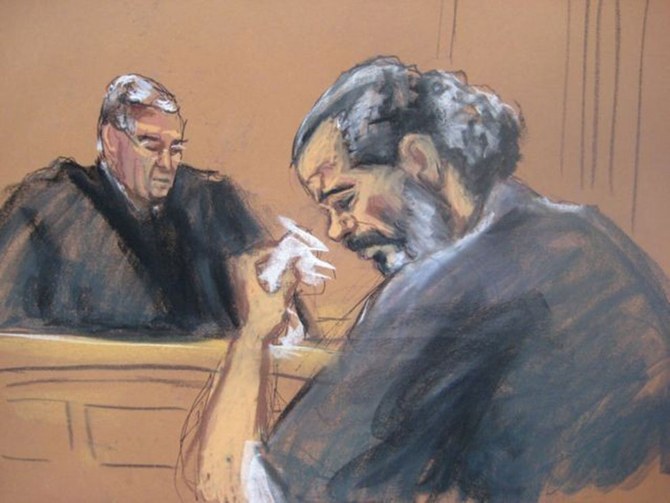
Adel Abdel Bary, 60, seen here in a court sketch from September 19, was convicted of terror offenses for his role in Al-Qaeda’s 1998 attacks on US embassies in Kenya and Tanzania that killed 224 people. (Reuters/File Photo)
Short Url
Updated 12 October 2020
Follow

Bin Laden’s former spokesman bound for Britain after US release

  • Adel Abdel Bary released from prison early due to being at high risk from COVID-19
  • He played a role in Al-Qaeda’s 1998 embassy attacks that claimed 224 lives

LONDON: Osama bin Laden’s former spokesman is due to return to the UK after being released early from prison in the US.

Adel Abdel Bary, 60, was convicted of terror offenses for his role in Al-Qaeda’s 1998 attacks on US embassies in Kenya and Tanzania that killed 224 people.

He was responsible for transmitting Al-Qaeda’s claims of responsibility for the attacks to the media, and for disseminating threats of further violence against US citizens.

Abdel Bary was arrested a year after the 1998 attacks and extradited to the US after a protracted legal battle.

As part of a plea deal, he admitted to three charges, including conspiracy to murder US citizens abroad, and was sentenced to 25 years behind bars. Consideration was made for the 16 years he had already spent in custody.

The Times reported that Abdel Bary, who is asthmatic and obese, was released weeks early on compassionate grounds due to the high risks posed to him by COVID-19.

The Egyptian-born terrorist operated from a base in London, where he claimed asylum. He became head of the London cell of an Egyptian terrorist organization before it merged with Al-Qaeda in 1998.

While working for Al-Qaeda, he spread propaganda on its behalf, assisted with recruitment and provision of funds, and provided cover and support for its military activities. 

The UK government is urgently reviewing Abdel Bary’s situation, and sources told The Times that he would be placed under priority investigation.

“This is not someone who will simply just be walking the streets of Britain again. We are very alive to the risk involved in his potential return,” a government source said.

He will be surveilled by the state for connections with former colleagues or other suspicious activities.

It is understood that he will not be deported from the US until the UK has adequately prepared for his arrival.

Abdel Bary’s son, Abdel-Majed Abdel, was arrested in Spain this year, having joined Daesh in Syria in 2013 and gaining notoriety for posing online with the severed head of a Syrian regime soldier.


Moscow made an offer to France regarding a French citizen imprisoned in Russia, says Kremlin

Updated 5 sec ago
Follow

Moscow made an offer to France regarding a French citizen imprisoned in Russia, says Kremlin

  • Laurent Vinatier, an adviser for Swiss-based adviser Center for Humanitarian Dialogue, Vinatier was arrested in Moscow in June 2024
  • He is accused of failing to register as a “foreign agent” while collecting information about Russia’s “military and military-technical activities” 

The Kremlin on Thursday said it was in contact with the French authorities over the fate of a French political scholar serving a three-year sentence in Russia and reportedly facing new charges of espionage.
Kremlin spokesman Dmitry Peskov told reporters that Russia has made “an offer to the French” regarding Laurent Vinatier, arrested in Moscow last year and convicted of collecting military information, and that “the ball is now in France’s court.” He refused to provide details, citing the sensitivity of the matter.
French President Emmanuel Macron is following Vinatier’s situation closely, his office said in a statement. French Foreign Ministry spokesperson Pascal Confavreux said Thursday that all government services are fully mobilized to pay provide consular support to Vinatier and push for his liberation as soon as possible.
Peskov’s remarks come after journalist Jérôme Garro of the French TF1 TV channel asked President Vladimir Putin during his annual news conference on Dec. 19 whether Vinatier’s family could hope for a presidential pardon or his release in a prisoner exchange. Putin said he knew “nothing” about the case, but promised to look into it.
Vinatier was arrested in Moscow in June 2024. Russian authorities accused him of failing to register as a “foreign agent” while collecting information about Russia’s “military and military-technical activities” that could be used to the detriment of national security. The charges carry a maximum penalty of five years in prison.
The arrest came as tensions flared between Moscow and Paris following French President Emmanuel Macron’s comments about the possibility of deploying French troops in Ukraine.
Vinatier’s lawyers asked the court to sentence him to a fine, but the judge in October 2024 handed him a three-year prison term — a sentence described as “extremely severe” by France’s Foreign Ministry, which called for the scholar’s immediate release.
Detentions on charges of spying and collecting sensitive data have become increasingly frequent in Russia and its heavily politicized legal system since Moscow invaded Ukraine in February 2022.
In addition to criticizing his sentence, the French Foreign Ministry urged the abolition of Russia’s laws on foreign agents, which subject those carrying the label to additional government scrutiny and numerous restrictions. Violations can result in criminal prosecution. The ministry said the legislation “contributes to a systematic violation of fundamental freedoms in Russia, like the freedom of association, the freedom of opinion and the freedom of expression.”
Vinatier is an adviser for the Center for Humanitarian Dialogue, a Switzerland-based nongovernmental organization, which said in June 2024 that it was doing “everything possible to assist” him.
While asking the judge for clemency ahead of the verdict, Vinatier pointed to his two children and his elderly parents he has to take care of.
The charges against Vinatier relate to a law that requires anyone collecting information on military issues to register with authorities as a foreign agent.
Human rights activists have criticized the law and other recent legislation as part of a Kremlin crackdown on independent media and political activists intended to stifle criticism of the war in Ukraine.
In August 2025, Russian state news agency Tass reported that Vinatier was also charged with espionage, citing court records but giving no details. Those convicted of espionage in Russia face between 10 and 20 years in prison.
Russia in recent years has arrested a number of foreigners — mainly US citizens — on various criminal charges and then released them in prisoner swaps with the United States and other Western nations. The largest exchange since the Cold War took place in August 2024, when Moscow freed journalists Evan Gershkovich and Alsu Kurmasheva, fellow American Paul Whelan, and Russian dissidents in a multinational deal that set two dozen people free.