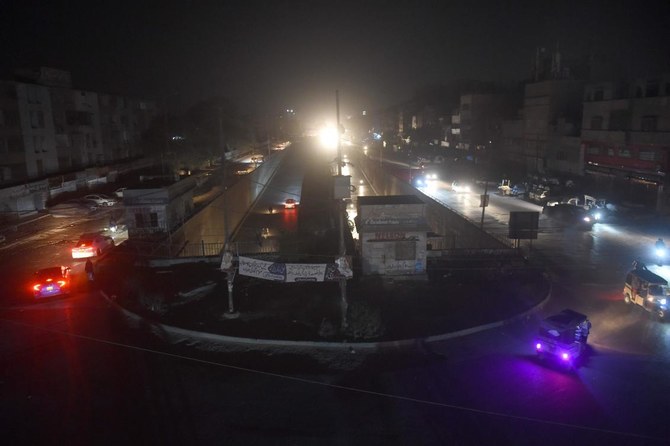
ISLAMABAD: Power supply was restored across Pakistan Sunday after the country was hit by a massive electricity blackout, officials said.
The electricity distribution system in the nation of more than 210 million people is a complex and delicate web, and a problem in one section of the grid can lead to cascading breakdowns countrywide.
The latest blackout, which lasted roughly 18 hours in most areas, was caused by “an engineering fault” in southern Pakistan at 11:41 p.m. local time on Saturday (1841 GMT), which tripped the system and caused power plants to shut down, power minister Omar Ayub Khan told a press conference in Islamabad.
Experts were however trying to determine the precise details of what happened as well as “the exact location of the fault,” the power minister said, adding that it would take time as the area was still covered in dense fog.
A spokesman from the National Transmission and Despatch Company (NTDC) reported that “all 500KV and 200KV grid stations and transmission lines have started supplying electricity” and that “the power supply has been restored across Pakistan.”
Jokes and memes flooded Twitter, Facebook and WhatsApp, mostly ridiculing Prime Minister Imran Khan’s government and its performance after the breakdown.
“Power breakdown in Pakistan is blackmailing Imran Khan,” tweeted Musarrat Ahmedzeb in reference to the premier’s recent statement accusing Shiite protesters of blackmailing him after the killing of 10 miners.
“What a start for the new year... let us seek Allah the Almighty’s mercy,” read another tweet, while a message on WhatsApp said: “new Pakistan sleeps in a night mode.”
There were no immediate reports of disruption at hospitals, which often rely on backup generators.
Netblocks, which monitors Internet outages, said web connectivity in the country “collapsed” as a result of the blackout.
Connectivity was at “62 percent of ordinary levels,” it said in a tweet.
The outage marked Pakistan’s second major power breakdown in less than three years. In May 2018, power was partially disrupted for more than nine hours.
In 2015, an apparent rebel attack on a key power line plunged around 80 percent of Pakistan into darkness.
That blackout, one of the worst in Pakistan’s history, caused electricity to be cut in major cities nationwide, including Islamabad, and even affected one of the country’s international airports.


![]()

Power restored in Pakistan after nationwide blackout
Short Url
https://arab.news/bscb9
Power restored in Pakistan after nationwide blackout
- The latest blackout, which lasted roughly 18 hours in most areas, was caused by “an engineering fault” in southern Pakistan
- It tripped the system and caused power plants to shut down, Pakistan’s power minister said


Latest updates


© 2026 SAUDI RESEARCH & PUBLISHING COMPANY, All Rights Reserved And subject to Terms of Use Agreement.