Palestinians say vaccines could come in March, accuse Israel of shirking duty to supply them

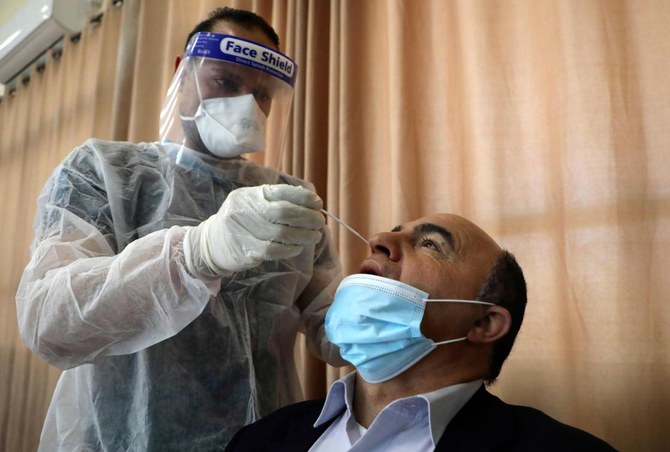
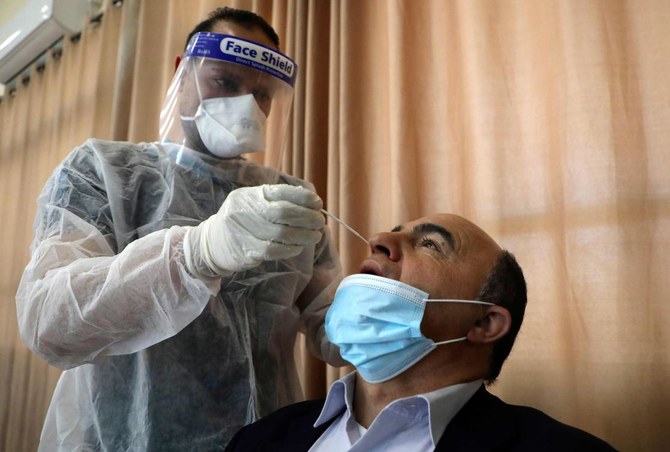
A Palestinian health worker takes a swab sample from a man to test for COVID-19 coronavirus in the West Bank village of Dura, southwest of Hebron, on January 8, 2021. (AFP)
Short Url
Updated 10 January 2021
Follow

Palestinians say vaccines could come in March, accuse Israel of shirking duty to supply them

GAZA: The Palestinian Authority said on Sunday it expects to receive its first COVID-19 vaccine doses in March under a deal with drugmaker AstraZeneca, and accused Israel of shirking a duty to ensure vaccines are available in occupied territory.
While Israel has already become the world leader in vaccinations per capita, Palestinians in the Israeli-occupied West Bank and the Gaza Strip have yet to secure their first supplies.
Yasser Bozyeh, the Palestinian general director of public health, told Reuters that in addition to reaching an agreement in principle with AstraZeneca, the Palestinians had also sought supplies from Moderna, Johnson & Johnson and Russia, which has developed the Sputnik V vaccine.
Supplies would also come through a World Health Organization vaccine program for poor and middle income countries.
There was no immediate response from AstraZeneca to an emailed request from Reuters for comment.
The Palestinian Foreign Ministry said in a statement Israel had been “ignoring its duties as an occupation power and committing racial discrimination against the Palestinian people, depriving them of their right to health care.”
“The search by the Palestinian leadership to secure the vaccines from various sources doesn’t exempt Israel from its responsibilities toward the Palestinian people in providing the vaccines,” it said.
Under interim peace accords with Israel, the Palestinian Authority exercises limited self-rule in the West Bank. Hamas Islamists run the Gaza Strip.
Israel’s vaccination program covers the country’s Arab citizens and Palestinian residents of East Jerusalem.
On the West Bank, it has given vaccines to Israeli settlers, but not to Palestinian residents, who receive health services from the Palestinian Authority.
Human rights groups including Amnesty International say Israel has a legal obligation to provide vaccines for Palestinians under occupation. Israeli officials say they could share vaccines with the Palestinians once Israel’s own needs are met.
A WHO official said on Sunday the organization had held “informal discussions” with Israel over allocating some supplies to the Palestinians to inoculate health workers. The official, Gerald Rockenschaub, head of the WHO office in the Palestinian territories, said Israel indicated it would explore the option.


Lebanon’s government approves a deal to transfer Syrian prisoners back to Syria

Updated 5 sec ago
Follow

Lebanon’s government approves a deal to transfer Syrian prisoners back to Syria

  • Lebanon and Syria have a complicated history with grievances on both sides
  • A key obstacle to warming relations has been the fate of about 2,000 Syrians in Lebanese prisons

BEIRUT: Lebanon’s Cabinet on Friday approved an agreement to transfer Syrian prisoners serving their sentences in Lebanon back to their home country.
The issue of prisoners has been a sore point as the neighboring countries seek to recalibrate their relations following the ouster of former Syrian President Bashar Assad in a lightning offensive by Islamist-led insurgents in December 2024. Former insurgent leader Ahmad Al-Sharaa is now Syria’s interim president.
Lebanon and Syria have a complicated history with grievances on both sides. Many Lebanese resent the decades-long occupation of their country by Syrian forces that ended in 2005. Many Syrians resent the role played by the Lebanese militant group Hezbollah when it entered Syria’s civil war in defense of Assad’s government.
A key obstacle to warming relations has been the fate of about 2,000 Syrians in Lebanese prisons, including some 800 held over attacks and shootings, many without trial. Damascus had asked Beirut to hand them over to continue their prison terms in Syria, but Lebanese judicial officials said Beirut would not release any attackers and that each must be studied and resolved separately.
The deal approved Friday appeared to resolve that tension. Lebanese Information Minister Paul Morcos said other issues remain to be resolved between the two countries, including the fate of Lebanese believed to have been disappeared into Syrian prisons during Assad’s rule and the demarcation of the border between the two countries.
Lebanon’s Deputy Prime Minister Tarek Mitri told reporters after the Cabinet meeting that about 300 prisoners would be transferred as a result of the agreement.
Protesters gathered in a square below the government palace in downtown Beirut ahead of the Cabinet vote to call for amnesty for Lebanese prisoners, including some who joined militant groups fighting against Assad in Syria. Some of the protesters called for the release of Sunni cleric Ahmad Al-Assir, imprisoned for his role in 2013 clashes that killed 18 Lebanese army soldiers.
“The state found solutions for the Syrian youth who are heroes and belong to the Syrian revolution who have been imprisoned for 12 years,” said protester Khaled Al- Bobbo. “But in the same files there are also Lebanese detainees. ... We demand that just as they found solutions for the Syrians, they must also find solutions for the people of this country.”