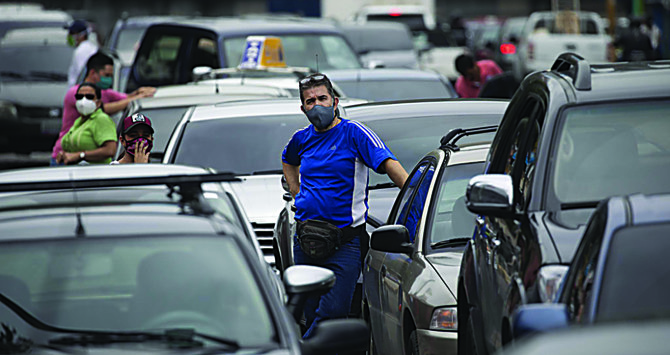
SAN CRISTOBAL, Venezuela: In crisis-hit Venezuela, even soldiers are struggling to make ends meet on meager salaries rendered practically worthless by the highest inflation in the world and have taken to moonlighting — as taxi drivers.
Some have taken to sneaking out of their barracks to pick up customers needing a lift — a job that can earn them 60 times their monthly salary with just one trip.
“I’m a father and given the situation in the country, my salary is worth nothing,” a 39-year-old sergeant said. “I do my taxi journeys and I earn much more than in my other job — that’s why I do it.”
The sergeant can earn more than $500 for driving passengers from San Cristobal on the border with Colombia to the capital Caracas, some 800 km to the northeast. His monthly wage as a soldier — 9 million bolivars — is worth just $8.
However, regular taxi drivers are furious and say members of the armed forces have an unfair advantage: Their uniform.
“They don’t get stopped at police checkpoints” where drivers are often asked for a bribe, and “they don’t have problems getting fuel,” complained Eusebio Correa, a 57-year-old career taxi driver.
“The military that should be providing security are now chauffeurs in uniform.”
Sourcing fuel for vehicles is a major issue in Venezuela, but especially in remote Tachira state and its capital San Cristobal.
Fuel shortages have led to people waiting at gas stations for days at a time to fill their tanks, or alternatively turning to the black market, where prices are considerably higher. That added cost has subsequently pushed up the price of taxi rides.
But since the military controls gas stations, soldiers don’t face the same restrictions the general population does.
“This uniform that I wear represents respect. With the uniform, I can come and go anywhere,” admitted the sergeant.
The salaries of the rank and file may have plummeted alongside everyone else’s earnings in a country that has been in recession for seven years, but the military as an institution remains powerful.
It is the main power propping up the government of President Nicolas Maduro.
The military also controls oil, mining and food distribution companies, as well as customs and several key ministries.
Venezuela’s opposition and some rights organizations claim many top military officials have gotten rich through corruption.
The taxi-driving sergeant said he started “escaping” his barracks to moonlight once the country was put under a coronavirus lockdown.
“For the release permits, sometimes I ask for medical leave. You even make up stuff to your own colleagues. I know many who do this job, right up to our superiors,” said the sergeant.
Under the lockdown, regular comings and goings were restricted — and only authorized via passes issued by the military.


Venezuela’s new taxi drivers: Moonlighting soldiers
https://arab.news/pkxme
Venezuela’s new taxi drivers: Moonlighting soldiers


Saudi Arabia’s PIF rises to 5th among world’s largest sovereign wealth funds
RIYADH: Saudi Arabia’s Public Investment Fund has climbed to fifth place among the world’s largest sovereign wealth funds, with assets under management reaching $1.15 trillion.
According to the latest rankings from the Sovereign Wealth Fund Institute, the PIF demonstrated a strong domestic investment orientation, with 80 percent of its assets allocated within the Kingdom and 55 percent of its portfolio invested in alternative assets.
This domestic and alternative-heavy allocation contrasts with global trends, as several top-ranked funds, such as Norges Bank Investment Management, maintain zero domestic exposure and lower allocations to alternative investments.
The PIF recorded an increase of $226 billion in assets by December, up from $925 billion at the end of December 2024, according to a report by Argaam.
Topping the global rankings is the Government Pension Fund of Norway, managed by Norges Bank Investment Management, with $2.04 trillion in assets.
China’s State Administration of Foreign Exchange ranked second with $1.69 trillion, while China Investment Corp. placed third with $1.56 trillion.
The Abu Dhabi Investment Authority ranked fourth, managing $1.18 trillion in assets.
Established in 1971, the PIF plays a central role in Saudi Arabia’s Vision 2030 economic diversification strategy, deploying sovereign capital across sectors including technology, tourism and infrastructure.
In December, the PIF reinforced its role as a key driver of economic transformation in the Kingdom by announcing a strategic transaction with global real estate services firm JLL.
Under the agreement, JLL will acquire a significant stake in Saudi Facilities Management Co., known as FMTECH, a national firm launched by the fund in 2023. The PIF will retain a majority stake, with the transaction expected to close subject to customary regulatory and contractual conditions.
FMTECH, which serves both PIF portfolio companies and clients across the public and private sectors, will leverage JLL’s global network, digital platforms, and operational expertise to enhance service delivery and operational transparency.
In November, PIF also completed the sale of part of its stake in Umm Al Qura for Development and Construction Co. through an accelerated bookbuild offering.
The transaction involved 48 million shares, equivalent to 3.3 percent of Masar’s share capital, and raised more than SR950 million ($253 million) at a final offer price of SR19.8 per share.


