

South Korea’s IPO market poised for record year on booming retail demand

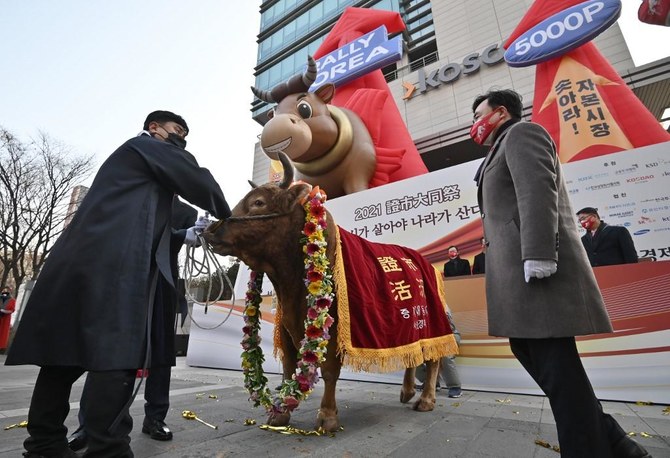
A man holds onto a bull during a ceremony marking the opening of the stock market at the Korea Exchange in Seoul on Jan. 4, 2021, on the first trading day of the new year. (AFP)
Short Url
Updated 08 January 2021
Follow

South Korea’s IPO market poised for record year on booming retail demand

  • Its IPO market could raise up to $18.40 billion, a record and about four times above 2020 levels

SEOUL/HONG KONG: South Korea is set for the busiest year ever for new share sales as companies ranging from a digital bank, game developer to an electric car battery maker rush to take advantage of robust retail demand, bankers and analysts said.
Its IPO market could raise up to 20 trillion won ($18.40 billion), a record and about four times above 2020 levels, led by firms providing products that are more in demand from people stuck indoors due to the pandemic, analysts said.
Also, a move by the country’s financial regulator to increase the allocation of IPO shares to retail customers this year will drive up investment, they added.
The projection comes against a recent rally in the main KOSPI index to above 3,000 for the first time, with investors looking toward a broad recovery in exports beyond South Korea’s tech titans.
This is “shaping up to look like it could be a record year,” said David Chung, head of Korea investment banking at Goldman Sachs. “The majority of big mandates and IPO themes are around the technology sector.”
That includes companies that were offline but now, amid the health crisis, have built up a significant online presence, Chung added. “That is where the growth is.”
Deals in the pipeline include a potential 4.6 trillion won float from KakaoBank, which has benefited from an inflow of customers from South Korea’s dominant chat app operator Kakao Corp. Kakao has a 32 percent stake in KakaoBank.
KakaoBank has picked advisers but not decided when it will list, a spokesman said.
An estimated 9-trillion won share sale by Tesla supplier LG Chem’s electric car battery unit is also in the pipeline, according to an analyst.
The IPO size or timing has not been decided yet, an LG Energy Solution official said.
South Korean companies raised about 4.7 trillion won via initial public offerings in 2020, Korea Exchange data shows, surpassing the past two years, but behind an all-time high of about 10 trillion won reached in 2010.

MORE SHARE SALES
EV battery maker SK Innovation’s chemical material unit SK IE Technology (SKIET) is also expected to make its market debut this year, bankers and analysts said.
SKIET said it plans to complete the IPO process within 2021.
Consumer demand for EVs has been relatively resilient, aided by tighter environment regulations and the launch of new models.
In South Korea, a “New Deal” economic initiative that pivots on digital innovation and eco-friendly growth is burnishing the appeal of EV-related stocks.
Gaming company Krafton and SK Bioscience are also looking to raise about 5 trillion won and 600 billion won, respectively, this year, Seoul-based SK Securities said.
In October, Krafton picked advisers for its IPO with plans to go public in 2021. A company spokeswoman said on Friday there were no further details to share at the moment.
SK Bioscience was not immediately available for comment.
Individual investors, who piled into the South Korean market last year, are trading at a pace not seen in years.
In 2020, the KOSPI clocked its biggest rise since 2009 as shares in companies like Samsung Electronics, the world’s biggest maker of memory chips, surged.
“The market right now is clearly attractive to retail investors and it will likely attract more of them as IPO shares allocation for retail investors has gone up to as much as 30 percent from 20 percent,” said Lee So-joong, an analyst with SK Securities.


First EU–Saudi roundtable on critical raw materials reflects shared policy commitment

Updated 16 January 2026
Follow

First EU–Saudi roundtable on critical raw materials reflects shared policy commitment

RIYADH: The EU–Saudi Arabia Business and Investment Dialogue on Advancing Critical Raw Materials Value Chains, held in Riyadh as part of the Future Minerals Forum, brought together senior policymakers, industry leaders, and investors to advance strategic cooperation across critical raw materials value chains.

Organized under a Team Europe approach by the EU–GCC Cooperation on Green Transition Project, in coordination with the EU Delegation to Saudi Arabia, the European Chamber of Commerce in the Kingdom and in close cooperation with FMF, the dialogue provided a high-level platform to explore European actions under the EU Critical Raw Materials Act and ResourceEU alongside the Kingdom’s aspirations for minerals, industrial, and investment priorities.

This is in line with Saudi Vision 2030 and broader regional ambitions across the GCC, MENA, and Africa.

ResourceEU is the EU’s new strategic action plan, launched in late 2025, to secure a reliable supply of critical raw materials like lithium, rare earths, and cobalt, reducing dependency on single suppliers, such as China, by boosting domestic extraction, processing, recycling, stockpiling, and strategic partnerships with resource-rich nations.

The first ever EU–Saudi roundtable on critical raw materials was opened by the bloc’s Ambassador to the Kingdom, Christophe Farnaud, together with Saudi Deputy Minister for Mining Development Turki Al-Babtain, turning policy alignment into concrete cooperation.

Farnaud underlined the central role of international cooperation in the implementation of the EU’s critical raw materials policy framework.

“As the European Union advances the implementation of its Critical Raw Materials policy, international cooperation is indispensable to building secure, diversified, and sustainable value chains. Saudi Arabia is a key partner in this effort. This dialogue reflects our shared commitment to translate policy alignment into concrete business and investment cooperation that supports the green and digital transitions,” said the ambassador.

Discussions focused on strengthening resilient, diversified, and responsible CRM supply chains that are essential to the green and digital transitions.

Participants explored concrete opportunities for EU–Saudi cooperation across the full value chain, including exploration, mining, and processing and refining, as well as recycling, downstream manufacturing, and the mobilization of private investment and sustainable finance, underpinned by high environmental, social, and governance standards.

From the Saudi side, the dialogue was framed as a key contribution to the Kingdom’s industrial transformation and long-term economic diversification agenda under Vision 2030, with a strong focus on responsible resource development and global market integration.

“Developing globally competitive mineral hubs and sustainable value chains is a central pillar of Saudi Vision 2030 and the Kingdom’s industrial transformation. Our engagement with the European Union through this dialogue to strengthen upstream and downstream integration, attract high-quality investment, and advance responsible mining and processing. Enhanced cooperation with the EU, capitalizing on the demand dynamics of the EU Critical Raw Materials Act, will be key to delivering long-term value for both sides,” said Al-Babtain.

Valere Moutarlier, deputy director-general for European industry decarbonization, and directorate-general for the internal market, industry, entrepreneurship and SMEs at European Commission, said the EU Critical Raw Materials Act and ResourceEU provided a clear framework to strengthen Europe’s resilience while deepening its cooperation with international partners.

“Cooperation with Saudi Arabia is essential to advancing secure, sustainable, and diversified critical raw materials value chains. Dialogues such as this play a key role in translating policy ambitions into concrete industrial and investment cooperation,” she added.