Indonesian police kill 2 suspected militants in raid

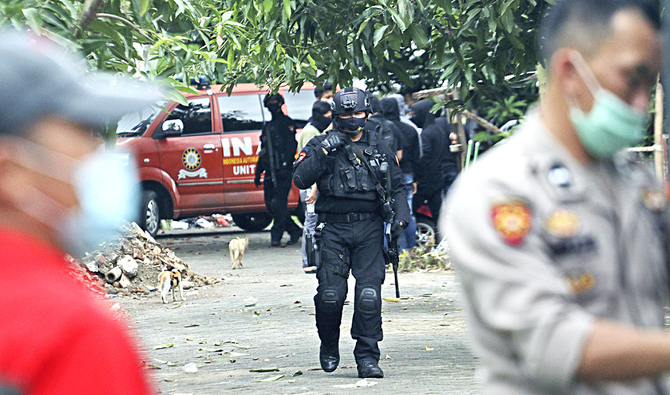
Police officers walk outside the site where two suspected militants were killed during a raid in Makassar, South Sulawesi, Indonesia, on Wednesday. (AP)
Short Url
Updated 07 January 2021
Follow

Indonesian police kill 2 suspected militants in raid

  • The suspects were linked to a banned militant organization responsible for a series of attacks in Indonesia, a local affiliate of the Daesh group known as Jemaah Anshorut Daulah

JAKARTA: Members of Indonesia’s anti-terrorism police squad on Wednesday shot and killed two suspected militants who they believe were connected to a deadly suicide attack at a Roman Catholic cathedral in the southern Philippines, and arrested 18 others, officials said.

The two men, Muhammad Rizaldy, 46, and his son-in-law, Sanjai Ajis, 23, were fatally shot by police after they resisted arrest by wielding a machete and an air-rifle during a raid at a house in Makassar, the capital of South Sulawesi province, said National Police spokesperson Ahmad Ramadhan.

The suspects were linked to a banned militant organization responsible for a series of attacks in Indonesia, a local affiliate of the Daesh group known as Jemaah Anshorut Daulah, Ramadhan said.

He said members of the counterterrorism squad were initially to arrest the two men for their alleged role in the Jan. 27, 2019, suicide bombing at Our Lady of Mount Carmel Cathedral in Jolo town in the Philippine province of Sulu that killed 23 people and wounded nearly 100.

Authorities in Indonesia and the Philippines believe the attack was carried out by an Indonesian couple, Rullie Rian Zeke and Ulfah Handayani Saleh.

“The two slain suspects were involved in sending funds to the suicide bombers for the attack at a cathedral in the southern Philippines’ Jolo town,” Ramadhan said of Rizaldy and Ajis, adding that police were still conducting an investigation at their house in Makassar.

Ramadhan said the two men were also accused of harboring Andi Baso, another suspected militant who was involved in a 2016 church attack in Samarinda city on Indonesia’s Borneo island that killed a three-year-old girl and wounded several other children. He said Indonesian authorities believe that Baso has fled to the southern Philippines and joined with a militant group there.

The two are believed to have been members of a militant Jemaah Anshorut Daulah cell who pledged allegiance to Daesh group leader Abu Bakr Al-Baghdadi in 2015. They tried to go to Syria in 2016 but police foiled their attempt at the airport.

Ramadhan said police also arrested 18 other members of the cell during Wednesday’s raid, and one of them was hospitalized with gunshot wounds after resisting arrest.

Indonesia has been battling militants since the 2002 bombings on the resort island of Bali that killed 202 people, mostly foreign tourists. Attacks aimed at foreigners have been largely replaced in recent years by smaller, less deadly strikes targeting the government, police and anti-terrorism forces, inspired by Islamic State group attacks abroad.

Indonesian police have been criticized for shooting suspects rather than trying to arrest them. Authorities say they are forced to defend themselves.


Only 4% women on ballot as Bangladesh prepares for post-Hasina vote

Updated 26 January 2026
Follow

Only 4% women on ballot as Bangladesh prepares for post-Hasina vote

  • Women PMs have ruled Bangladesh for over half of its independent history
  • For 2026 vote, only 20 out of 51 political parties nominated female candidates

DHAKA: As Bangladesh prepares for the first election since the ouster of its long-serving ex-prime minister Sheikh Hasina, only 4 percent of the registered candidates are women, as more than half of the political parties did not field female candidates.

The vote on Feb. 12 will bring in new leadership after an 18-month rule of the caretaker administration that took control following the student-led uprising that ended 15 years in power of Hasina’s Awami League party.

Nearly 128 million Bangladeshis will head to the polls, but while more than 62 million of them are women, the percentage of female candidates in the race is incomparably lower, despite last year’s consensus reached by political parties to have at least 5 percent women on their lists.

According to the Election Commission, among 1,981 candidates only 81 are women, in a country that in its 54 years of independence had for 32 years been led by women prime ministers — Hasina and her late rival Khaleda Zia.

According to Dr. Rasheda Rawnak Khan from the Department of Anthropology at Dhaka University, women’s political participation was neither reflected by the rule of Hasina nor Zia.

“Bangladesh has had women rulers, not women’s rule,” Khan told Arab News. “The structure of party politics in Bangladesh is deeply patriarchal.”

Only 20 out of 51 political parties nominated female candidates for the 2026 vote. Percentage-wise, the Bangladesh Socialist Party was leading with nine women, or 34 percent of its candidates.

The election’s main contender, the Bangladesh Nationalist Party, whose former leader Zia in 1991 became the second woman prime minister of a predominantly Muslim nation — after Pakistan’s Benazir Bhutto — was the party that last year put forward the 5 percent quota for women.

For the upcoming vote, however, it ended up nominating only 10 women, or 3.5 percent of its 288 candidates.

The second-largest party, Jamaat-e-Islami, has not nominated a single woman.

The 4 percent participation is lower than in the previous election in 2024, when it was slightly above 5 percent, but there was no decreasing trend. In 2019, the rate was 5.9 percent, and 4 percent in 2014.

“We have not seen any independent women’s political movement or institutional activities earlier, from where women could now participate in the election independently,” Khan said.

“Real political participation is different and difficult as well in this patriarchal society, where we need to establish internal party democracy, protection from political violence, ensure direct election, and cultural shifts around female leadership.”

While the 2024 student-led uprising featured a prominent presence of women activists, Election Commission data shows that this has not translated into their political participation, with very few women contesting the upcoming polls.

“In the student movement, women were recruited because they were useful, presentable for rallies and protests both on campus and in the field of political legitimacy. Women were kept at the forefront for exhibiting some sort of ‘inclusive’ images to the media and the people,” Khan said.

“To become a candidate in the general election, one needs to have a powerful mentor, money, muscle power, control over party people, activists, and locals. Within the male-dominated networks, it’s very difficult for women to get all these things.”