

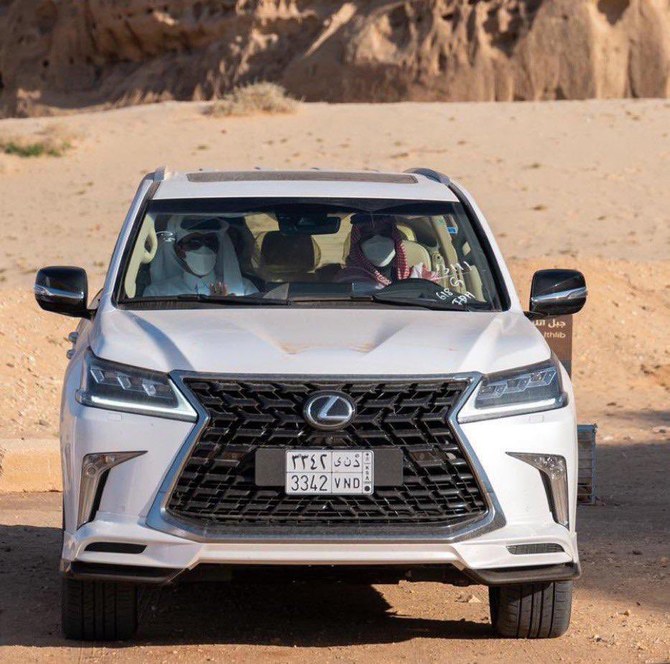
Lexus emerges as a winner of GCC accord

Driving through AlUla in a Lexus , Saudi Arabia’s Crown Prince Mohammed bin Salman took Qatar’s Emir Sheikh Tamim bin Hamad Al-Thani on a cruise around the heritage sites on Tuesday.
Short Url
Updated 07 January 2021
Follow

Lexus emerges as a winner of GCC accord

  • Lexus, Toyota vehicles have long been the best-selling brands in KSA

DUBAI: As the 41st Gulf Cooperation Council (GCC) Summit ends, Saudi Arabia and its allies have taken a historic step in restoring full diplomatic relations with Qatar after a three-year dispute.

Lexus, the luxury division of Japanese car brand Toyota, also emerged as a winner of the GCC reconciliation.

Driving through AlUla in a Lexus LX570SS model, Saudi Arabia’s Crown Prince Mohammed bin Salman took Qatar’s Emir Sheikh Tamim bin Hamad Al-Thani on a cruise around the heritage sites on Tuesday.

The flashy model has 383-horsepower, 5.7-liter v8 engine and 7,000-lb towing capacity.

Lexus and Toyota vehicles have long been the best-selling car brands in Saudi Arabia, thanks to Abdul Latif Jameel (ALJ), a family-owned diversified business founded in Jeddah in 1945 by Sheikh Abdul Latif Jameel.

The Saudi company became an official Toyota distributor in 1955 and began exporting and distributing Lexus cars in 1989. ALJ was importing and selling over 200,000 Toyota vehicles per year during the 1980s.

Toyota’s market share remains high in Saudi Arabia, hitting 35 percent in 2016.

In 2019, Toyota led car sales in the Kingdom by 27.7 percent. According to a YouGov study conducted by Arab News Japan in the same year, 56 percent of Arab respondents associated Japan with car manufacturing, and considered Toyota a favorite brand in high demand.

The study also found that 13 percent viewed Nissan and Lexus as favored automobiles.

Photos of the two royals emerged on social media and inspired reactions from Saudis, Qataris and Japanese Twitter users.

One Twitter user from Japan was proud to see Saudi Arabia’s crown prince and the Qatari emir take a cruise in the Lexus: “This is Toyota’s Lexus! Saudi Arabia recovered its diplomatic relations with Qatar. As a Japanese living in the Middle East, I’m a little proud of it.”

Another user from Saudi Arabia noted that Lexus gained some recognition from the GCC reconciliation.

Toyota is not the only Japanese firm to have strong business relationships in Saudi Arabia, with recent deals between the two nations including the Saudi Electricity Co. signing an agreement with Tokyo Electric Power Co., Nissan Motor Co. and Tecaoca Coco Energy Solutions Co. to implement electric vehicles and adapt them for Saudi use.

Soleimani’s shadow
Qassem Soleimani left a trail of death and destruction in his wake as head of Iran’s Quds Force … until his assassination on Jan. 3, 2020. Yet still, his legacy of murderous interference continues to haunt the region

Enter


keywords


RLC Global Forum helping retail experts exchange knowledge around new tech, industry leaders say

Updated 6 sec ago
Follow

RLC Global Forum helping retail experts exchange knowledge around new tech, industry leaders say

RIYADH: New technologies used to improve customer experience and day-to-day operations are driving Saudi Arabia’s retail transformation, industry leaders have told Arab News during a high-profile gathering in Riyadh.

On the sidelines of the RLC Global Forum, key players in the sector spoke to Arab News about how artificial intelligence is playing an increasingly important role as tech-savvy consumers look for integration between the virtual and physical worlds.

They also praised the role of the forum in bringing stakeholders together to exchange knowledge and ideas, which is driving forward retail offerings in the Kingdom and beyond.

The two-day RLC Global Forum started on Feb. 3 under the strategic theme “Growth Crossroads,” and brought together more than 2,000 global leaders, policymakers, and innovators from over 40 countries to define the next chapter of growth across retail, consumer, and lifestyle industries.

Speaking to Arab News, Majid Al-Gothmi, acting CEO of shopping centre management company Red Malls, said: “The Saudi retail sector is changing under Vision 2030. The transformation has helped our growth.”

He agreed that digital tools, AI, and new technologies are being used to improve customer experience and day-to-day operations.

“It’s helping us a lot in actually profiling our customers, understanding them, and providing better services to the younger generation,” said Al-Gothmi.

“Gen Z constitutes a major component of the retail market. We can see that 70 percent of the consumers are Gen-Z — they do most of their shopping online, over 60 percent of them,” he added, going on to say that his company’s focus is on “future proofing” shopping malls by integrating technology along with physical space that allows people to mingle comfortably and seamlessly.

Al-Gothmi described the RLC Global Forum as “an excellent platform gathering all the developers, retailers, brands, and most importantly, policymakers.”

He added: “This is a first, I think, where they share their insights, challenges, and exchange solutions, which helps the whole industry to move faster.”

Stefania Lazzaroni, CEO of Italian luxury brands association Altagamma Foundation, told Arab News that she expects steady growth for high-end products and experiences in the Kingdom.

She said: “There’s a new trend about hospitality, fine dining, longevity, and health spa beauty. These are the key factors that are growing. And we believe fine dining, hospitality and spa health as well will be a new trend even in this area. Honestly, they have been doing well for a couple of years.”

Stefania Lazzaroni, CEO of Altagamma Foundation. AN

Lazzaroni asserted that digital tools, AI and new technologies are being used to improve customer experience, as “the luxury client is very specific about what they want.”

She added: “Artificial intelligence is really perfect for us. We have a lot of counterfeiting all around the world, so technology can really support luxury brands in protecting their brands.

“So we are very pro artificial intelligence, which is changing the game and giving more strength and potential for luxury brands.”

The CEO explained that AI is also useful for talking to Gen Z, “which will be the clients of the future.”

She added: “So today with social media, TikTok, and so forth, there is an explosion of beauty, Gen Z is very much active on this.”

Abdel-Salam Bdeir, CEO at the Saudi Co. for Hardware, agreed that the retail sector is changing under Vision 2030 transformation.

He told Arab News: “We are building new technologies for AI to be used and demand planning and inventory optimization, marketing, and pricing optimization, margin, maximization.

“Even in security cameras, communication with customers, shopping behavior targeting certain sectors of customers, we are building all that as we speak.”

Bdeir believes technological progress brings both opportunities and challenges, among them the risk of fewer jobs.

He said: “With major international platforms entering the market, not only the jobs, but money goes to other markets. That’s why the United States, UK, France, Italy, Spain, and Germany put strict regulations on international platforms first to meet safety standards for the consumer and environmental standards, and second to secure jobs for locals.

“They also put higher tariffs, customs duties, on developing markets like India, Egypt, Turkiye, Brazil, Mexico, Vietnam, Indonesia, and Malaysia.”

Bdeir added: “So what is in my opinion, necessary is for the regulators to do what European countries and developing markets did to protect jobs, consumers and the economy.”