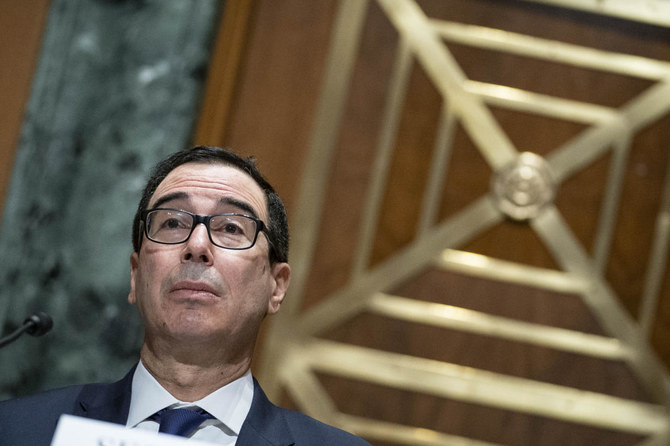
CAIRO: US Treasury Secretary Steven Mnuchin arrived in Sudan Wednesday, the first visit by a senior American official since President Donald Trump’s administration removed the African country from the list of state sponsors of terrorism.
Mnuchin landed in Khartoum’s international airport, where he received by acting Finance Minister Heba Mohammed Ali, and US Charge d’Affaires in Sudan Brian Shukan, the prime minister’s office said in a statement.
It is the first visit by a US treasury chief to Sudan, the statement said. Secretary of State Mike Pompeo in August became the first top American diplomat to visit Sudan since 2005, when Condoleezza Rice visited. Pompeo was also the most senior US official to visit the African country since last year’s ouster of Omar Al-Bashir.
Mnuchin landed at Khartoum’s international airport, where he was received by Egypt’s President Abdel-Fattah El-Sisi, a close Trump ally. The visit is part of a flurry of activity during the final days of the Trump administration. Democrat Joe Biden becomes president on Jan. 20.
The US treasury secretary is expected to meet with Sudan’s leaders, including Gen. Abdel-Fattah Burhan, head of the ruling sovereign council, and Prime Minister Abdalla Hamdok.
Mnuchin’s one-day visit was focusing on the country’s struggling economy and possible US economic assistance, including potential debt relief, the statement said. Sudan today has more than $60 billion in foreign debt, and debt relief and access to foreign loans are widely seen as its gateway to economic recovery.
Sudan is on a fragile path to democracy after a popular uprising led the military to overthrow Al-Bashir in April 2019. The county is now ruled by a joint military and civilian government that seeks better ties with Washington and the West.
Last month, Trump’s administration finalized the removal of Sudan from the US list of state sponsors of terrorism. The move was a key incentive for the government in Khartoum to normalize relations with Israel.
The two countries, Sudan and Israel, have agreed to have full diplomatic ties, making Sudan the third Arab state — after the United Arab Emirates and Bahrain — to move to normalize relations with Israel late last year. Morocco also established diplomatic ties with Israel.
Sudan’s economy has suffered from decades of US sanctions and mismanagement under Al-Bashir, who had ruled the country since a 1989 Islamist-backed military coup.
The designation dates back to the 1990s, when Sudan briefly hosted Al-Qaeda leader Osama bin Laden and other wanted militants. Sudan was also believed to have served as a pipeline for Iran to supply weapons to Palestinian militants in the Gaza Strip.


US treasury chief visits Sudan after ending pariah status
https://arab.news/53cbz
US treasury chief visits Sudan after ending pariah status

- It is the first visit by a US treasury chief to Sudan
- Mnuchin’s one-day visit was focusing on the country’s struggling economy and possible US economic assistance

Syria’s leader set to visit Berlin with deportations in focus
- Sharaa is scheduled to meet his counterpart Frank-Walter Steinmeier, the German president’s office said
BERLIN: Syrian President Ahmed Al-Sharaa is expected in Berlin on Tuesday for talks, as German officials seek to step up deportations of Syrians, despite unease about continued instability in their homeland.
Sharaa is scheduled to meet his counterpart Frank-Walter Steinmeier, the German president’s office said.
Chancellor Friedrich Merz’s office has yet to announce whether he would also hold talks with Sharaa during the visit.
Since ousting Syria’s longtime leader Bashar Assad in late 2024, Sharaa has made frequent overseas trips as the former Islamist rebel chief undergoes a rapid reinvention.
He has made official visits to the United States and France, and a series of international sanctions on Syria have been lifted.
The focus of next week’s visit for the German government will be on stepping up repatriations of Syrians, a priority for Merz’s conservative-led coalition since Assad was toppled.
Roughly one million Syrians fled to Germany in recent years, many of them arriving in 2015-16 to escape the civil war.
In November Merz, who fears being outflanked by the far-right AfD party on immigration, insisted there was “no longer any reason” for Syrians who fled the war to seek asylum in Germany.
“For those who refuse to return to their country, we can of course expel them,” he said.
- ‘Dramatic situation’ -
In December, Germany carried out its first deportation of a Syrian since the civil war erupted in 2011, flying a man convicted of crimes to Damascus.
But rights groups have criticized such efforts, citing continued instability in Syria and evidence of rights abuses.
Violence between the government and minority groups has repeatedly flared in multi-confessional Syria since Sharaa came to power, including recent clashes between the army and Kurdish forces.
Several NGOs, including those representing the Kurdish and Alawite Syrian communities in Germany, have urged Berlin to axe Sharaa’s planned visit, labelling it “totally unacceptable.”
“The situation in Syria is dramatic. Civilians are being persecuted solely on the basis of their ethnic or religious affiliation,” they said in a joint statement.
“It is incomprehensible to us and legally and morally unacceptable that the German government knowingly intends to receive a person suspected of being responsible for these acts at the chancellery.”
The Kurdish Community of Germany, among the signatories of that statement, also filed a complaint with German prosecutors in November, accusing Sharaa of war crimes, genocide and crimes against humanity.
There have also been voices urging caution within government.
On a trip to Damascus in October, Foreign Minister Johann Wadephul said that the potential for Syrians to return was “very limited” since the war had destroyed much of the country’s infrastructure.
But his comments triggered a backlash from his own conservative Christian Democratic Union party.


