

After Kaavan, elephant Malka in the spotlight over ‘dire’ conditions at Karachi safari

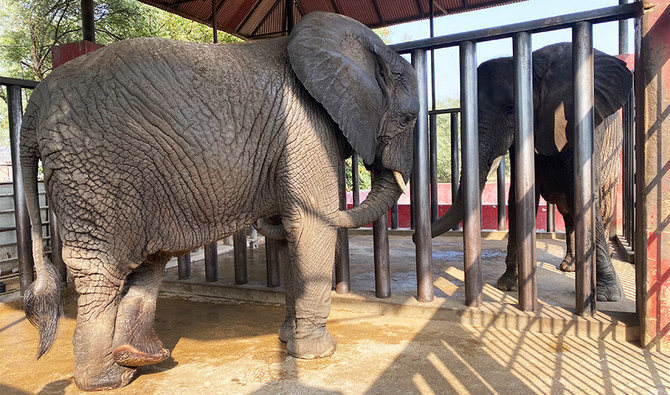
Elephants Malka and Suno at a safari park in Karachi, Pakistan, on January 5, 2021. (AN Photo)
Short Url
Updated 29 March 2021
Follow

After Kaavan, elephant Malka in the spotlight over ‘dire’ conditions at Karachi safari

  • Malka’s plight came to light after a social media user posted pictures on Twitter this week, experts say her foot’s condition indicates dehydrations and inadequate care and food
  • Authorities deny mistreatment, say Malka has a common winter rash that is expected to heal within a week

KARACHI: Authorities in Pakistan’s financial hub of Karachi said Malka, a female elephant at a safari park in the city, had a painful winter rash, as wildlife experts said the condition of the animal’s foot indicated dehydration and a lack of adequate food and medical attention.

The news of Malka comes just weeks after the “world’s loneliest elephant,” Kaavan, was rescued from a life of misery in Islamabad Zoo and sent to a sanctuary in Cambodia, and two Himalayan brown bears, Suzie and Bubloo, were airlifted to a wildlife park in Jordan.

Malka’s plight came to light this week when a social media user posted about her and her partner Sonu on Twitter, saying the two elephants were “in dire need of foot care ... are chained for 15 hours a day.” 

Ali Hasan Sajjad, a spokesperson for the Karachi Municipal Corporation, denied reports of mistreatment of the animals, saying safari authorities were taking proper care of the elephants and Malka’s foot was not injured but had a winter rash. 

“The itching will heal within a week,” he said.
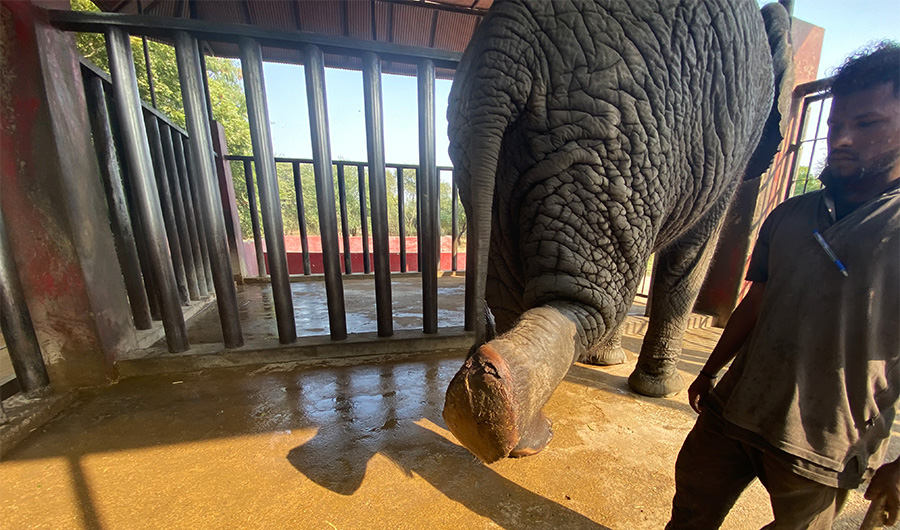


Malka, a female elephant, walks in an enclosure at a safari park as a caretaker watches in Karachi, Pakistan, on January 5, 2021. (AN Photo)
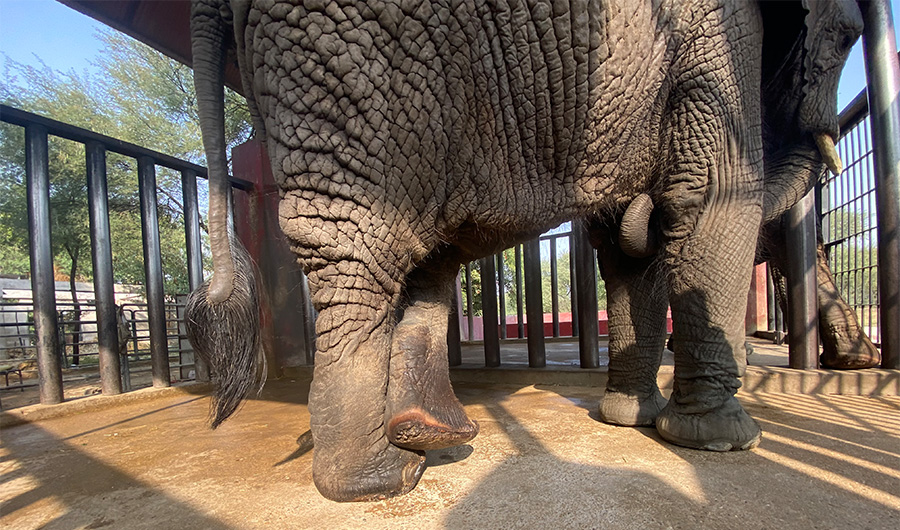


Malka, a female elephant, walks in an enclosure at a safari park as a caretaker watches in Karachi, Pakistan, on January 5, 2021. (AN Photo)

Karachi’s safari park, spread over 265 acres, is the largest in SouthEast Asia and houses hundreds of animals, including Malka and Sonu for whom a special enclosure was constructed in 2014, officials said.
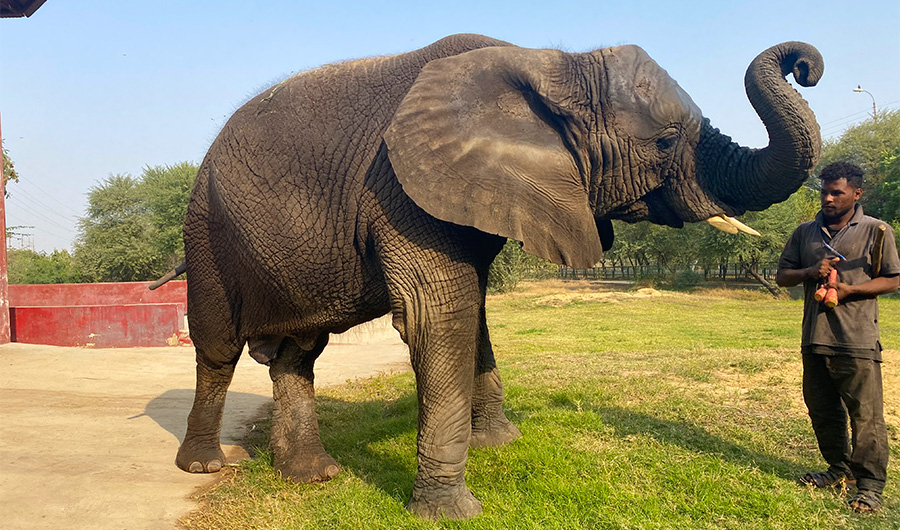


Malka, a female elephant, with her caretaker at a safari park in Karachi, Pakistan, on January 5, 2021. (AN Photo)  ​​​

Dr. Fakhar-i-Abbas, a known wildlife biologist, said the condition of Malka’s foot indicated inadequate food and care as well as dehydration. 

“See the rankles, totally dehydrated. The foot has swelled,” he said. 

“Proper care should have been taken of Malka and other elephants after the Kaavan episode but unfortunately it seems that people looking after the elephants do not have relevant qualifications,” the biologist said. “At present, the elephant should be given a food supplement which will hydrate the body.” 

He added: “It’s high time we train the people who handle elephants.”


Pakistan condemns Netanyahu’s ‘hexagon of alliances’ plan, says alert to growing India-Israel defense ties

Updated 26 February 2026
Follow

Pakistan condemns Netanyahu’s ‘hexagon of alliances’ plan, says alert to growing India-Israel defense ties

  • Israel’s Netanyahu last week proposed an alliance of countries in and around Middle East against its adversaries
  • Pakistan maintains “robust military preparedness” to deter any potential aggression, says foreign office spokesperson

ISLAMABAD: Pakistan’s foreign office spokesperson on Thursday condemned Israeli Prime Minister Benjamin Netanyahu’s recent statement about forming a “hexagon of alliances” within or around the Middle East, saying Islamabad was alert to growing defense ties between New Delhi and Tel Aviv. 

Netanyahu on Sunday outlined plans to form a new regional bloc, describing it as a “hexagon of alliances” that he said could include Israel, India, Greece and Cyprus, along with other unnamed Arab, African and Asian states. He said the grouping would collectively stand against what he described as “radical” adversaries.

His comments came days before Indian Prime Minister Narendra Modi arrived in Israel on Wednesday for a two-day trip to bolster ties. The two are expected to discuss cooperation in science and technology, innovation, agriculture, water management, technology, defense and security during the trip. 

The statement drew a sharp response from Pakistan’s Senate, which unanimously passed a resolution on Tuesday rejecting Netanyahu’s remarks.

“I would also like to draw your attention to the recent resolution adopted by the Senate of Pakistan that strongly condemned such remarks and attempts to undermine Muslim unity,” Foreign Office spokesperson Tahir Andrabi told reporters during a weekly press briefing.

“We continue to condemn these provocative steps and statements by the leadership of the occupying power that threaten regional peace and stability,” he added.

Netanyahu had also said Israel’s goal was to create an axis of nations that see eye to eye against what he described as the “radical Shia” and “radical Sunni” axis of nations. 

Andrabi said attempts to divide the Muslim world along sectarian lines were a “nefarious design” on Netanyahu’s part.

India is Israel’s largest arms buyer and second-largest trading partner in Asia, after China. In response to a question on India’s growing defense ties with Israel, Andrabi said Pakistan remained cognizant of the risks posed by such cooperation.

“Yes, we remain seized of the defense ties between Israel and India,” the spokesperson said, noting that certain “systems and platforms” may have been used by India against Pakistan in the past.

“We are alive to the threats they pose to our security, sovereignty and territorial integrity, as well as to regional peace and stability.”

Andrabi said Pakistan maintained “robust military preparedness” to deter any potential aggression from hostile forces.

‘UTMOST CAUTION EXERCISED’

Andrabi spoke about Pakistan’s recent strikes against alleged militant camps in Afghanistan, saying Islamabad had conducted them in self-defense and with extreme caution to avoid casualties. 

Pakistan said it carried out airstrikes in Afghanistan against militant camps and hideouts in three provinces on Saturday night, killing over 100 militants. Afghanistan accused Pakistan of violating its territorial sovereignty and killing dozens of civilians. Kabul has vowed to retaliate. 

Andrabi said the strikes were carried out to ensure protection for the lives of the people of Pakistan and to prevent “imminent terrorist attacks.”

“These actions were directed solely against identified terrorist camps and hideouts, and utmost caution was exercised to prevent harm to civilians,” he said. 

He warned Pakistan would take necessary measures under its right to self-defense against “terrorist threats” emanating from Afghan territory.

On the safety of Pakistani nationals in Afghanistan following the strikes, Andrabi said Islamabad had raised the issue with Afghan authorities, adding that Islamabad expected “foolproof security” for Pakistani diplomats and civilians.