TOKYO: Tokyo reported a record 1,591 new coronavirus cases on Wednesday, as Japan's government faces increasing pressure from health experts to impose a strict state of emergency for the greater metropolitan area.
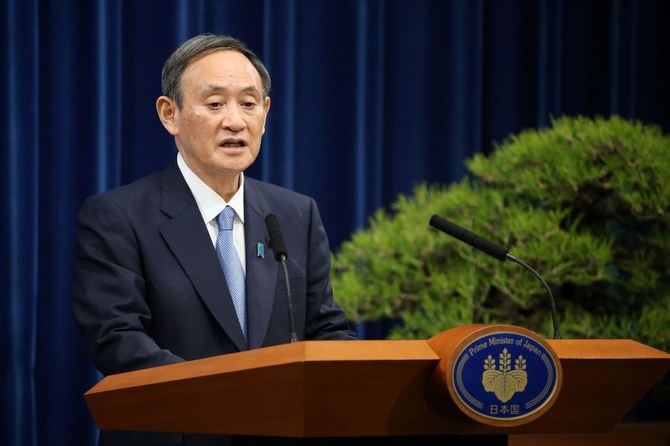
Rising infections have driven the Tokyo and surrounding areas to the highest level of a four-stage alert, prompting regional governors to urge for a declaration of emergency that Prime Minister Yoshihide Suga is expected to announce on Thursday.
The health ministry held a meeting of infectious disease experts on Wednesday, the second in as many days. They have called for stricter and longer countermeasures, while Suga has sought a more limited response to avoid damaging the economy.
"Even if we take strong measures immediately, it will be difficult to bring the Tokyo metropolitan area down to stage 3 by the end of January," Takaji Wakita, chief of the National Institute of Infectious Diseases, told reporters after the meeting.
Without new measures, daily infections in Tokyo could nearly triple to 3,500 per day by February and hit 7,000 by March, according to simulations by Kyoto University scientist Hiroshi Nishiura. An emergency declaration would need to last at least two months to bring infections to manageable levels, he said.
A senior ruling party lawmaker said on Tuesday it should be set for one month, and extended if necessary. The government is anxious about the economic impact as it prepares to host the Olympics this summer.
The government's top spokesman, Katsunobu Kato, said a decision would likely come on Thursday on whether and how long to impose the second state of emergency since the start of the pandemic.
Economists warned of a big hit to gross domestic product (GDP) if restrictions are prolonged or expanded, but noted that could be unavoidable.
"If you consider the current number of infected and weather-related factors, it may be difficult to end it in one month," said BNP Paribas Securities senior economist Hiroshi Shiraishi. "The probability of it running longer is not low."
Nationwide, COVID-19 infections reached a daily record of 4,915 on Tuesday, while deaths were also an all-time high of 76.
Shiraishi estimated that a one-month state of emergency in the Tokyo area would push consumer spending down 1.1% and first-quarter GDP by about 0.5 percentage points. That would double to 1 percentage point if extended to two months, and to 2 points if expanded nationally, he predicted.
Tokyo and the three surrounding prefectures have asked residents to refrain from non-essential, non-urgent outings after 8 p.m. from Friday until at least the end of the month, and said restaurants and bars must close by that time.
But measures are likely to be far less sweeping than they were during last year's roughly six-week-long state of emergency, during which schools and non-essential businesses shut down.


![]()


Tokyo daily coronavirus cases hit record as state of emergency looms
Short Url
https://arab.news/wbq8r
Tokyo daily coronavirus cases hit record as state of emergency looms
- Rising infections have driven the Tokyo and surrounding areas to the highest level of a four-stage alert
China’s birth rate falls to lowest on record: official data
BEIJING: China’s birth rate fell last year to its lowest level on record, official data showed Monday, as its population shrank for a fourth year running despite authorities’ efforts to curb the decline.
There were just 7.92 million births recorded last year, Chinese officials said Monday, a rate of 5.63 births per thousand people.
It marks the lowest birth rate since records by the National Bureau of Statistics (NBS) began in 1949 — the year Communist leader Mao Zedong declared the founding of the People’s Republic of China.
Beijing has scrambled to boost marriage and fertility rates, offering childcare subsidies and taxing condoms as it grapples with a rapidly aging population.
China’s birth rate had declined consistently over the last decade, despite the end of the restrictive “one-child policy,” until a slight uptick in 2024 when 6.77 births were recorded per thousand.
The previous low was in 2023, when China recorded 9.02 million births — a rate of 6.39 per 1,000 people.
Marriage rates are also at record low levels, with many young couples put off having babies by high child-rearing costs and career concerns.
Meanwhile China recorded 11.31 millions deaths in 2025, a mortality rate of 8.04 per thousand — leading to a population decline of 2.41 per thousand, NBS data showed.
There were just 7.92 million births recorded last year, Chinese officials said Monday, a rate of 5.63 births per thousand people.
It marks the lowest birth rate since records by the National Bureau of Statistics (NBS) began in 1949 — the year Communist leader Mao Zedong declared the founding of the People’s Republic of China.
Beijing has scrambled to boost marriage and fertility rates, offering childcare subsidies and taxing condoms as it grapples with a rapidly aging population.
China’s birth rate had declined consistently over the last decade, despite the end of the restrictive “one-child policy,” until a slight uptick in 2024 when 6.77 births were recorded per thousand.
The previous low was in 2023, when China recorded 9.02 million births — a rate of 6.39 per 1,000 people.
Marriage rates are also at record low levels, with many young couples put off having babies by high child-rearing costs and career concerns.
Meanwhile China recorded 11.31 millions deaths in 2025, a mortality rate of 8.04 per thousand — leading to a population decline of 2.41 per thousand, NBS data showed.
Latest updates


© 2026 SAUDI RESEARCH & PUBLISHING COMPANY, All Rights Reserved And subject to Terms of Use Agreement.