

OIC rights body condemns incarceration of Kashmiri rights activist

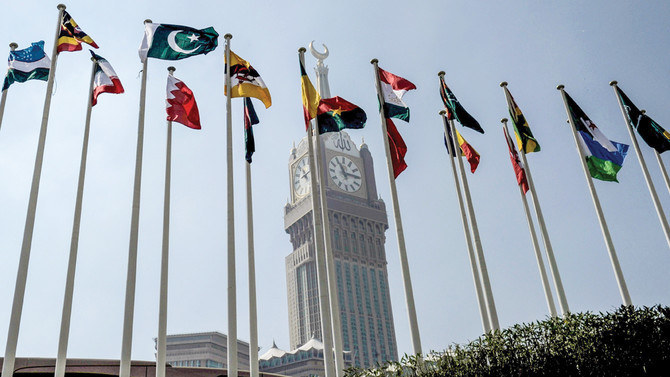
The Organization of Islamic Cooperation consists of 57 member states. (AFP file photo)
Short Url
Updated 05 January 2021
Follow

OIC rights body condemns incarceration of Kashmiri rights activist

  • The Independent Permanent Human Rights Commission demands immediate release of Asiya Andrabi and other political prisoners 
  • The commission asks New Delhi to implement UN resolutions and grant right to self-determination to Kashmiri Muslims 

ISLAMABAD: The Independent Permanent Human Rights Commission (IPHRC) of the Organization of Islamic Cooperation (OIC) strongly condemned on Monday the prolonged incarceration of Asiya Andrabi and her two female associates in Tihar Jail in India on “concocted and baseless charges.” 

“As per media reports, Ms. Andrabi and her associates, like other political prisoners in IoJ&K [Indian Occupied Jammu and Kashmir], are being held without access to free and fair trial and subjected to physical and psychological torture and denied critical medical care endangering their lives in contravention of the international human rights and humanitarian laws,” said its official statement. 

It pointed out that Andrabi was the founder of an influential women rights organizations and widely respected as a voice of reason. The commission also noted in its handout that she had made significant contribution to women empowerment in Indian administered Kashmir. 

The OIC’s human rights body expressed its concern over the detention of political activists, members of civil society and journalists by the Indian security forces. 

It also urged the United Nations, OIC member states and international human rights community to ask India for Andrabi’s immediate release and to give free and fair trials to all political prisoners. The commission demanded repeal of all “discriminatory laws” which are used against Kashmiri Muslims to repress their freedom struggle. 

Other than that, the OIC rights body urged New Delhi to provide access to international fact-finding missions to Kashmir and implement relevant UN Security Council and OIC resolutions that seek right to self-determination for the residents of the disputed region. 


Pakistan plans broader privatization push, eyes power utilities this year

Updated 5 sec ago
Follow

Pakistan plans broader privatization push, eyes power utilities this year

  • Considerably high losses, inefficiencies and mounting subsidies in power sector have dented Pakistan’s public finances
  • Finance Minister Muhammad Aurangzeb says 26 state-owned entities have been handed over to Privatization Commission

ISLAMABAD: Pakistan is widening a sweeping privatization program following the sale of its national airline last year, with power distributors next in line and more state companies to be handed to the Privatization Commission, the finance minister said on Monday.

Pakistan’s government successfully divested a 75 percent stake in the Pakistan International Airlines (PIA) in December last year. The move was part of Islamabad’s broader privatization program, which aims to reduce fiscal losses inflicted by loss-making state-owned enterprises (SOEs) by either privatizing or restructuring them.

Pakistani officials have said the Privatization Commission plans to divest the country’s electricity distribution companies in two batches. The first phase will include the Islamabad Electric Supply Company, Gujranwala Electric Power Company and Faisalabad Electric Supply Company, followed by Hyderabad Electric Supply Company and Sukkur Electric Power Company in the second batch. Considerably high losses, inefficiencies and mounting subsidies in the power sector have dented Pakistan’s public finances over the years, making it a central focus of Islamabad’s reform agenda.

Speaking at a news conference about Pakistan’s privatization program, Finance Minister Muhammad Aurangzeb said there are five power distribution companies to be privatized this year, out of which the sell-side advisers for three are Alvarez & Marsel. He said the Turkish Investment Bank has been entrusted with the task of being the sell-side advisers for the other two companies. 

“Overall, 26 SOEs have been handed over to the Privatization Commission,” Aurangzeb told reporters. “This decision is first made in the Cabinet Committee on SOEs, it then goes to the Cabinet Committee on Privatization, and then its overall approval is given by the prime minister and the cabinet.”

Aurangzeb vowed the government will take the privatization process forward with the same level of transparency as it had exhibited during the PIA sale last year. 

“And this will be taken forward with a lot of speed because we will not stop at 26 SOEs,” the finance minister said. “We will also gradually hand over other state institutions to the Privatization Commission,” he added. 

Speaking further about SOEs and their performances over the years, the minister said losses from the state entities decreased by about Rs74 billion [$264.6 million] over the last three years.

He said SOEs had reported losses of Rs905 billion [$3.24 billion] in 2023, Rs851 billion [$3.04 billion] in 2024 and Rs832 billion [$2.98 billion] in 2025.

Pakistan’s privatization push comes at the back of its efforts to ensure sustainable economic progress after a prolonged macroeconomic crisis that drained its foreign exchange reserves and triggered a balance of payments crisis.
