

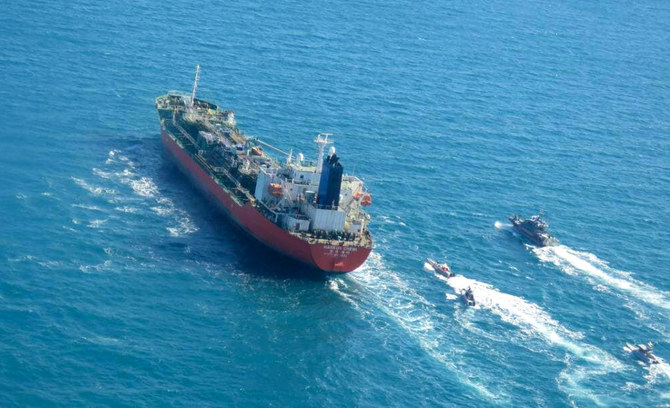

LONDON: A South Korean-flagged chemical tanker has been seized in the Strait of Hormuz by Iranian forces, the latest in a string of maritime incidents raising tensions in one of the world’s most important shipping lanes.
The South Korean ship Hankuk Chemi diverted course northwards into Iranian territorial waters while en-route to Fujairah, in the UAE, from the Saudi city of Al-Jubail on Monday.
Seoul confirmed that the vessel, which has a crew of 11 from Myanmar, five South Koreans, two Indonesians and two Vietnamese, was detained by Iran’s Islamic Revolutionary Guard Corps (IRGC).

The tanker was seized by iranian forces ion the Strait of Hormuz. (Reuters)
A statement from the South Korean foreign ministry requested “the early release of the ship.”
The country’s defence ministry said an anti-piracy unit has been dispatched to the scene in response to the seizure, and that it will cooperate with a multinational anti-piracy naval force operating in nearby waters.
Relations between Tehran and Seoul, an ally of the US, have deteriorated in recent years, in part because of a dispute over Iranian oil money allegedly frozen in South Korean banks.
Iranian media outlets claimed the IRGC navy seized the ship for polluting the Gulf with chemicals. The reports said the tanker was being held at Bandar Abbas port in Iran.
The US State Department accused Iran of threatening "navigational rights and freedoms" and called on Tehran to immediately release the tanker.

The South Korean-flagged tanker after it was seized by Iran's IRGC navy in the Strait of Hormuz. (AFP/Tasnim)
Munro Anderson, a partner at maritime security firm Dryad Global, told Arab News that the incident is indicative of wider Iranian regional strategy and foreign policy.
“The vessel was detained for what Iran describes as oil pollution, which is complete nonsense,” he said, adding that the ship’s detention is undoubtedly linked to the feud over the frozen oil money.
Incidents such as this indicate “that Iran will seek to leverage all sorts of attributable and non-attributable actions against those who it perceives to be working against its interests,” he said.
Anderson added that broadly speaking, shipping safety in the region is not in decline, but that ships and sailors from states involved in disputes with Iran are at heightened risk of being targeted as part of Tehran’s strategy in the Arabian Gulf.
The detention of ships “is a classic Iranian and IRGC playbook activity, and it shows that Iran has the capacity and the intent to exercise its influence within the region to achieve its wider foreign policy goals,” he said.
Anderson added that this incident is the latest in a string of actions blamed on Iran, including the recent discovery of limpet mines on two ships in the Arabian Gulf and off the coast of Iraq. The Iranians “have shown that this is how they operate,” he said.
Tensions in the Arabian Gulf between the US and Iran are once again approaching boiling point. Sunday saw the one-year anniversary of the US killing of IRGC Quds Force commander Qassem Soleimani. On Monday, Tehran announced it would resume enriching uranium to 20 percent, far exceeding the level of purity that is allowed under Tehran’s 2015 nuclear pact with six major powers.
On Monday the US announced that its aircraft carrier the USS Nimitz would remain in the Gulf due to “recent threats” by Iran, and a US official warned that “no one should doubt the resolve of the United States of America.”
Despite the USS Nimitz’s presence, Anderson warned that “Iran will continue to use all sorts of unconventional and unscrupulous means to further its foreign policy agenda,” and the Arabian Gulf “is a natural area for it to do this,” he added.


