31 arrested for demolishing Hindu temple — Pakistani religious harmony adviser

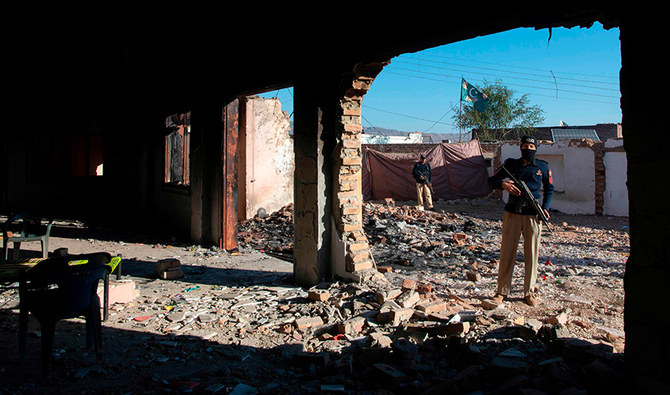
Policemen stand guard at the burnt Hindu temple a day after a mob attack in a remote village in Karak district, some 160 kms southeast of Peshawar on December 31, 2020. (AFP)
Short Url
Updated 31 December 2020
Follow

31 arrested for demolishing Hindu temple — Pakistani religious harmony adviser

  • Those involved in attacking and threatening minorities will not be “forgiven,” Tahir Ashrafi says
  • Pakistan’s minister for religious affairs called the attack a “conspiracy against sectarian harmony”

ISLAMABAD: Thirty-one people had been arrested after a Hindu temple was set on fire and demolished by a mob, Hafiz Muhammad Tahir Mehmood Ashrafi, special adviser to the prime minister on religious harmony, said on Thursday.
The temple’s destruction on Wednesday in the northwestern town of Karak drew condemnation from government officials, human rights activists and the minority Hindu community.
Local police told media they had detained dozens of people in overnight raids and searches were underway to arrest more people who had participated or provoked the mob to demolish the temple.
The attack happened after members of the Hindu community received permission from local authorities to renovate the temple. Witnesses told AP the mob was led by a local cleric and supporters of Pakistan’s Jamiat Ulema-e-Islam party. There has been no comment from the party so far.
“31 culprits including mastermind involved in attack at Hindu temple in Karak have been arrested,” Ashrafi said in a statement. “Elements involved in making attacks at worship places of minorities and threatening minorities will not be forgiven.”
“The Karak temple attack will be thoroughly probed as this instance maligned Pakistan in the world,” Ashrafi added.
Pakistan’s minister for religious affairs, Noorul Haq Qadri, called the attack on the temple “a conspiracy against sectarian harmony.” He took to Twitter Thursday, saying attacks on places of worship of minority religious groups are not allowed in Islam and “protection of religious freedom of minorities is our religious, constitutional, moral and national responsibility.”
Pakistan Chief Justice Gulzar Ahmed also took notice of the incident and fixed a court hearing for January 5. 
The incident comes weeks after the government allowed Hindu residents to build a new temple in Islamabad on the recommendation of a council of clerics.
Although Muslims and Hindus generally live peacefully together in Pakistan, there have been other attacks on Hindu temples in recent years. Most of Pakistan’s minority Hindus migrated to India in 1947 when India was divided by Britain’s government.


Pakistan graft survey echoes IMF warning on weak governance, public dissatisfaction

Updated 5 sec ago
Follow

Pakistan graft survey echoes IMF warning on weak governance, public dissatisfaction

  • Most Pakistanis say they were not compelled to pay bribes, but distrust remains high in anti-corruption efforts
  • PM Shahbaz Sharif calls report a recognition of his government’s efforts to fight corruption, promote transparency

ISLAMABAD: Governance weaknesses flagged by the International Monetary Fund (IMF) appeared to align with findings from Pakistan’s latest corruption perception survey, analysts said on Tuesday, as Transparency International Pakistan (TI-Pakistan) reported widespread public dissatisfaction with the state’s accountability mechanisms.

TI-Pakistan’s National Corruption Perception Survey (NCPS) 2025 found that 58 percent of respondents fully or partly agreed that the IMF program and Pakistan’s removal from the Financial Action Task Force’s grey list had helped stabilize the economy.

“Encouragingly, a majority of Pakistanis (66 percent) nationwide reported that they did not experience a situation where they felt compelled to offer a bribe to access any public service,” said the survey. “Sindh recorded the highest proportion of respondents paying a bribe to access public service (46 percent), followed by Punjab (39 percent), Balochistan (31 percent) and Khyber Pakhtunkhwa (20 percent).”

In this context, 77 percent said they were unhappy with the government’s anti-corruption performance.

However, Prime Minister Muhammad Shehbaz Sharif expressed satisfaction over the report in a statement, saying “a large majority of citizens said they did not face corruption during our government’s tenure” which is “recognition of our efforts to fight corruption and promote transparency.”

“It is highly encouraging that most citizens considered the government’s measures for economic recovery to be successful,” he said.

“We worked on a priority basis to establish a system grounded in merit and transparency across all sectors of government, and we are continuing to build on these efforts,” he added.

Economist and former finance ministry adviser Dr. Khaqan Najeeb said the survey highlighted the same structural weaknesses identified by the IMF’s Governance and Corruption Diagnostic, published on Nov. 20 at the international lender’s request, which said Pakistan suffers from “persistent and widespread corruption vulnerabilities” rooted in a state-dominated economy, weak regulatory capacity, and inconsistent enforcement.

“Transparency International Pakistan’s National Corruption Perception Survey does suggest progress in reducing low-level, day-to-day bribery, but it does not contradict the IMF’s governance findings,” he told Arab News. “Instead, it highlights that Pakistan’s real challenge lies in deeper, systemic weaknesses in transparency, oversight and institutional accountability.”

“While public perception has improved, it does not mean the underlying governance issues identified by the IMF have been resolved,” he argued, adding that addressing those will require sustained reforms, stronger institutions and consistent enforcement.

Political analyst Mazhar Abbas said the report was going to be used by the government to bolster its economic narrative.

“Survey reports have usually been tilted in favor of the government, and this report is no different,” he told Arab News. “The government will certainly use it to support its narrative of an improved economy, as the report states that a majority of respondents partially or fully agree that the government has successfully stabilized the economy through the IMF agreement and by exiting the FATF grey list.”

Abbas added it was difficult to either challenge or endorse the findings of the report without knowing who was interviewed and who the respondents were.

“The police have consistently been at the top of Transparency International’s corruption perception reports, whereas there may be other organizations where the frequency and volume of corruption are even higher,” he continued, adding that since the police are a public-dealing organization and consistently top the corruption perception index, it suggested that most respondents are from the general public, who may either lack access to or knowledge of corrupt practices in other organizations.

Islamabad-based social-sector development consultant Muhammad Qasim Jan said the survey should be seen as a barometer of public sentiment rather than an empirical measure of corruption.

“The National Corruption Perception Survey 2025 offers a sobering snapshot of how Pakistanis view corruption and accountability,” he told Arab News. “At the same time, the absence of basic methodological detail means the results should be interpreted with caution, especially when citing national percentages or making population-wide claims.”