

Debt and pandemic are a double whammy for Zambia

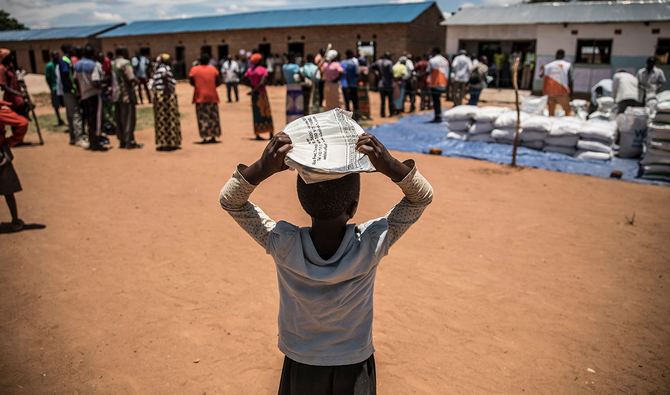
People await for food distribution in Simumbwe, Zambia. (AFP)
Short Url
Updated 31 December 2020
Follow

Debt and pandemic are a double whammy for Zambia

  • In mid-October, Zambia missed the deadline to honor a payment of $42.5 million due on a bond worth $750 million, which matures in 2022

LUSAKA: For days on end, Mildred Mwenya has not seen so much as the shadow of a customer in her pharmacy in the Zambian capital Lusaka.

Today, her stomach was as empty as her premises. She had been unable to afford breakfast before coming to open the store.

She is one of a growing number of victims in Zambia of a double hit — a macro-economic crisis combined with the coronavirus disease (COVID-19) pandemic.

“When we come for work, we have no customers and not even food to eat for the morning,” says Mwenya, from behind her counter.

“When you go to order goods and the following day the prices increase, business is bad,” she explains.

A landlocked country in southern Africa, and the world’s second-largest copper producer, Zambia has been lashed by a plunge in commodity prices.

Starved of income, the government announced in mid-November that the country would no longer pay creditors — and the prices of basic goods began to rise.

The nation of 17 million people has a foreign debt estimated at nearly $12 billion, half of which comes from private creditors. Much is owed to China.

In mid-October, Zambia missed the deadline to honor a payment of $42.5 million due on a bond worth $750 million, which matures in 2022.

The global rating agency Standard & Poor’s relegated the country to the “selective default” category.

Once classified as a defaulter, a country undergoes penalties that further increase the cost of servicing its debts, said economist Mambo Hamaundu.

“You won’t have money to buy medicines in hospitals, chalks for our schools, because more money would have moved away from the treasury,” Hamaundu says. “If there is no money in the treasury the ordinary citizens will suffer.”

“This will mean that sectors like health, agriculture and education will be affected,” said Nalucha Ziba, country director for the charity ActionAid.

Closing Bell: Saudi equities continue 4-day upward trend 

Updated 14 January 2026
Follow

Closing Bell: Saudi equities continue 4-day upward trend 

RIYADH: Saudi equities closed higher on Wednesday, with the Tadawul All Share Index rising 51.52 points, or 0.47 percent, to finish at 10,945.15. 

Trading activity was robust, with 373.9 million shares exchanged and total turnover reaching SR6.81 billion. 

The MT30 Index also ended the session in positive territory, advancing 11.93 points, or 0.82 percent, to 1,472.82, while the Nomu Parallel Market Index declined 116.82 points, or 0.49 percent, to 23,551.47, reflecting continued volatility in the parallel market.

The main market saw 90 gainers against 171 decliners, indicating selective buying. 

On the upside, Al Kathiri Holding Co. led gainers, closing at SR2.18, up SR0.12, or 5.83 percent. Wafrah for Industry and Development Co. advanced to SR23, gaining SR0.99, or 4.5 percent, while Al Ramz Real Estate Co. rose 4.35 percent to close at SR60.

SABIC Agri-Nutrients Co. added 4.21 percent to SR118.70, and Al Jouf Agricultural Development Co. climbed 4.12 percent to SR45. 

Meanwhile, losses were led by Saudi Industrial Export Co., which fell 9.73 percent to SR2.69. United Cooperative Assurance Co. declined 5.08 percent to SR3.74, while Thimar Development Holding Co. dropped 4.54 percent to SR35.30.  

Abdullah Saad Mohammed Abo Moati for Bookstores Co. retreated 4.15 percent to SR48.50, and Gulf Union Alahlia Cooperative Insurance Co. slipped 3.96 percent to SR10.44. 

On the announcement front, Saudi National Bank announced its intention to issue US dollar-denominated Additional Tier 1 capital notes under its existing international capital programe, with the final size and terms to be determined subject to market conditions and regulatory approvals.  

The planned issuance aims to strengthen Tier 1 capital and support the bank’s broader financial and strategic objectives.  

The stock closed at SR42.70, gaining SR0.70, or 1.67 percent, reflecting positive investor reaction to the capital management move. 

Separately, Almasane Alkobra Mining Co. said its board approved the establishment of a wholly owned simplified joint stock company to provide drilling, exploration and related support services, with a share capital of SR100 million and headquarters in Najran, subject to regulatory approvals.  

The new subsidiary aligns with the company’s strategy to enhance operational efficiency and expand its role in the Kingdom’s mining sector.

Shares of Almasane Alkobra Mining closed at SR98.70, up SR0.30, or 0.3 percent, by the end of the session.