

Two Lebanese banks deny ties to Hezbollah lender

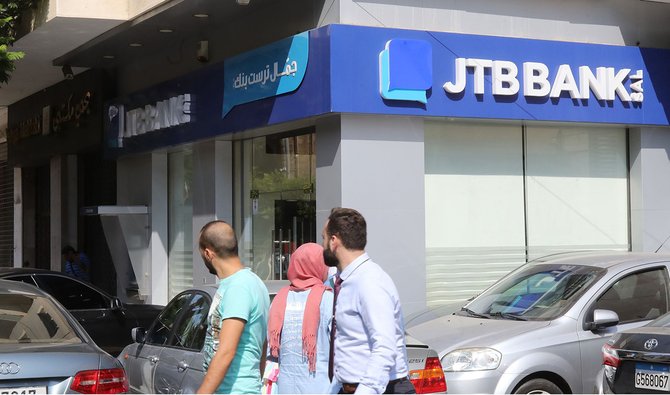
People walk past a branch of Jammal Trust Bank in Beirut. (AFP)
Short Url
Updated 30 December 2020
Follow

Two Lebanese banks deny ties to Hezbollah lender

  • Hackers promise more ‘dumps’ after breaching client database

BEIRUT: Hackers who hit one of Hezbollah’s principal lenders and dumped records of thousands of its customers across Lebanon online have vowed to release further information on other institutions with links to the militant group.

Hundreds of accounts with Al-Qard Al-Hassan (benevolent loan association) have been laid bare by the hacking group, which goes by the name of Spiderz, in recent days, with lists of borrowers and depositors in each branch of the organization published online.

The hack revealed that more than one bank was providing services to Hezbollah through the association, including the Lebanese Canadian Bank and Jammal Trust Bank, both of which were placed on a US sanctions list in 2019.

Two banks mentioned in the hacked accounts, Societe Generale and Byblos Bank, quickly denied any relationship with Al-Qard Al-Hassan.

The hackers released a video clip with information related to the association, including budgets and accounts. An unknown person called on depositors to “withdraw their money” and urged borrowers to “stop paying their instalments.”

Al-Qard Al-Hassan confirmed there had been a breach, which it said was a response to its “qualitative achievements.”

The association acknowledged that it had granted “200,000 loans worth $480 million.”

Al-Qard Al-Hassan is regarded as the financial backbone of Hezbollah. In the past month, the association has come under fire for its network of ATMs in Hezbollah strongholds, and for providing dollar-denominated loans amid Lebanon’s worst economic and financial crisis in decades.

Customers can withdraw up to $5,000 at the ATMs.

Many Lebanese accused Hezbollah of creating a parallel economy and a “state within the Lebanese state.”

Former MP Walid Jumblatt, head of the Progressive Socialist Party, criticized “the arrangements that Hezbollah is making on the ground.”

In an interview this week, he said: “Hezbollah’s Al-Qard Al-Hassan now has an ATM that pays customers $5,000 at a time when Lebanese citizens suffer at the hands of the banks and their money is seized.”

Jumblatt was widely criticized by Hezbollah supporters, who accused him of inciting anger against the association.

The pro-Hezbollah Al-Akhbar newspaper said on Wednesday that the association “is not the only one that has been hacked.”

Several institutions “revolving in the orbit of Hezbollah” had been targeted, it said, which could mean the attack was coordinated by external intelligence agencies.

The hack, which started last Saturday, was “massive and programmed,” the newspaper said.

On Wednesday, Jumblatt published a video on Twitter with the comment: “Al-Labwa road (in the northern Bekaa) toward Syria, with 50 diesel and food trucks during the day. Where is the rationing?”

The area where the photos were taken is considered a Hezbollah stronghold.

A security official at one border crossing told Arab News: “These pictures are correct. Al-Labwa is 60 km from the illegal border crossings, and this quantity of diesel far exceeds the area’s need, which means it is being smuggled into Syria in broad daylight.”


Saudi ports brace for cargo surge as shipping lines reroute

Updated 09 March 2026
Follow

Saudi ports brace for cargo surge as shipping lines reroute

RIYADH: Preliminary estimates suggest that several global shipping lines could reroute part of their operations to Saudi Arabia’s Red Sea ports, potentially adding 250,000 containers and 70,000 vehicles per month, according to Rayan Qutub, head of the Logistics Council at the Jeddah Chamber of Commerce, in an interview with Al-Eqtisadiah.

“Any disruption in the Strait of Hormuz not only affects maritime traffic in the Arabian Gulf but could also reshape global trade routes,” Qutub said, highlighting the strait’s status as one of the world’s most critical maritime chokepoints for energy and goods transport.

With rising regional tensions, international shipping companies are reassessing their routes, adjusting shipping lines, or exploring alternative sea lanes. This signals that the current challenges extend beyond the Arabian Gulf, impacting the global supply chain as a whole.

Limited impact on US, European shipments

The effects of these developments will not be uniform across trade routes. Qutub noted that goods from China and India, which rely heavily on routes through the Arabian Gulf, are most vulnerable to disruption. In contrast, shipments from Europe and the US typically traverse western maritime routes via the Suez Canal and the Red Sea, making them less susceptible to regional disturbances.

Saudi Arabia’s strategic location, he emphasized, strengthens the resilience of regional trade. The Kingdom operates an integrated network of Red Sea ports — including Jeddah, Rabigh, Yanbu, and Neom — that have benefited from substantial infrastructure upgrades and technological enhancements in recent years, boosting their capacity to absorb increased cargo volumes.

Red Sea bookings

Several major carriers, including MSC, CMA CGM, and Maersk, have already opened bookings to Saudi Red Sea ports, signaling a shift in operational focus to these strategically positioned hubs.

However, Qutub warned that rerouted shipments could increase sailing times. Cargo from Asia, which normally takes 30-45 days, might now require longer voyages via the Cape of Good Hope and the Mediterranean, potentially extending transit to 60-75 days in some cases.

These changes are also reflected in rising shipping costs, driven by longer routes, higher fuel consumption, and increased insurance premiums — a typical response when global trade patterns shift due to geopolitical pressures.

Qutub emphasized that Saudi Arabia’s transport and logistics sector is managing these developments through coordinated government oversight. The Ministry of Transport and Logistics, the Logistics National Committee, and the Logistics Partnership Council recently convened to evaluate the impact on trade and supply chains. Regular weekly meetings have been established to monitor developments and implement solutions to safeguard the stability of supplies and continuity of trade.

He noted that the Kingdom’s logistical readiness is the result of long-term strategic investments, encompassing ports, airports, road networks, rail systems, and logistics zones. Today, Saudi logistics integrates maritime, land, rail, and air transport, enabling a resilient response to global disruptions.

Qutub also highlighted the need for the private sector to continuously review logistics and crisis management strategies, develop alternative plans, and manage strategic stockpiles. Such measures are essential to mitigate temporary fluctuations in global trade and ensure smooth supply chain operations.