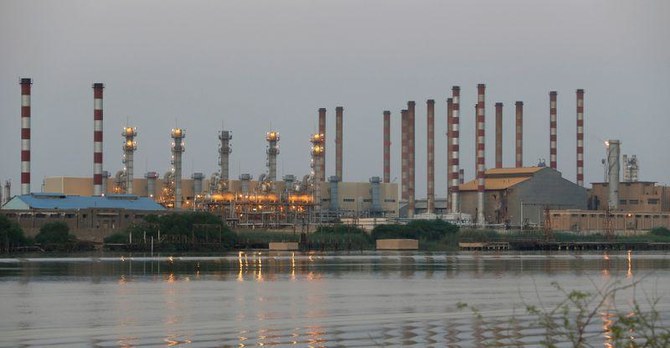
BAGHDAD: Iran will resume normal gas flows to Iraq on Wednesday after reaching an agreement with Iraq on Tuesday over unpaid bills, a spokesman for Iraq’s electricity ministry said.
Iran’s state gas company said on Monday it had cut supplies to neighboring Iraq over arrears of more than $6 billion. The Iraqi electricity ministry said the cuts placed Baghdad and other cities at risk of serious power shortages.
An agreement was reached during a meeting between Iranian Energy Minister Reza Ardakanian, who is visiting Baghdad, and Iraqi counterpart Majid Mahdi to resume normal gas flow rates as of Wednesday evening, spokesman Ahmed Moussa told Reuters.
Iran’s energy minister also met with Prime Minister Mustafa Al-Kadhimi and conveyed the Iranian government’s pledge to “urgently resume gas pumping which had been slashed recently after technical problems,” a statement from the prime minister’s office cited Iran’s minister as saying without giving details.
Energy Minister Ardakanian told state news agency IRNA that “good agreements were reached with the Iraqi officials to withdraw Iranian funds from Iraq to pay for the purchase of the coronavirus vaccine from Europe using Iran’s existing financial resources in Iraq.”
Tehran said last week it had received approval from US authorities to transfer $244 million to buy coronavirus vaccines from the World Health Organization-led COVAX alliance.
Ardakanian said Iraqi authorities had paid back an “appreciable portion” of their debt to Iran’s state gas and electricity companies, IRNA reported. He did not give any amounts.
“With these new arrangements, we hope to use our existing financial resources in Iraq more quickly to purchase basic goods and other needed items in the near future,” Ardakanian added.
Iraq said on Dec. 21 it was ready to export 700,000 tons of barley to Iran at a price of $125 per ton as part of payments owed by the Iraqi government to Iran.
An Iraqi trade ministry official said on Tuesday the barley export shipments to Iran, in addition to other goods, will be used to pay back part of the delayed gas debts.
Iran has been unable to access billions of dollars in assets in several countries due to US sanctions.
The United States has insisted that oil-rich Iraq, OPEC’s second-largest producer, moves toward self-sufficiency as a condition for its exemption to import Iranian energy, yet Baghdad has struggled to do so, in part due to low oil prices.


Iran to resume gas flows to Iraq after agreement on unpaid bills: Iraq ministry
https://arab.news/rvajw
Iran to resume gas flows to Iraq after agreement on unpaid bills: Iraq ministry

- Iran had cut supplies to Iraq over arrears of more than $6 billion


Global trade isn’t deglobalizing — it’s reshuffling, Harvard economist says
ALULA: Global trade is not retreating into deglobalization despite geopolitical shocks, but is instead undergoing a structural reshuffling led by US-China tensions, according to Harvard University economist Pol Antras.
Presenting research at the AlUla Emerging Market Economies Conference, Antras said there is no evidence that countries are systematically turning inward. Instead, trade flows are being redirected across markets, creating winners and losers depending on export structure and exposure to Chinese competition.
This comes as debate intensifies over whether supply-chain disruptions, industrial policy and rising trade barriers signal the end of globalization after decades of expansion.
Speaking to Arab News on the sidelines of the event, Antras said: “I think the right way to view it is more a reorganization, where things are moving from some countries to others rather than a general trend where countries are becoming more inward looking, in a sense of producers selling more of their stuff domestically than internationally, or consumers buying more domestic products than foreign products.”
He said a change of that scale has not yet happened, which is important to recognize when navigating the reshuffling — a shift his research shows is driven by Chinese producers redirecting sales away from the US toward other economies.
He added that countries are affected differently, but highlighted that the Kingdom’s position is relatively positive, stating: “In the case of Saudi Arabia, for instance, its export structure, what it exports, is very different than what China exports, so in that sense it’s better positioned so suffer less negative consequences of recent events.”
He went on to say that economies likely to be more negatively impacted than the Kingdom would be those with more producers in sectors exposed to Chinese competition. He added that while many countries may feel inclined to follow the United States’ footsteps by implementing their own tariffs, he would advise against such a move.
Instead, he pointed to supporting producers facing the shock as a better way to protect and prepare economies, describing it as a key step toward building resilience — a view Professor Antras underscored as fundamental.
Elaborating on the Kingdom’s position amid rising tensions and structural reorganization, he said Saudi Arabia holds a relative advantage in its economic framework.
“Saudi Arabia should not be too worried about facing increased competitive pressures in selling its exports to other markets, by its nature. On the other hand, there is a benefit of the current situation, which is when Chinese producers find it hard to sell in US market, they naturally pivot to other markets.”
He said that pivot could benefit importing economies, including Saudi Arabia, by lowering Chinese export prices. The shift could increase the Kingdom’s import volumes from China while easing cost pressures for domestic producers.


