

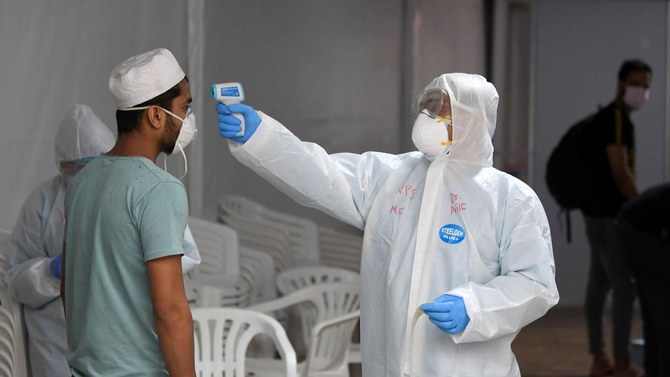

DUBAI: The UAE has discovered a “limited number” of cases of people infected with the new coronavirus variant in the country, a government official said, the first confirmed cases of a more contagious COVID-19 mutant in the Gulf region.
Omar Al-Hammadi, an official spokesman of the UAE government, said at a press briefing on Tuesday that those affected had traveled from abroad, without specifying from where or the number of the cases.
“In light of the emergence of the new emerging strain of the coronavirus in Britain, and in conjunction with the continuous investigations by the health sector, it has been proven that there are limited cases in the country and received from abroad,” he said.
The UAE on Tuesday recorded 1,506 new coronavirus cases, the highest since October, and two virus-related deaths.
Officials from the Ministry of Health and Prevention said the total number of cases since the pandemic began had reached 204,369. The death toll is 662.
It was also announced that 1,475 people had recovered from the virus in the past 24 hours. The total number of recoveries is 181,400.
Dubai’s Roads and Transport Authority said it was implementing an integrated traffic plan for this year’s New Year’s Eve celebrations. All roads leading to the Burj Khalifa area, the site of Dubai’s renowned fireworks display, will be closed at different times according to a schedule, starting from 4 p.m. local time.
.@rta_dubai prepares a full traffic plan during the New Year's Eve celebrations 2021, adopting the preventive guidelines. Watch to know more. #MyDubaiNewYear pic.twitter.com/uLVmzrMwau
— Dubai Media Office (@DXBMediaOffice) December 29, 2020
Movement around the area will be restricted, but 200 buses will be available to transport revelers to and from the event. The Burj Khalifa/Dubai Mall metro station will also be closed from 5 p.m. on Dec. 31 until 6 a.m. on Jan. 1.
Dubai Police said strict precautionary measures are being implemented across all sites to ensure public health and safety and Dubai Health Authority (DHA) said it had completed all of its preparations to provide and secure integrated medical care for visitors to the event and its surrounding areas.
القائد العام لشرطة #دبي يتفقد غرفة عمليات برج خليفة وبوليفارد محمد بن راشد.
Dubai Police Commander in Chief reviews security measures at the Burj Khalifa and Mohammed bin Rashid Blvd Operation Room @DubaiPoliceHQ pic.twitter.com/k1Wkz1N0fm— Dubai Media Office (@DXBMediaOffice) December 29, 2020
DHA said its planned to provide three field hospitals equipped with the latest medical equipment and supplies, in addition to specialized and qualified medical and nursing staff capable of dealing with various emergency cases during the event, which is expected to witness a great turnout from people from all over the world.
Elsewhere, Kuwait reported 236 new coronavirus cases, raising the total number to 150,093. The death toll remained at 932 after zero coronavirus-related deaths were reported in the previous 24 hours.
تعلن #وزارة_الصحة عن تأكيد إصابة 236 حالة جديدة، وتسجيل 248 حالة شفاء، ولم تسجل أي حالة وفاة جديدة بـ #فيروس_كورونا_المستجدّ COVID-19 ، ليصبح إجمالي عدد الحالات 150,093 حالة pic.twitter.com/c4cB9WQGUC
— وزارة الصحة - الكويت (@KUWAIT_MOH) December 29, 2020
Oman’s health ministry confirmed 70 new cases and two deaths, raising the totals to 128,633 and 1,497, respectively.
Oman News Agency had reported on Dec. 21 that Omani health authorities were examining four suspected cases of the variant coming from the United Kingdom, citing Health Minister Ahmed Al-Saidi. No further details were available.
#Statement No, 255
December 29, 2020 pic.twitter.com/ugWALdPfVZ— وزارة الصحة - عُمان (@OmaniMOH) December 29, 2020
In Bahrain, zero deaths was reported, keeping the death toll to 351, while 234 new infected cases were confirmed.
Out of 9855 COVID-19 tests carried out on 29 December 2020, 234 new cases have been detected among 122 expatriate workers, 96 new cases are contacts of active cases, and 16 are travel related. There were 161 recoveries from #COVID19, increasing total recoveries to 89804 pic.twitter.com/Yfj6OzYxKT
— وزارة الصحة | مملكة البحرين (@MOH_Bahrain) December 29, 2020
The UAE has kept its borders and international flights open, while neigbouring Saudi Arabia on Monday extended a ban on entry to the kingdom by air, land and sea for another week.
Oman reopened its border on Tuesday, while Kuwait — which had also suspended all commercial flights and closed its land and sea borders until Jan. 1, does not plan to extend the suspension.
(With Reuters)


