KARACHI: Pakistan’s top economic decision-making body, the Economic Coordination Committee (ECC), is expected to approve a new five-year textile policy this week, with incentives worth more than Rs900 billion ($5.6 billion) for the industry and an aim to increase exports to $21 billion in five years, officials have said.
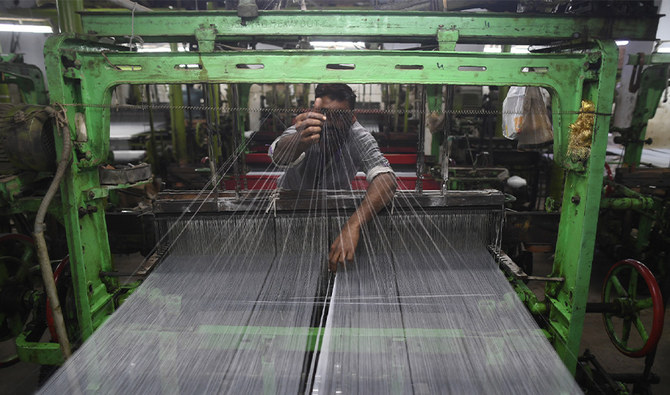
Textiles make up more than half of Pakistan’s exports, but have lost ground to South Asian neighbors in recent years, hurt by chronic energy shortages and underinvestment in machinery.
But this year, after Pakistan lifted its comprehensive coronavirus lockdown in May while other countries in the neighborhood kept their economies closed, international textile orders have been diverted to Pakistan, leading to a nine-year record in exports. The South Asian nation has now drafted a new policy to augment the gains, officials say.
“The textile policy has already been approved by the prime minister, which will be presented in the ECC next week,” Aliya Hamza Malik, parliamentary secretary for commerce, told Arab News. “After ECC approval, the policy would be a pubic document,” she added, saying the government of the ruling Pakistan Tehreek-e-Insaf (PTI) party had granted Rs900 billion ($5.6 billion) in incentives to the textile sector in the new policy, the country’s third.
The textile industry, which comprises 46 percent of the total manufacturing sector and provides employment to around 25 million Pakistanis, contributes 8.5 percent to the GDP, according to the Pakistan Board of Investment. It also contributes 60 percent to overall exports and is one of the major earners of foreign exchange for Pakistan.
Despite a global economic slowdown due to COVID-19, Pakistan’s textile sector reached $6 billion exports in the first five months of current fiscal year (July-November 2020), which is 62 percent of total exports (worth $9.7 billion) and almost 5 percent higher compared to the same period last year, official data shows.
“Incentives and export facilitations have played a big role in making Pakistan a competitive exporting country,” Malik said.
The new measures aim to increase textile exports from $12.86 billion to $21 billion in the next five years, with a major focus on value addition, a draft of the policy seen by Arab News said. The document said electricity would be provided to the industry at the rate of US cents 7.5/kWh, RLNG at $6.5/MMBtu and system gas at Rs 786/MMBtu under the new policy.
The last two textile policies, for 2009-14 and 2014-19, had aimed to up exports to $25 billion and $26 billion respectively but the targets were not achieved. The third policy was approved in March this year but still awaits official announcement.
“Approval of the new policy will give clarity to entrepreneurs and the industry to attract further investment,” said Khurram Mukhtar, patron-in-chief of the Pakistan Textile Exporters Association (PTEA). “Pakistan needs minimum investment of $7 billion to enhance production capacity in the next 5 years and double our textile exports.”
He added: “Currently investment of more than Rs100 billion ($623 million) is in the pipeline in spinning, weaving, finishing, knitting and garments. Many companies are enhancing their capacities.”
Made in Pakistan textiles, woven and knitted apparel, socks and towels are currently being supplied to major brands around the world, including Puma , Nike, Ralph Lauren, Dorma, Warner Bros, Next, M&S , Bed Bath & Beyond, Macy’s, Zara , Mango, Levies and Hugo Boss.


Pakistan to approve new textile policy to increase exports to $21 billion
https://arab.news/4ptkv
Pakistan to approve new textile policy to increase exports to $21 billion

- Economic Coordination Committee to finalize five-year policy this week with incentives worth over $5.6 billion
- Textiles seeing “unprecedented” revival as international orders diverted to Pakistan after it lifted its comprehensive lockdown in May

Pakistan's Sindh announces judicial inquiry into deadly Karachi plaza fire
- Around 80 people were killed in Karachi Gul Plaza fire that broke out on Jan. 17, says Sindh information minister
- Says initial fact-finding committee discovered fire tenders were provided water with delay, which affected firefighting
ISLAMABAD: Sindh Information Minister Sharjeel Inam Memon announced on Thursday that the provincial government has requested a judicial inquiry into a deadly Karachi shopping plaza inferno that killed around 80 people earlier this month.
The fire broke out at Karachi's famous Gul Plaza, a multi-story shopping complex in the city's Saddar area, on the night of Jan. 17. The blaze killed 80 and took three days to extinguish, while rescue and relief efforts took over a week.
Speaking to reporters during a news conference, Memon said a Sindh cabinet sub-committee, chaired by Chief Minister Murad Ali Shah, reviewed a fact-finding committee report on the Karachi Gul Plaza fire.
He said the fact-finding committee discovered that the Civil Defense department conducted fire safety audits of the mall and other buildings since 2023, but no effective, precautionary or legal action was taken to ensure such incidents were avoided. He said as a result, the Civil Defense director and the department's additional controller for district South were both suspended.
"A letter is being written to the honorable chief justice of the Sindh High Court in which we are requesting the chief justice to appoint a serving judge for a judicial inquiry," Memon said.
"So that we can review everything in accordance with the law himself and take decisions on it."
Memon said that there were around 2,000 to 2,500 people in the building when the fire broke out, adding that these included workers and visitors.
He said the sub-committee had also noted that fire tenders were provided water with delay which affected the firefighting services of the Karachi Municipal Corporation (KMC), Rescue 1122 and fire brigades.
The minister said the government had also suspended the chief engineer and in-charge hydrants of the Karachi Water and Sewerage Corporation, and that action will be taken against them.
Memon said the committee had also concluded that the KMC, Rescue 1122 and fire brigades' firefighting tools and training to deal with an inferno of such a scale were "inadequate."
He said the government has also suspended the senior director of municipal services in the KMC and that departmental action against him will be taken for not ensuring that the fire staff was properly prepared to tackle such a blaze.
The minister said the sub-committee had directed the relevant department to carry out a needs assessment so that the firefighting capabilities of the provincial and local government are further strengthened.
Fires have become an increasingly frequent occurrence in Karachi, a megacity of more than 20 million people, where fire services remain severely overstretched and under-resourced relative to population density and the scale of commercial activity.
Successive deadly incidents have drawn criticism of the provincial Sindh administration over lax enforcement of building codes, inadequate inspections and limited emergency response capacity.
Sindh's opposition parties, especially the Muttahida Quami Movement-Pakistan, accuse the Sindh government of neglecting Karachi's infrastructural development. The provincial government rejects these allegations.