

Al-Ittihad halt Al-Hilal march after Saudi Clasico draw

1 / 3
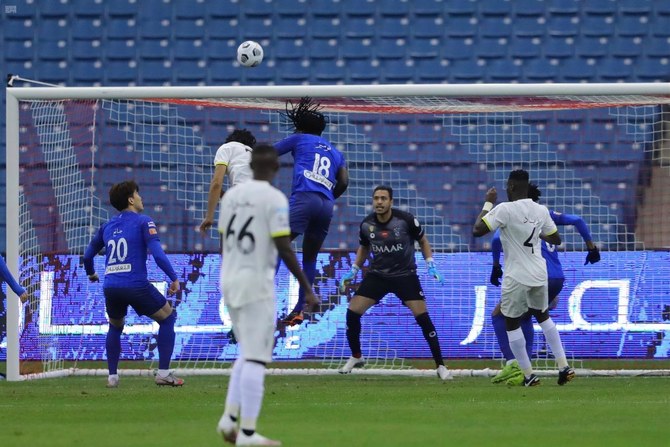
Al-Hilal showed superiority through most of the game but Al-Ittihad managed to eke out a draw. (SPA)
2 / 3
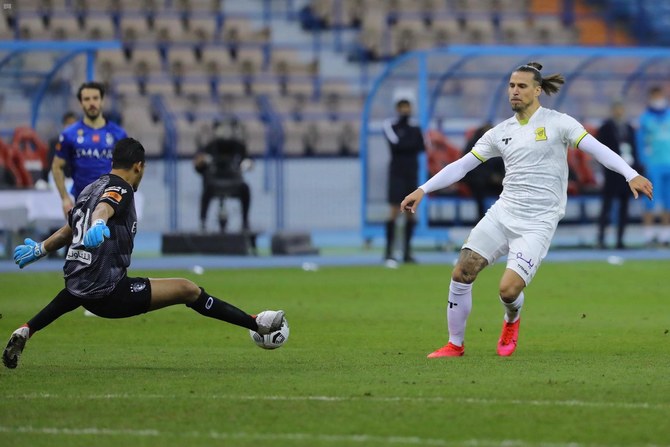
Al-Hilal showed superiority through most of the game but Al-Ittihad managed to eke out a draw. (SPA)
3 / 3
Al-Hilal showed superiority through most of the game but Al-Ittihad managed to eke out a draw. (SPA)
Short Url
Updated 27 December 2020
Follow

Al-Ittihad halt Al-Hilal march after Saudi Clasico draw

  • Champions Al-Hilal will go into 2021 as SPL leaders

DUBAI: Al-Ittihad ensured that Al-Hilal will not go into 2021 with a potential six-point lead at the top of the Saudi Professional League after securing a 1-1 draw against the champions at King Saud University stadium in Riyadh.

It could have been so much better for Al-Ittihad, having led by a solitary goal going into the last five minutes of the match.

After a disastrous 2019-20 season for Ittihad, one that saw them flirt with relegation, the Jeddah club came into the Saudi Clasico in far better shape than they had been for some time, in fifth place and with 14 points already on the board. Still, few would have expected anything other than a home-win Al-Hilal in the 10th round of the season, and last of the year.

The early stages of the match had brought few clear-cut chances, with Andre Carrillo looking lively for Al-Hilal, while Egyptian international Ahmed Hegazi, on loan from West Brom, proved a solid presence at the back for Al-Ittihad.

And it was Al-Ittihad who took the lead 20 minutes on through Abdulrahman Al-Aboud’s superb curling strike.

As expected, Al-Hilal came out for the second half with greater purpose while Al-Ittihad looked to soak the pressure and hit them on the break.

Carrillo and Bafetimbi Gomis carried the home team’s greatest threat, and with 20 minutes left Salem Al-Dawsari’s shot from inside the penalty area was deflected just wide for a corner.
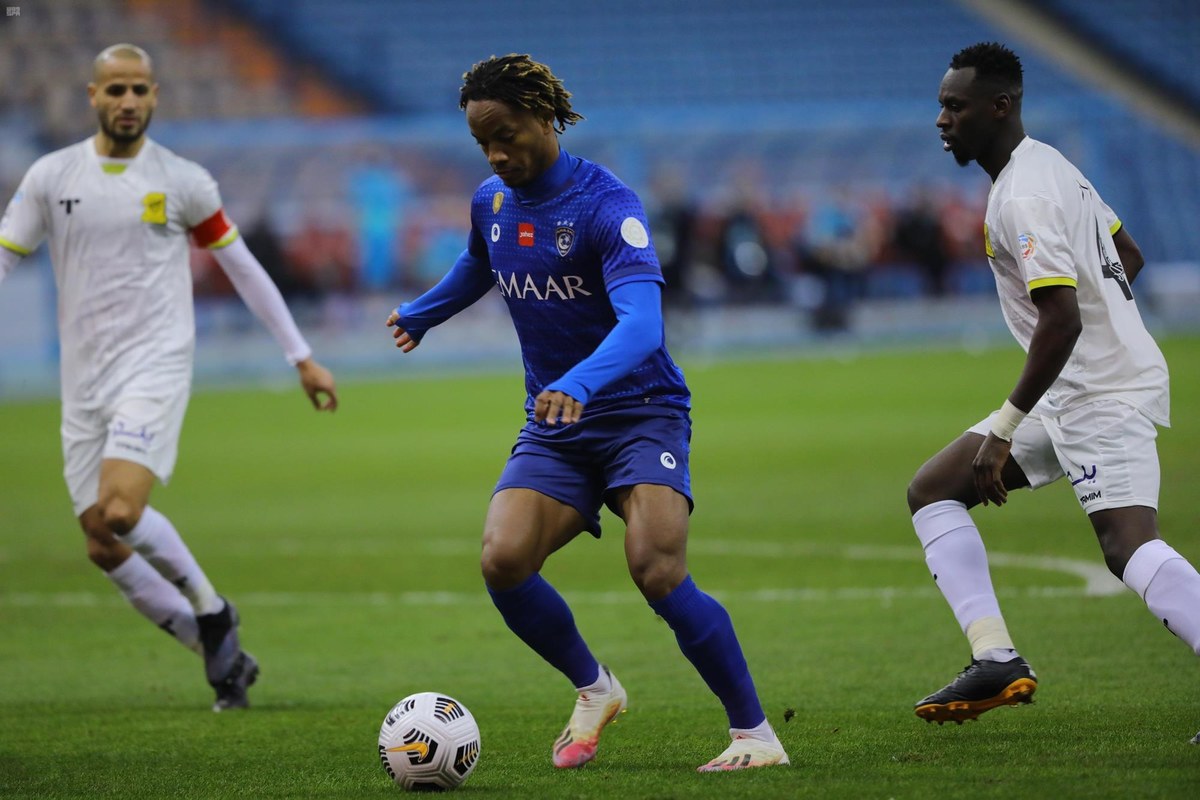


Al-Hilal showed superiority through most of the game but Al-Ittihad managed to eke out a draw. (SPA)

Al-Hilal continued to dominate possession — and would end the match with 70 percent superiority — but this did not translate into many dangerous chances.

With nine minutes left, Nasser Al-Dawsari and Saleh Al-Shehri replaced Mohammed Al-Breik and Jang Huyn-soo as Al-Hilal coach Razvan Lucescu desperately looked to save the match.

The move paid dividends, with Al-Shehri meeting Sebastian Giovinco’s pinpoint free-kick with glancing header to secure a 1-1 draw for Al-Hilal five minutes from the end. The result leaves Al-Hilal four points ahead of second-place Al-Ahli, who have a game in hand.

“I came in pretty late in the half when were one goal down, and I had certain instructions from the coach which I will keep private,” Al-Shehri said. “I’m grateful I scored, of course we had ambitions of winning the match but a point is better than nothing.”

Ittihad captain Karim El Ahmadi was disappointed that his team did not secure the win.

“Al-Hilal had chances, but we also had chances to make it 2-0,” the Moroccan midfielder said. “To come to Al-Hilal and get a 1-1 draw against a big team is a good result. But looking at the chances that came our way, we could have won.”

He also had special praise for the team’s new-found defensive resilience.

“Al-Hilal have great control and great players,” El Ahmadi said. “You always have to double-mark their individual attackers, and we didn’t give them too many chances today. Hopefully we can win our next match. We’ve had an unbeaten run of 11 matches and we can see the improvement in the team.
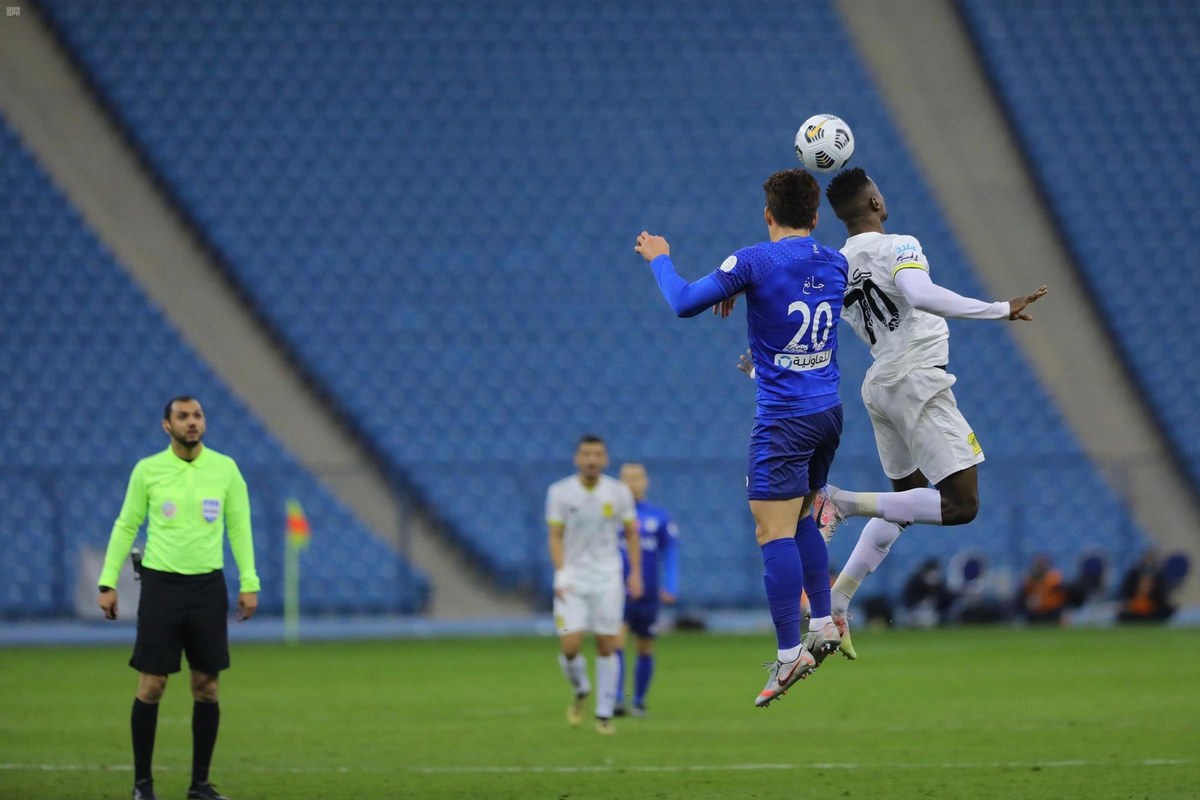


Al-Hilal showed superiority through most of the game but Al-Ittihad managed to eke out a draw. (SPA)

Al-Hilal defender Al-Breik said that Al-Ittihad had proven a tough opponent as anticipated.

“We expected the match to be tough,” the Saudi International said. “We were hoping for a win, of course, to put more distance between us and the challengers. But today we came up against a worthy opponent, and I would say the draw was a fair result.”

Ittihad keeper Marcelo Grohe praised his teammates for their defensive solidity but felt disappointed at the outcome.

“Sadly we conceded that late equalizer but I have to congratulate the players for their positive attitude and the performance,” the Brazilian said. “A draw against such a strong team is good result. But I hope we learn from our mistakes, and we don’t repeat them in the coming matches.

He also said that the addition of Hegazi has improved the understanding and cohesion in the back line.

“There is no doubt Hegazi is a quality footballer — he’s an international plays and played in the Premier League — he’s a big player,” Grihe said. “But it’s not just him, there was an improvement in all of our defenders, and personally I’m very happy to play behind this defensive line.”

Al-Ittihad coach Fabio Carille insisted that his team did not intend to simply sit back after taking the lead, and that they had looked to increase their lead.

“We did not take advantage of our chances,” he said. “Perhaps we were missing the confidence that comes from winning regularly, but in general the team has improved significantly, especially compared to last season. It took Al-Ittihad half of last season to get 15 points and here we are now with 15 points. The difference is clear.”

Earlier in the day, 14th-placed Al-Nassr missed an opportunity to ease their relegation worries by drawing 2-2 at home to Damac, which sits one place below them in the table. Al-Shabab, meanwhile, strengthened their grip on third place with a fine 3-1 win over Al-Batin.


The ‘Porsche of off-road’: Ford CEO Jim Farley unveils vision for global lineup forged in Saudi sands

Updated 8 sec ago
Follow

The ‘Porsche of off-road’: Ford CEO Jim Farley unveils vision for global lineup forged in Saudi sands

  • Farley spoke to Arab News about creating a direct engagement between Ford and Dakar
  • He wants customers to feel like they are buying a piece of the world-famous rally with Ford vehicles

RIYADH: Ford’s leadership has signaled a new ambition to make the brand the “Porsche of off-road,” having used Saudi Arabia’s grueling Dakar Rally terrain to to hone their technology into a new lineup of off-road vehicles.

“Porsche has dominated the enthusiast automotive industry for a long time, and Ford, we have the ambition to be the Porsche of off-road,” Jim Farley, Ford Motor Company CEO, told Arab News. 

“There’s no more important off-road race in the world than Dakar,” he said, as the endurance event came to a close in Saudi Arabia at the weekend.

“We want to link the Dakar racing vehicles, our T1 Raptors to something that people can buy, not just a Raptor pickup truck, but a whole new lineup that people have not seen before. So, Dakar is really the inspiration for our future off-road lineup,” he added. 

Speaking on what the future holds for Ford racing and how Saudi Arabia’s terrain impacts vehicle innovation and engineering, Farley said: “I think it’s a story still playing out. The Baja race very much inspired the creation of a global Raptor brand.”

The CEO said that the company wants to create direct engagement between Ford and Dakar, so that consumers feel like they are purchasing a piece of Dakar when they buy a vehicle. 

“Toyota took the lead in off-road because the products were functional. And yes, they’ve been racing for a long time in Dakar. But I don’t think most people who buy the Toyota brand for off-road products imagine they’re buying a piece of Dakar.” 

The CEO highlighted the influential role Dakar plays in Ford’s future off-road lineup, describing the race as the Formula 1 and Le Mans of off-roading. 

“You’re going to see more and more products from Ford that are not utilitarian. Vehicles used to just get from point A to point B off road, but literally they’re designed to give people a piece of the racing technology similar to what portion Ferrari have done on the on road side.”

On the sidelines of the 2026 Dakar Rally, Farley reflected on what he called a “heartening” experience in the Saudi desert. After spending a night camping in a tent without electricity, he spoke of being moved by the profound solitude of the dunes and the deep dedication of the Saudi people to their cultural roots.

“I was very struck by the people I met in the desert the last couple of days. It’s just a sea of young people who kind of return to their roots as a culture out in the desert to enjoy this beautiful place as a social activity, and motorsports is that connection for them,” he said. 

“And I found that very appealing for me as an automobile executive that our industry is the kind of industry that can that can make a connection between the cultural, authentic cultural norms here in the Kingdom. 

“And it really struck me how interesting and important it is for the Saudi people to be connected to this beautiful desert, this beautiful resource you have, but doing so through motorsports, not necessarily through the traditional way of enjoying the desert. I found that very heartening in our world, where people had their shoes off, their feet in the sand and enjoying this beautiful place.”

Comparing a Dakar victory to winning Le Mans or a Formula 1 World Championship, Farley described the race as the “missing jewel” in its storied motorsports crown.

Highlighting why Dakar remains the most important off-road race in the world, the CEO said: “Because it’s global. If you go to Spain and Portugal, and Italy and France, and Thailand and South Africa, and around the world, people know what the Dakar race is.

“They know how difficult it is to win here. They understand the technology required to win here.

“It’s not something in North America. But if you want to create an off-road enthusiast brand for people who love the joy of driving off-road fast, there is no other event.

“But it’s equally compelling because it’s so difficult to win,” he said. 

Dakar came to a close on Saturday, after passing through AlUla, Hail, Wadi Ad-Dawasir, Bisha and Al-Henakiyah, and ending in Yanbu. 

Qatar’s Nasser Al-Attiyah won ​the Dakar Rally for the sixth time in the car category on Saturday as Argentina’s Luciano Benavides won by two seconds on two wheels, the narrowest margin ever.

Ford’s Nani Roma finished second, nine minutes and 42 seconds behind, and teammate Mattias Ekstrom was third after winning the final stage.

“There is an element about this race, like Le Mans, that comes down to kind of fortune and persistence. Do you try long enough and hard enough? Because it only takes one small mistake, one part to break, one driver error for navigation to lose the race,” Farley said.