Millions of Americans lose jobless benefits as Trump refuses to sign aid bill

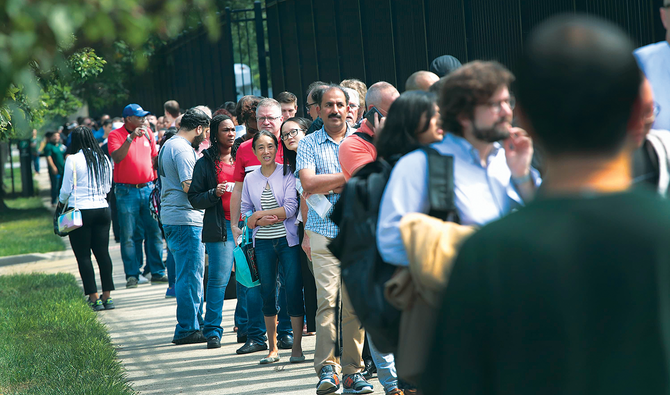
Many economists agree the bill’s aid is too low but say the immediate support is still welcome and necessary. (AFP)
Short Url
Updated 26 December 2020
Follow

Millions of Americans lose jobless benefits as Trump refuses to sign aid bill

  • Without Trump’s signature, about 14 million people could lose those extra benefits, according to Labor Department data

WASHINGTON: Millions of Americans saw their jobless benefits expire on Saturday after US President Donald Trump refused to sign into law a $2.3 trillion pandemic aid and spending package, protesting that it did not do enough to help everyday people.

Trump stunned Republicans and Democrats alike when he said this week he was unhappy with the massive bill, which provides $892 billion in badly needed coronavirus relief, including extending special unemployment benefits expiring on Dec. 26, and $1.4 trillion for normal government spending. Without Trump’s signature, about 14 million people could lose those extra benefits, according to Labor Department data. A partial government shutdown will begin on Tuesday unless Congress can agree to a stopgap government funding bill before then. After months of wrangling, Republicans and Democrats agreed to the package last weekend, with the support of the White House.

Trump, who hands over power to Democratic President-elect Joe Biden on Jan. 20, did not object to terms of the deal before Congress voted it through on Monday night.

But since then he has complained that the bill gives too much money to special interests, cultural projects and foreign aid, while its one-time $600 stimulus checks to millions of struggling Americans were too small. He has demanded that be raised to $2,000.

“Why would politicians not want to give people $2,000, rather than only $600? Give our people the money!” the president tweeted on Christmas Day, much of which he spent golfing at his Mar-a-Lago resort in Palm Beach, Florida.

Many economists agree the bill’s aid is too low but say the immediate support is still welcome and necessary.

A source familiar with the situation said Trump’s objection to the bill caught many White House officials by surprise. While the outgoing president’s strategy for the bill remains unclear, he has
not vetoed it and could still sign it in coming days.

On Saturday, he was scheduled to remain at Mar-a-Lago, where the bill has been sent and awaits his decision. Biden, whose Nov. 3 electoral victory Trump refuses to acknowledge, is spending the holiday in his home state of Delaware and had no public events scheduled for Saturday.


Saudi Arabia’s cultural sector is a new economic engine between Riyadh and Paris, says ambassador

Updated 25 January 2026
Follow

Saudi Arabia’s cultural sector is a new economic engine between Riyadh and Paris, says ambassador

RIYADH: Culture has become a fundamental pillar in bilateral relations between France and Saudi Arabia, according to the French Ambassador to the Kingdom, Patrick Maisonnave.

Maisonnave noted its connection to the entertainment and tourism sectors, which makes it a new engine for economic cooperation between Riyadh and Paris.

He told Al-Eqtisadiah during the opening ceremony of La Fabrique in the Jax district of Diriyah that cultural cooperation with Saudi Arabia is an important element for its attractiveness in the coming decades.

La Fabrique is a space dedicated to artistic creativity and cultural exchange, launched as part of a partnership between the Riyadh Art program and the French Institute in Riyadh. 

Running from Jan. 22 until Feb 14, the initiative will provide an open workspace that allows artists to develop and work on their ideas within a collaborative framework.

Launching La Fabrique as a space dedicated to artistic creativity

The ambassador highlighted that the transformation journey in the Kingdom under Vision 2030 has contributed to the emergence of a new generation of young artists and creators, alongside a growing desire in Saudi society to connect with culture and to embrace what is happening globally. 

He affirmed that the relationship between the two countries is “profound, even cultural par excellence,” with interest from the Saudi side in French culture, matched by increasing interest from the French public and cultural institutions unfolding in the Kingdom.

Latest estimates indicate that the culture-based economy represents about 2.3 percent of France’s gross domestic product, equivalent to more than 90 billion euros ($106.4 billion) in annual revenues, according to government data. The sector directly employs more than 600,000 people, making it one of the largest job-creating sectors in the fields of creativity, publishing, cinema, and visual arts.

Saudi Arabia benefiting from French experience in the cultural field

Maisonnave explained that France possesses established cultural institutions, while Saudi Arabia is building a strong cultural sector, which opens the door for cooperation opportunities.

This comes as an extension of the signing of 10 major cultural agreements a year ago between French and Saudi institutions, aiming to enhance cooperation and transfer French expertise and knowledge to contribute to the development of the cultural system in the Kingdom.

He added that experiences like La Fabrique provide an opportunity to meet the new generation of Saudi creators, who have expressed interest in connecting with French institutions and artists in Paris and France.

La Fabrique encompasses a space for multiple contemporary artistic practices, including performance arts, digital and interactive arts, photography, music, and cinema, while providing the public with an opportunity to witness the stages of producing artistic works and interact with the creative process.