

Yemen’s new government sworn in, ending months of wrangling

1 / 2
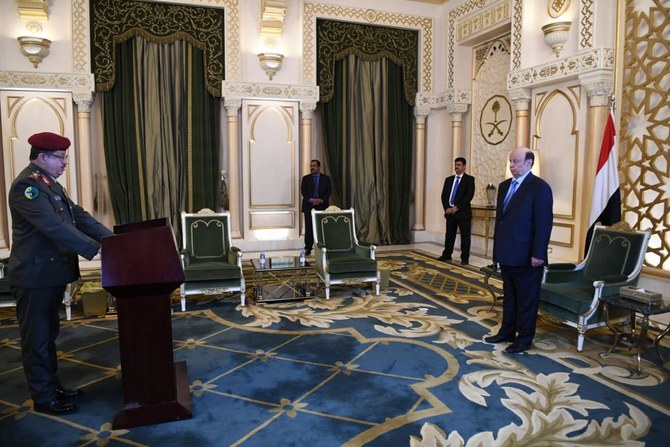
Yemen’s new unity government was sworn in on Saturday before President Abed Rabbo Mansour Hadi in Riyadh. (Saba News Agency)
2 / 2
Yemen’s new unity government was sworn in on Saturday before President Abed Rabbo Mansour Hadi in Riyadh. (Saba News Agency)
Short Url
Updated 26 December 2020
Follow

Yemen’s new government sworn in, ending months of wrangling

  • The new government is formed of 24 ministers, representing major political forces in Yemen
  • The prime minister said that his government is aware of the big challenges

AL-MUKALLA: Yemen’s new unity government was sworn in on Saturday before President Abed Rabbo Mansour Hadi in Riyadh, closing months of violence and political wrangling in southern Yemen provinces that weakened the anti-Houthi bloc.

Led by Prime Minister Maeen Abdul Malik Saeed, the new government is formed of 24 ministers, representing major political forces in Yemen, including the powerful Southern Transitional Council (STC).

Setting the new government’s priorities, the Yemeni president met with the ministers after the ceremony, in which he ordered them to focus their attention and efforts on addressing economic woes including managing a plunging currency, boosting revenues and defeating the Houthis, official news agency SABA reported. Hadi told the ministers that Yemenis are pinning hopes on this government to restore peace and stability to the liberated provinces, revive government bodies and unify forces to confront the Iran-backed Houthis.

“We want a revival of institutions, recovery of the economy, restoration of security and a confrontation of the coup. This in short is what awaits you,” Hadi said, pledging his full support and the dismissal of ineffective ministers. Addressing the ministers of defense and interior, Hadi said that the new government is responsible for merging and disarming factions, getting them under the state’s control and putting into place the remaining security and military components of the Riyadh Agreement.

“We want the temporary capital Aden free of all military units. Security services must carry out their duties. We do not want conflicts after today. No more blood. Our enemy is the Houthis,” he said. 

During the meeting, Hadi thanked Saudi Arabia for paving the way for the implementation of the Riyadh Agreement, expressing hope for a new bailout from the Kingdom to steady the country’s troubled economy. 

At the same time, the new prime minister said that his government is aware of the big challenges and would collectively work in accordance with agendas set by President Hadi.

After months of political stalemate, the Arab coalition announced on Dec. 11 that Yemeni parties would immediately implement security and military arrangements under the Riyadh Agreement, agreeing to form a new government when the deployment of forces came to an end. 

Under the supervision of the Saudi de-escalation committee in Yemen, hundreds of military troops from the former government and the STC departed contested areas in the southern province of Abyan. Military units also withdrew from Aden and were redeployed in battlefields with the Houthis. 

Positive news about the formation of the new government and its expected return to Aden have pushed the Yemeni riyal into recovering against foreign currencies. Moneychangers told Arab News on Saturday afternoon that the riyal surged to 720 against the US dollar after sinking to 920 a couple of weeks ago, shortly after ministers took the constitutional oath.


Iran FM criticizes Israel for ‘doctrine of domination’

Updated 8 sec ago
Follow

Iran FM criticizes Israel for ‘doctrine of domination’

  • Doctrine allows Israel to expand its military arsenal while pressuring other countries in the region to disarm
  • His remarks came a day after renewed nuclear talks with Washington in Oman
DOHA: Iran’s Foreign Minister Abbas Araghchi on Saturday criticized what he said was a “doctrine of domination” that allows Israel to expand its military arsenal while pressuring other countries in the region to disarm.
His remarks came a day after renewed nuclear talks with Washington, with previous talks collapsing when Israel launched an unprecedented bombing campaign against Iran last June that triggered a 12-day war.
Araghchi was speaking at the Al Jazeera Forum conference in Qatar but made no reference to Friday’s talks with the United States.
“Israel’s expansionist project requires that neighboring countries be weakened: militarily, technologically, economically and socially,” Araghchi said.
“Under this project Israel is free to expand its military arsenal without limits ... Yet other countries are demanded to disarm. Others are pressured to reduce defensive capacity. Others are punished for scientific progress,” he added.
“This is a doctrine of domination.”
During the 12-day war Israel targeted senior Iranian military officials, nuclear scientists and sites as well as residential areas, with the US later launching its own attacks on key nuclear facilities.
Iran responded at the time with drone and missile attacks on Israel, as well as by targeting the largest US military base in the Middle East, located in Qatar.
On Friday, Araghchi led the Iranian delegation in indirect nuclear talks with US Middle East envoy Steve Witkoff in Muscat.
The top Iranian diplomat later described the atmosphere as having been “very positive,” while US President Donald Trump said the talks were “very good,” with both sides agreeing to proceed with further negotiations.
The talks followed threats from Washington and its recent deployment of an aircraft carrier group to the region following Iran’s deadly crackdown on anti-government protests last month.
The United States has sought to address Iran’s ballistic missile program and its support for militant groups in the region — issues which Israel has pushed to include in the talks, according to media reports.
Tehran has repeatedly rejected expanding the scope of negotiations beyond the nuclear issue.