India’s Modi makes fresh appeal to farmers protesting over new laws

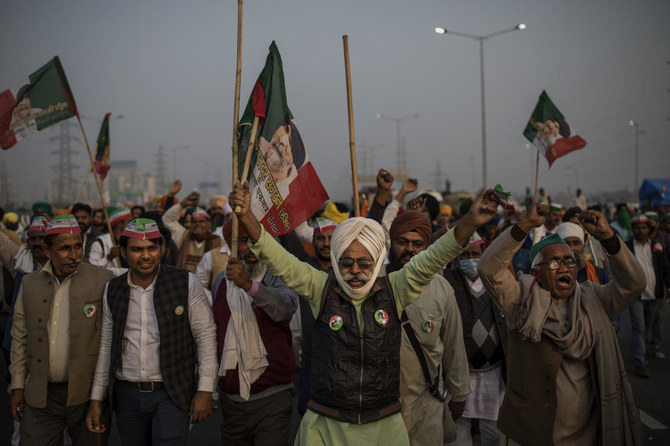
Indian farmers fear the government would stop buying wheat and rice at guaranteed prices, leaving them at the mercy of big corporates. (AP)
Short Url
Updated 25 December 2020
Follow

India’s Modi makes fresh appeal to farmers protesting over new laws

  • Tens of thousands of farmers have been camping out near several entry points to New Delhi since November 26

NEW DELHI: Indian Prime Minister Narendra Modi on Friday offered to hold fresh talks to end a stalemate over new agricultural reforms, in his latest push to win over farmers protesting for almost a month against the move.
Tens of thousands of farmers have been camping out near several entry points to New Delhi since November 26 against three new laws they say will lead to dismantling of regulated markets.
They also fear the government would stop buying wheat and rice at guaranteed prices, leaving them at the mercy of big corporates.
In a speech beamed live to millions of farmers across the country, Modi sought to allay their misgivings, insisting the laws, passed in September, would give them the freedom to sell their produce “anywhere and to anyone they like.”
“Lies are being spread that the local mandis (markets) will shut down, the minimum support price will be stopped... don’t be misguided by those having political motives,” Modi, 70 said.
“I am saying this with humility that we are ready to discuss every issue of the farmers, even with those (political parties) who are against us, for the sake of our farmers.”
Modi also released $2.5 billion to 90 million farmers under a financial scheme that his party launched last year.
Under the direct cash transfer scheme, small farmers get 6,000 rupees ($82) in four instalments in a year.
Modi also interacted with seven farmers from different states via a video conference in which they praised the government’s various farm schemes.
Agriculture employs about 70 percent of India’s 1.3 billion people and accounts for 15 percent of its $2.7 trillion economy.
But in recent decades farm incomes have stagnated, and experts say the sector badly needs investment and modernization.
Farmer unions have demanded a total repeal of the laws and warned of a bigger agitation if their demands are not met.
Several rounds of talks between ministers and farmer leaders have failed to produce a breakthrough so far.


Modi ally proposes social media ban for India’s teens as global debate grows

Updated 54 min 18 sec ago
Follow

Modi ally proposes social media ban for India’s teens as global debate grows

  • India is the world’s second-biggest smartphone market with 750 million devices and a billion Internet users
  • South Asian nation is a key growth market for social media apps and does not set a minimum age for access

NEW DELHI: An ally of Indian Prime Minister Narendra Modi has proposed a bill to ban social media for children, as the world’s biggest market for Meta and YouTube joins a global debate on the impact of social media on young people’s health and safety.
“Not only are our children becoming addicted to social media, but India is also one of the world’s largest producers of data for foreign platforms,” lawmaker L.S.K. Devarayalu said on Friday.
“Based on this data, these companies are creating advanced AI systems, effectively turning Indian users into unpaid data providers, while the ‌strategic and economic ‌benefits are reaped elsewhere,” he said.
Australia last ‌month ⁠became the ‌first country to ban social media for children under 16, blocking access in a move welcomed by many parents and child advocates but criticized by major technology companies and free-speech advocates. France’s National Assembly this week backed legislation to ban children under 15 from social media, while Britain, Denmark and Greece are studying the issue.
Facebook operator Meta, YouTube-parent Alphabet and X did ⁠not respond on Saturday to emails seeking comment on the Indian legislation. Meta has ‌said it backs laws for parental oversight but ‍that “governments considering bans should be careful ‍not to push teens toward less safe, unregulated sites.”
India’s IT ministry ‍did not respond to a request for comment.
India, the world’s second-biggest smartphone market with 750 million devices and a billion Internet users, is a key growth market for social media apps and does not set a minimum age for access.
Devarayalu’s 15-page Social Media (Age Restrictions and Online Safety) Bill, which is not public but was seen by Reuters, says ⁠no one under 16 “shall be permitted to create, maintain, or hold” a social media account and those found to have one should have them disabled.
“We are asking that the entire onus of ensuring users’ age be placed on the social media platforms,” Devarayalu said.
The government’s chief economic adviser attracted attention on Thursday by saying India should draft policies on age-based access limits to tackle “digital addiction.”
Devarayalu’s legislation is a private member’s bill — not proposed to parliament by a federal minister — but such bills often trigger debates in parliament and influence lawmaking.
He is from the ‌Telugu Desam Party, which governs the southern state Andhra Pradesh and is vital to Modi’s coalition government.