- International orders have been diverted to Pakistan from other countries after it lifted its comprehensive lockdown in May
- Parliamentary secretary says industry running at 110 percent capacity with export orders until June 2021
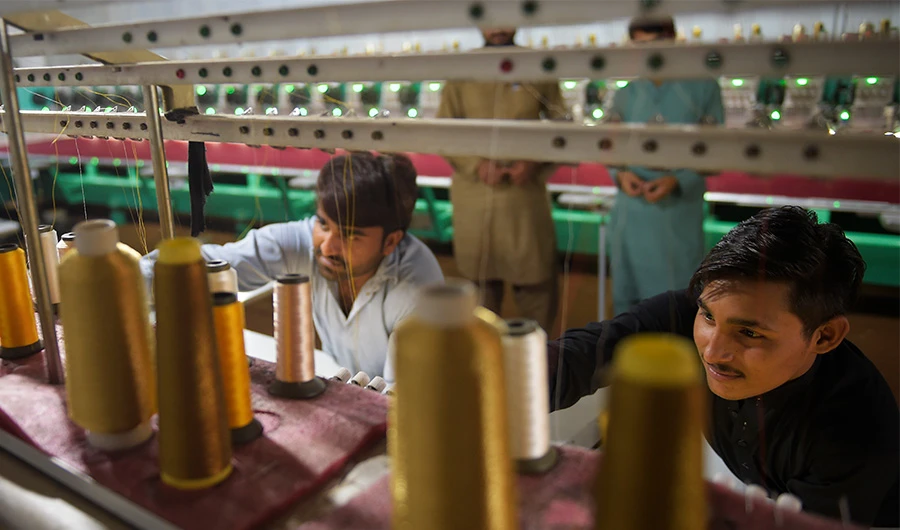
KARACHI: After years of slump, Faisalabad, the hub of textile production in Pakistan, is facing growing demand and acute labor shortages as the country’s textile sector witnesses a revival, industry and government officials said.
Textiles make up more than half of Pakistan’s exports, but have lost ground to South Asian neighbors in recent years, hurt by chronic energy shortages and underinvestment in machinery.
But this year, after Pakistan lifted its comprehensive coronavirus lockdown in May while other countries in the neighborhood kept their economies closed, international textile orders have been diverted to Pakistan, leading to a nine-year record in exports, Aliya Hamza Malik, parliamentary secretary for commerce, told Arab News.
“Pakistan’s policy of early easing of lockdowns and opening the economy has diverted export orders from China, India and Bangladesh to Pakistan,” she said. “The exports in November 2020 have broken a nine-year record.”
Malik said the industry was currently running at 110 percent capacity, with export orders until June 2021.
Waheed Khaliq Ramay, chairman of the Power Looms Association of Pakistan, said factory owners were “desperately” searching for workers as “almost all power looms in Pakistan, and particularly in Faisalabad, were running at full capacity.”
“Those that were closed since 2016-17 and before are now back in business and continuously expanding,” Ramay said.
Faisalabad has around 300,000 fabric-manufacturing power looms, of which more than 50,000 were closed in 2016-17 due to a long-running energy crisis. But industry officials say the industry is picking up once more, with 40,000 new power looms being set up to meet growing demand, Malik said.
The textile industry, which comprises 46 percent of the total manufacturing sector and provides employment to around 25 million Pakistanis, contributes 8.5 percent to the GDP, according to the Pakistan Board of Investment. It also contributes 60 percent to overall exports and is one of the major earners of foreign exchange for Pakistan.
Despite a global economic slowdown due to COVID-19, Pakistan’s textile sector reached $6 billion exports in the first five months of current fiscal year (July-November 2020), which is 62 percent of total exports (worth $9.7 billion) and almost 5 percent higher compared to the same period last year, official data shows.
“Incentives and export facilitations have played a big role in making Pakistan a competitive exporting country,” Malik said.
Khurram Mukhtar, partron-in-chief of the Pakistan Textile Exporters Association (PTEA), said five key reforms by the government had helped turn the sector around: “Energy package at competitive tariff, reduction in interest rates, timely disbursement of refunds, flexible market-based exchange rate and working capital and long-term financing at subsidized rates.”
“All segments of the value chain of the textile industry in Pakistan are running at full capacity and this is unprecedented,” Mukhtar added.
However, some exports are skeptical the upwards export trend can be sustained in the upcoming months due to the rising costs of input at home and surging coronavirus cases in markets, particularly Europe, that Pakistan imports textiles to.
Europe became the first region worldwide to cross 500,000 COVID-19 deaths this week, according to a Reuters tally, as a new variant of the coronavirus discovered in Britain threatened the region’s prevention measures to curb the pandemic.
Reports of the mutated variant out of England prompted a pre-Christmas lockdown and have forced dozens of countries close their borders to British travelers this week.
Italy, the nation with the highest death toll in Europe, on Sunday detected a patient infected with the new variant, as have Denmark and France.
“Major marketing activities in big European markets like London have largely been disrupted by the new strain of virus,” said Ijaz Khokhar, chief coordinator at the Pakistan Readymade Garments Manufacturers and Exporters Association, predicting a dip in textile exports in January and beyond. “The price of raw material such as yarn has increased from Rs13,500 in August 2020 to Rs 18,800 per 100 pounds now.”