

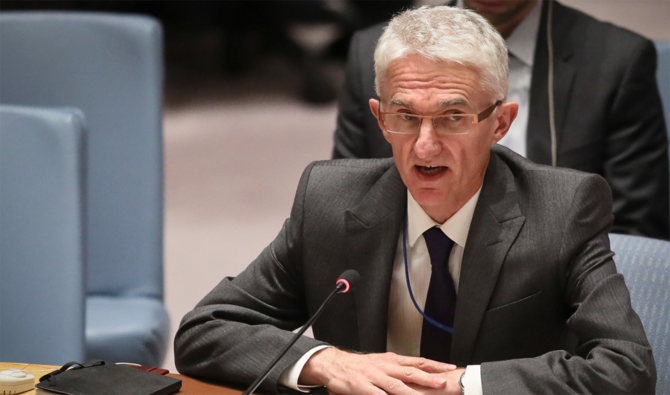

NEW YORK: The UN’s humanitarian chief, Mark Lowcock, has once again sounded the alarm over the precarious conditions the Syrian people are living in while they prepare to face another harsh winter.
As the 10th anniversary approaches of the start of the Civil War in March 2011, hostilities have continued to rage in northern Syria in recent weeks, putting civilians at risk. Lowcock told the Security Council on Wednesday that millions of Syrians have been displaced and impoverished, and are suffering from “trauma and deep personal loss.”
More than 80 per cent of displaced families across Syria say that their income does not cover their basic needs. In the northwest, there has been a five per cent increase in stunted growth in children, and 37 per cent of displaced mothers are undernourished.
The Syrian economy continues to crumble, with the problems worsened by the COVID-19 pandemic, rising food insecurity and malnutrition.
As a result, the number of Syrians in need of assistance has spiked, said Lowcock, the UN’s under-secretary-general for humanitarian affairs and emergency relief coordinator. He added that current funding levels mean that aid can only reach about 2.3 million of the 3 million people who need it most. “More is needed,” he said.
There has also been an increase in the number of COVID-19 cases reported in Syria. It is impossible to gauge the true scale of the outbreak because testing is limited, but Lowcock said hospitals have reached maximum capacity in areas such as Sweida and Homs.
“We also know that many people who are sick are reluctant to seek in-patient treatment,” he added.
Beyond the immediate health threat, Lowcock also expressed concern about the secondary effects of the pandemic, including reduced access to education. He cited an investigation by Save the Children that estimated two thirds of young people in northern Syria no longer go to school because of the pandemic and rising poverty levels.
Meanwhile food and fuel are getting harder to find and costs are soaring. The prices of bread and diesel, for example, have doubled since September.
“The market price of a standard reference food basket is higher than at any point” since the World Food Program (WFP) began monitoring prices in Syria in 2013, Lowcock said.
Meanwhile the humanitarian-aid operation in the northeast is facing challenges to its efforts to help people. For example, one organization was ordered by Syrian authorities to stop distributing WFP food aid to about 220,000 people in areas of Ar-Raqqa governorate that are not controlled by the government.
“When aid is suspended, those most in need are the ones who suffer,” Lowcock said. “International humanitarian law requires that all parties allow and facilitate the rapid and unimpeded passage of humanitarian relief for civilians in need.”
Meanwhile, UN Special Envoy for Syria Geir Pedersen briefed the Security Council on the outcome of the fourth session of the Small Body of the Syrian Constitutional Committee, which convened in Geneva this month.
He said that while a fragile calm has descended in much of Syria, it falls well short of the nationwide ceasefire envisaged by UN Security Council Resolution 2254, which was adopted in December 2015.
“Shelling, airstrikes and IED (improvised explosive device) attacks continue to kill and injure civilians,” he said.
He also warned that with five international armies operating in Syria, the country remains “a tinderbox for major international incidents,” which has potential implications for the entire region.
Pedersen pointed out that after nearly 10 years of conflict, the political process has failed to deliver results for the Syrian people, who “continue to suffer deeply” inside and outside the country.
Disappointed by the lack of progress on the issues of detainees, abductees and missing persons, he said that “only a political solution can end this suffering and prevent renewed conflict and instability, protecting Syria’s civilians and the region from further grave danger.”
He added that there were stark differences of opinion in the positions and narratives presented within the Constitutional Committee, which resulted in some tense moments.
Against the backdrop of deep divisions in Syria, the region and worldwide, Pedersen acknowledged that forging a consensus on how to encourage mutual and reciprocal steps that result in constructive diplomacy “is proving very difficult.”
“But I am convinced it is possible and that there are common interests that make it so,” he said.
He added that the Constitutional Committee agreed to convene again in January.


