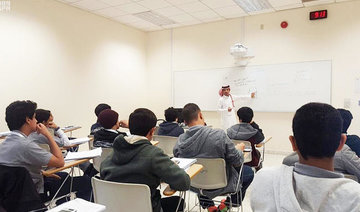
JEDDAH: A total of 356 male and female students won prizes for the King Abdul Aziz and His Companions Foundation for Giftedness’ (Mawhiba) Bebras challenge.
The contest, held in cooperation with the Ministry of Education, is an international initiative that seeks to promote informatics and computational thinking among school students of all ages.
Participants are usually supervised by teachers who may integrate the Bebras challenge in their teaching activities.
The Kingdom launched the experimental version of the challenge in 2019 in which only 73 schools took part. However, this year more than 3,370 public, private and international schools participated in the contest.
According to results, 60 male and female students won gold, 108 students clinched silver medals and 189 won bronze.
The Bebras competitions are made of a set of short online problems called Bebras Tasks. The tasks are fun, engaging and based on problems that computer scientists often meet and enjoy solving.
Dr. Saud bin Said Al-Mathami, secretary-general of Mawhiba, urged parents of students to help nurture their talents. “Don’t get bored of their queries,” he said.
He said Bebras is one of the several tools Mawhiba is using to identify talented students.

356 Saudi students win Bebras Mawhiba contest
https://arab.news/w3dnu
356 Saudi students win Bebras Mawhiba contest
Riyadh summit to highlight next-gen governance and strategic innovation
RIYADH: The fourth annual Governance, Performance, Risk, and Compliance Summit, themed “Integration for Strategic Performance,” will begin on Monday in Riyadh, aiming to transform regulatory systems from oversight tools into drivers of innovation and growth.
Inge Vasshus, chair of the organizing committee, said: “The summit seeks to foster a corporate culture where risk management and compliance are seamlessly embedded into strategic operations.”
Day 1 will open with a keynote titled “Risk Is Our Business,” focusing on shifting from documentation-based approaches to strategic risk integration.
The agenda includes panel discussions with representatives from the Center for Governance, the Royal Commission for AlUla, and the GCC Board Directors Institute, examining the integration of governance, risk, and compliance into Saudi companies’ strategies.
Speakers will also present case studies from Saudi institutions and PIF-backed companies, highlighting the impact of governance practices, the role of artificial intelligence in sustainability, and the link between sustainability and competitive governance.
Day 2 focuses on practical applications, starting with a session on managing supplier and third-party risks in complex organizations. This will be followed by a discussion on future governance frameworks and their alignment with international standards and Saudi Vision 2030.
The program will include a session on its impact on the risk management function, as well as a dedicated session on establishing AI governance frameworks.
It will further explore the evolution of the Gulf’s compliance function from a regulatory obligation into a driver of operational efficiency.
In addition, workshops will address applying “zero-trust” principles to AI agent security, the shift from reactive to proactive risk management, and the impact of individual dominance on board effectiveness.


