Japan ‘Twitter killer’ sentenced to death for nine murders

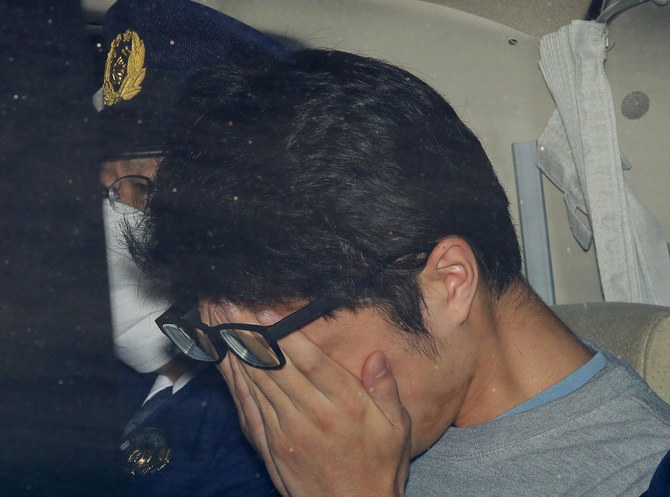
The judge sentenced Takahiro Shiraishi with death penalty over the 2017 crimes, which he called ‘cunning and cruel.’ (Kyodo News via AP)
Short Url
Updated 15 December 2020
Follow

Japan ‘Twitter killer’ sentenced to death for nine murders

  • Takahiro Shiraishi admitted killing and butchering his young victims
  • Japan is one of the few developed nations to retain the death penalty

TOKYO: A Japanese man dubbed the “Twitter killer” was sentenced to death by a Tokyo court on Tuesday for murdering and dismembering nine people he met on the social media platform.
Takahiro Shiraishi, 30, admitted killing and butchering his young victims, all but one of whom were women.
Shiraishi targeted social media users who posted about taking their own lives, telling them he could help them in their plans — or even die alongside them.
His lawyers had argued he should receive a prison sentence rather than be executed because his victims, aged between 15 and 26, had expressed suicidal thoughts on social media and so had consented to die.
But a judge dismissed that argument and handed down the death penalty over the 2017 crimes, which he called “cunning and cruel,” public broadcaster NHK said.
“None of the nine victims consented to be killed, including silent consent,” NHK quoted the judge as saying.
“It is extremely grave that the lives of nine young people were taken away. The dignity of the victims was trampled upon,” he said, adding that Shiraishi had preyed upon people who were “mentally fragile.”
The judge said the case, which prompted calls for tighter control on social networks, “provoked great anxiety in society, because social networks are so commonly used.”
The grisly murders attracted international attention, and the case has been followed closely in Japan, with 435 people reportedly turning up to secure one of 16 available public seats.
When asked if the verdict was audible, Shiraishi, wearing a white mask, stood still and only said: “I understood.”
Family members of the victims have spoken emotionally of their continued pain over the case, with the brother of a 25-year-old woman killed by Shiraishi saying his “heart died” when he heard the murderer’s testimony.
“It didn’t sound at all like he regretted it... It felt like I was being hurt with a sharp knife over and over again.”
On Tuesday, the father of another 17-year-old victim told NHK the death sentence was “appropriate.”
“I feel like I want to get revenge, but bereaved families can’t do anything. I don’t know how to vent my anger,” he said.

Shiraishi was detained three years ago by police investigating the disappearance of a 23-year-old woman who had reportedly tweeted about wanting to kill herself.
After she went missing, her brother gained access to her Twitter account, and noticed a suspicious handle, eventually leading them to Shiraishi’s residence, where they uncovered a house of horrors on the morning of Halloween in 2017.
Nine dismembered bodies — with as many as 240 bone parts stashed in coolers and toolboxes — had been sprinkled with cat litter in a bid to hide the evidence.
Shiraishi has admitted the crimes, telling the court last month: “I’m ready to admit my guilt and incur the punishment without appealing to a high court.”
It was not immediately clear if he would stick with the decision to forgo an appeal of the sentence.
Japan is one of the few developed nations to retain the death penalty, with more than 100 inmates on death row, and support for it remains high.
But years usually pass between sentencing and execution, with the last in December 2019, when a Chinese man was hanged for the murder of a family of four.
Shiraishi’s crimes reignited debate in Japan about suicide and help for those considering it.
Japan has the highest suicide rate among the Group of Seven industrialized nations, with more than 20,000 people taking their lives annually.
Numbers have fallen since a peak in 2003, but there have been signs that suicide rates are rising again in the wake of the coronavirus pandemic.


2025 among world’s three hottest years on record, WMO says

Updated 4 sec ago
Follow

2025 among world’s three hottest years on record, WMO says

  • All eight datasets confirmed that the last three years were the planet’s three hottest since records began, the WMO said
  • The slight differences in the datasets’ rankings reflect their different methodologies and types of measurements

BRUSSELS: Last year was among the planet’s three warmest on record, the World Meteorological Organization said on Wednesday, as EU scientists also confirmed average temperatures have now exceeded 1.5 degrees Celsius of global warming for the longest since records began.
The WMO, which consolidates eight climate datasets from around the world, said six of them — including the European Union’s European Center for Medium-Range Weather Forecasts (ECMWF) and the British national weather service — had ranked 2025 as the third warmest, while two placed it as the second warmest in the 176-year record.
All eight datasets confirmed that the last three years were the planet’s three hottest since records began, the WMO said. The warmest year on record was 2024.

THREE-YEAR PERIOD ABOVE 1.5 C AVERAGE ⁠WARMING LEVEL
The slight differences in the datasets’ rankings reflect their different methodologies and types of measurements — which include satellite data and readings from weather stations.
ECMWF said 2025 also rounded out the first three-year period in which the average global temperature was 1.5 C above the pre-industrial era — the limit beyond which scientists expect global warming will unleash severe impacts, some of them irreversible.
“1.5 C is not a cliff edge. However, we know that every fraction of a degree matters, particularly for worsening extreme weather events,” said Samantha Burgess, strategic ⁠lead for climate at ECMWF.
Burgess said she expected 2026 to be among the planet’s five warmest years.

CHOICE OF HOW TO MANAGE TEMPERATURE OVERSHOOT
Governments pledged under the 2015 Paris Agreement to try to avoid exceeding 1.5 C of global warming, measured as a decades-long average temperature compared with pre-industrial temperatures.
But their failure to reduce greenhouse gas emissions means that target could now be breached before 2030 — a decade earlier than had been predicted when the Paris accord was signed in 2015, ECMWF said. “We are bound to pass it,” said Carlo Buontempo, director of the EU’s Copernicus Climate Change Service. “The choice we now have is how to best manage the inevitable overshoot and its consequences on societies and natural systems.”
Currently, the world’s long-term warming level is about 1.4 C above the pre-industrial era, ECMWF said. Measured on a short-term ⁠basis, average annual temperatures breached 1.5 C for the first time in 2024.

EXTREME WEATHER
Exceeding the long-term 1.5 C limit would lead to more extreme and widespread impacts, including hotter and longer heatwaves, and more powerful storms and floods. Already in 2025, wildfires in Europe produced the highest total emissions on record, while scientific studies confirmed specific weather events were made worse by climate change, including Hurricane Melissa in the Caribbean and monsoon rains in Pakistan which killed more than 1,000 people in floods.
Despite these worsening impacts, climate science is facing political pushback. US President Donald Trump, who has called climate change “the greatest con job,” last week withdrew from dozens of UN entities including the scientific Intergovernmental Panel on Climate Change.
The long-established consensus among the world’s scientists is that climate change is real, mostly caused by humans, and getting worse. Its main cause is greenhouse gas emissions from burning fossil fuels like coal, oil and gas, which trap heat in the atmosphere.