

Nothing lost in translation: Demand for learning Urdu picks up in Chinese varsities 

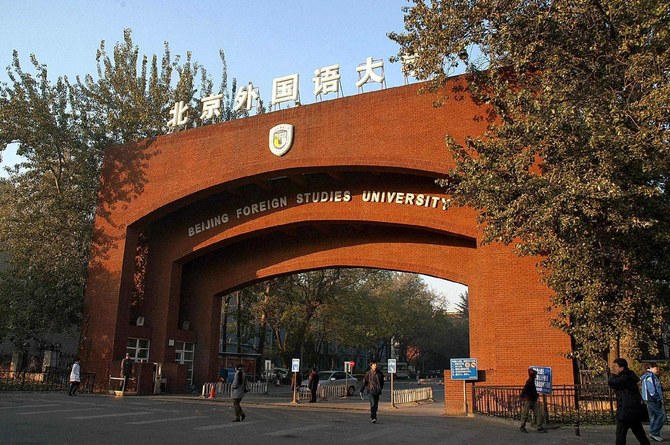
An exterior view of Beijing Foreign Studies University. (Photo Courtesy: Beijing Foreign Studies University)
Short Url
Updated 14 December 2020
Follow

Nothing lost in translation: Demand for learning Urdu picks up in Chinese varsities 

  • First Urdu department was set up at the Peking University in Beijing in 1951
  • Educator says reasons for learning Urdu vary, but cites 'curiosity about Pakistani culture' and potential job opportunities as top reasons  

Islamabad: Sixteen new students have enrolled for an Urdu language course at a Chinese university this year, "reflecting the popularity" of the widely-spoken dialect from across the border in Pakistan, an educator from the varsity said. 

"We have a new batch in every fourth year,” Zhou Yuan, Head of Urdu Department, School of Asian and African Studies, Beijing Foreign Studies University (BFSU) told the Associated Press of Pakistan on Sunday. 

Zhou Yuan, who goes by the name 'Nasreen' for her students, added that besides teaching Urdu, the BFSU department also organizes competitions in Urdu calligraphy and speech and cultural activities "to improve students' skills" and create more awareness "about Pakistan, its culture and people". 

“Some of these students were especially invited by the Pakistan Embassy 

in Beijing to attend the birth anniversary of Allama Dr. Muhammad Iqbal where they recited poetry of the great poet,” she added. 

The BFSU's Urdu Department was set up in 2007 with 51 students completing the four-year degree course so far.  

Zhou Yuan said some students were sent to Pakistan universities for six months "to get a better chance to improve their speaking and writing skills". 

"The increased interest in learning Urdu means that more students from around China are interested to learn the national language of Pakistan, the all-weather friend and strategic cooperative partner of China," she said. 

A dedicated department for the Urdu language was first established at the Peking University in Beijing, the capital city of China, in 1951. 

Later, more varsities joined in by adding the language to their course studies in the Chinese cities of Xian, Guangzhou and Kunming. 

Zhou Yuan says the reasons for learning Urdu vary.  

"Some students have been romanced by Pakistan’s culture, food and landscape; others by the beauty of the language itself. Yet, a large number see learning Urdu as a practical means of eventually working with companies undertaking projects under the China Pakistan Economic Corridor (CPEC) framework in Pakistan." 

Pakistan and China's ties have deepened in recent years with Beijing pledging about $60 billion for infrastructure in the neighbouring country, particularly for China's Belt and Road initiative, which includes the prestigious CPEC project. 


Saudi Arabia, US, Türkiye condemn separatist attacks in Pakistan’s Balochistan

Updated 4 sec ago
Follow

Saudi Arabia, US, Türkiye condemn separatist attacks in Pakistan’s Balochistan

  • Kingdom says it stands with Pakistan as security forces kill 133 militants in counteroffensive this week
  • Attacks hit multiple districts including Quetta and Gwadar, killing civilians and security personnel

ISLAMABAD: Saudi Arabia, US, Türkiye and Qatar this week condemned separatist attacks in Pakistan’s southwestern Balochistan province, expressing solidarity with Islamabad after a wave of coordinated violence killed civilians and security personnel across multiple districts.

In a statement cited by the Saudi ambassador to Pakistan, Nawaf bin Said Al-Malki, the Kingdom said it rejected violence in all its forms and stood with Pakistan as its security forces responded to the attacks.

“The Ministry of Foreign Affairs of the Kingdom of Saudi Arabia strongly condemns the attacks carried out by separatist elements in various areas of Pakistan’s Balochistan province,” he said in a social media message on Saturday. 

“The Kingdom of Saudi Arabia renews its firm position rejecting all acts of terrorism and extremism.”

Pakistan’s military said on Saturday its forces killed 92 militants, including three suicide bombers, while repelling coordinated attacks across the southwestern province, following assaults that targeted civilians and law enforcement personnel in several towns, including Quetta, Gwadar, Mastung and Kharan.

The military said it had killed 41 militants on Friday in separate operations in Panjgur and Harnai, bringing the total number of militants killed in the past two days to 133.

The military said 18 civilians, including women and children, were killed in attacks on laborer families in Gwadar and Kharan, while 15 security personnel died during clearance operations and armed standoffs.

Saudi Arabia’s foreign ministry also conveyed condolences to the families of those killed and wished a speedy recovery to the injured, reaffirming its support for Pakistan’s efforts to safeguard stability and security.

US Charge d’Affaires Natalie Baker also condemned the attacks in a statement shared by the US embassy on Sunday. 

“The United States remains a steadfast partner of Pakistan in its efforts to ensure peace and stability. We stand in solidarity with Pakistan during this difficult time,” Baker was quoted as saying. 

The Turkish foreign ministry also condemned the attacks and prayed for the souls of the soldiers who were killed. 

Qatar’s foreign ministry condemned the attacks as well and wished a speedy recovery for the injured. 

“The Ministry of Foreign Affairs reiterates the State of Qatar’s firm position rejecting violence, terrorism, and criminal acts in all forms, regardless of their motives or justifications.”

https://x.com/MofaQatar_EN/status/2017643162211438683

Balochistan, which borders Iran and Afghanistan, has faced a decades-long separatist insurgency marked by attacks on security forces, infrastructure projects and civilians, as Pakistan steps up counter-militancy operations in the region.