

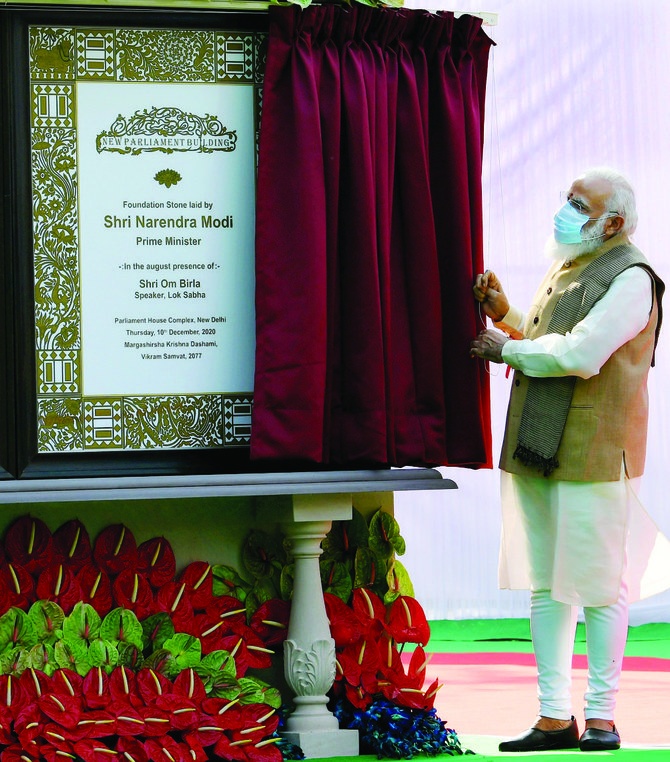

NEW DELHI: Indian Prime Minister Narendra Modi laid the foundation stone for a new parliament building on Thursday that critics have branded a “vanity project” that will have a disastrous impact on the capital’s environment.
The $121 million construction project is part of the Indian government’s $3 billion program to redevelop New Delhi’s historic Central Vista area, which stretches from the presidential palace to the India Gate war memorial and was designed for colonial authorities by British architects.
In a speech during the cornerstone ceremony, Modi said: “Today is a milestone in the history of India’s democratic history. It is an important stage in the history of India’s democratic history. Today is a historic day. Today is a day that in a way is like the foundation stone of our India.”
The foundation stone was laid despite a Supreme Court ruling on Monday that told the government to hold construction amid mounting petitions from civil society groups pleading with the apex court to prevent the “destruction” of Delhi’s landscape.
While the court’s decision put building work on hold, it allowed the cornerstone ceremony to take place.
“The court has in a baffling way for people like me given a contrary judgement. They said that everything is on hold, but the foundation laying ceremony can take place,” historian Narayani Gupta told Arab News.
Gupta was one of 90 academics, architects, and environmentalists who in June appealed with the Delhi Urban Arts Commission (DUAC) to reject the new parliament building proposal.
She said: “When a new city center is coming it should not have been done in such a dull way when you don’t give details of the project and do everything in a hush hush way. We are not getting any pleasure from this exercise.
“The thought of the monstrous building is lacking in any kind of aesthetic quality,” she added
Modi justified the move by claiming that the present parliament building was no longer fit for its purpose.
“It has undergone several renovations and security and technological upgradations, but it has reached its capacity. It is now seeking rest,” the premier said in his address.
Delhi-based architect, Anuj Srivastava, one of the petitioners urging the court to stop the project, told Arab News: “First is the necessity of the project. It is not justified, no deliberation has taken place, whether inside or outside parliament.
“The existing parliament can be used to accommodate the changing requirements using the principles of adaptive reuse.”
According to the Indian government, the new building, which is expected to be completed by 2022, will seat 888 members in the lower house and accommodate 1,224 lawmakers during joint parliamentary sessions. The upper house will have a seating capacity of 384. The current building can host 545 members of the lower house and 245 of the upper house.
The main opposition Congress party slammed the project as a fulfilment of Modi’s “whims.”
In a tweet on Thursday, Congress spokesman Randeep Surjewala said: “Mr. Modi in democracy, power is not a means to fulfill whims, it is a medium for public service and public welfare.
“Parliament is not mortar and stones, it envisions democracy, it imbibes constitution, it is economic-political-social equality, it is compassion and camaraderie, it is aspirations of 130 Cr Indians. What would a building built upon trampling of these values represent?” he added.
V. Selvarajan, the founder of Green Circle, a non-governmental organization working to tackle air pollution, said the scheme would have a “devastating impact on the environment of the capital with so many trees being uprooted and complete secrecy in which the whole plan is shrouded.”
He added: “There is no transparency about the project. Trees are being transplanted in far-off locations.”
Going forward with the redevelopment project when India’s economy is reeling from the coronavirus disease (COVID-19) pandemic has also been described as wasteful.
Prof. Farhat Hasan, of Delhi University, said: “It smacks of an insensitive and indifferent government. The government should have been focusing on providing welfare schemes for the poor and the indigent, creating employment opportunities for them, and improving infrastructural facilities. Instead, it has decided to waste the taxpayers’ money in an ill-thought and unnecessary project.”
Sanjay Kapoor, Delhi-based political analyst and editor of fortnightly magazine Hard News, said the project formed part of Modi’s obsession “to leave a legacy.”
He told Arab News: “That means that in 2022, when India turns 75, he can safely create an impression that he’s the tallest leader India has seen, far bigger than Mahatma Gandhi and (former Indian PM) Jawaharlal Nehru.”
Kapoor described the new parliament building as a “vanity project,” adding that it would likely “fall short from the grand designs that we have seen all over the world. The architect is unknown and if Modi indeed wanted some new building to come up then he should have gone for the world’s best.”


