

Leaders react to Morocco-Israel agreement to establish ties

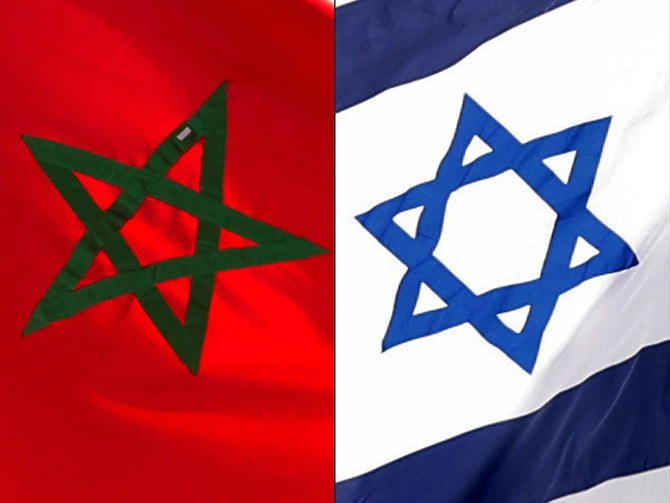
This combination of file pictures created on December 10, 2020 shows a Moroccan flag off the coasts of the city of Cayenne on March 21, 2012 and an Israeli national flag on September 23, 2020. (AFP)
Short Url
Updated 11 December 2020
Follow

Leaders react to Morocco-Israel agreement to establish ties

  • Move makes Morocco fourth country in Arab region to set up ties with Israel

CAIRO: Regional leaders welcomed Morocco’s decision to establish diplomatic ties and communications with Israel.

The move makes Morocco the fourth country in the Arab region to establish ties with Israel in recent months in a deal brokered by the US.  

Oman welcomed Morocco’s announcement in a statement released by the foreign ministry.

“(Oman) welcomes what Morocco’s King Mohammed VI announced in his phone calls with U.S President Trump and Palestinian President Mahmoud Abbas, and hopes this will further endeavours to achieve a comprehensive, just and lasting peace in the Middle East,” the statement read.

The UAE, which announced in August it would normalize relations with Israel welcomed Morocco’s decision.

“This step, a sovereign move, contributes to strengthening our common quest for stability, prosperity, and just and lasting peace in the region,” Abu Dhabi Crown Prince Sheikh Mohammed bin Zayed wrote on Twitter.

Egypt's President Abdel Fattah El-Sisi hailed the agreement saying its an important step to achieve stability.

“I have followed with great attention the significant advance between Morocco and Israel in terms of the normalization of their relations under the auspices of the US,” El-Sisi said. “I believe this is an important step to achieve more stability and cooperation in our region.”

Egypt, along with Jordan, were the only Arab countries to have relations with Israel until the UAE announcement earlier this year. The Emirates was followed by Bahrain and Sudan, and now Morocco.

Israeli Prime Minister Benjamin Netanyahu said the deal between Israel and Morocco was a “historic peace between us.”

Netanyahu said it would lead to direct flights between Morocco and Israel and that the fourth US-brokered deal between Israel and an Arab country in recent months would be a “very warm peace.”

In a televised address, he said: “I've always believed that this historic peace would come. I've always worked for it.”

Thanking Trump, he added: “I want to thank, too, the king of Morocco, King Mohammed the Sixth, for taking this historic decision to bring a historic peace between us.”


International court sentences Sudanese militia leader to 20 years in prison for Darfur atrocities

Updated 8 sec ago
Follow

International court sentences Sudanese militia leader to 20 years in prison for Darfur atrocities

  • Abd-Al-Rahman stood and listened, but showed no reaction as Judge Korner passed the sentence
  • It added that it also took into account the large number of victims, that included at least 213 people who were murdered

THE HAGUE: Judges at the International Criminal Court sentenced a leader of the feared Sudanese Janjaweed militia to 20 years imprisonment Tuesday for war crimes and crimes against humanity committed in the catastrophic conflict in Darfur more than two decades ago.
At a hearing last month, prosecutors sought a life sentence for Ali Muhammad Ali Abd–Al-Rahman who was was convicted in October of 27 counts of war crimes and crimes against humanity that included ordering mass executions and bludgeoning two prisoners to death with an ax in 2003-2004.
“He committed these crimes knowingly, willfully, and with, the evidence shows, enthusiasm and vigor,” prosecutor Julian Nicholls told judges at the sentencing hearing in November.
Abd-Al-Rahman, 76, stood and listened, but showed no reaction as Presiding Judge Joanna Korner passed the sentence. He was handed sentences ranging from eight years to 20 years for each of the counts for which he was convicted before the court imposed the overarching joint sentence of 20 years.
She said that Abd-Al-Rahman “not only gave the orders that led directly to the crimes” in attacks that largely targeted members of the Fur tribe perceived as supporting a rebellion against Sudanese authorities, he “also personally perpetrated some of them using an ax he carried in order to beat prisoners.”
The court's prosecution office said that its staff would study the sentencing decision to decide whether to “take further action.” The office could appeal the sentence and renew its call for a life term.
The office said in a written statement that it sought a life sentence “owing to the extreme gravity of the crimes Mr. Abd-Al-Rahman was convicted of — murders, rapes, torture, persecution and other crimes carried out with a high level of cruelty and violence as a direct perpetrator, as a co-perpetrator and for ordering others to commit such crimes.”
It added that it also took into account the large number of victims, that included at least 213 people who were murdered, including children, and 16 women and girls who were victims of rape.
Abd–Al-Rahman, who is also known as Ali Kushayb, is the first person convicted by the ICC for atrocities in Sudan’s Darfur region, where trial judges ruled that the Janjaweed crimes were part of a government plan to stamp out a rebellion there.
The ICC has a maximum sentence of 30 years imprisonment, but judges have the discretion to raise that to life in extremely grave cases. Abd-Al-Rahman’s time in detention before and during his trial will be deducted from the sentence.
Abd-Al-Rahman’s crimes were committed more than two decades ago, but violence continues to plague Darfur as Sudan is torn apart by civil war. ICC prosecutors are seeking to gather and preserve evidence from a deadly rampage last month in a besieged city in the region.
The latest alleged atrocities in famine-hit el-Fasher “are part of a broader pattern of violence that has afflicted the entire Darfur region” and “may constitute war crimes and crimes against humanity,” the ICC statement said, noting that evidence could be used in future prosecutions.
Korner said that ICC sentences are imposed as a deterrent to prevent other crimes in the future.
“Deterrence is particularly apposite in this case given the current state of affairs in Sudan,” she said.