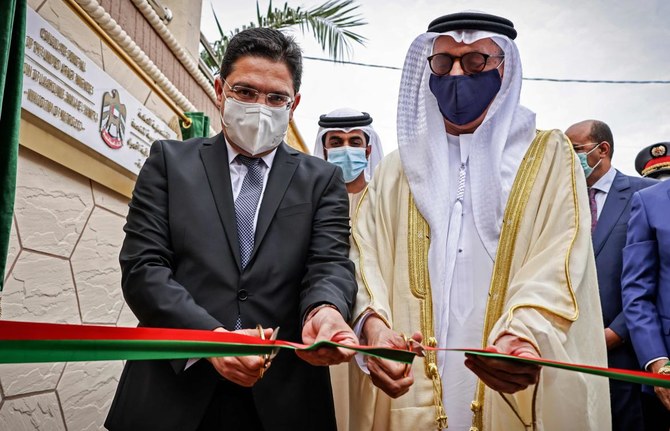
LAAYOUNE: The United Arab Emirates on Wednesday became the first Arab country to open a diplomatic mission in the Moroccan-controlled area of the disputed Western Sahara.
The inauguration of the consulate general in the northern coastal city of Laayoune brings to 16 the number of missions opened in the region since late last year.
The UAE move “reinforces a dynamic of recognition of the ‘Moroccan identity’” of Western Sahara, with “increasing support from the international community,” Moroccan Foreign Minister Nasser Bourita told AFP on Wednesday after the opening.
Western Sahara, a vast swathe of desert on Africa’s Atlantic coast, is a disputed former Spanish colony.
Rabat controls 80 percent of the territory, including its phosphate deposits and its fishing waters.
The Algerian-backed Polisario Front, which fought a war for independence from 1975 to 1991, demands a referendum on self-determination.
Morocco, which maintains that Western Sahara is an integral part of the kingdom, has offered autonomy but insists it will retain sovereignty.
Since late 2019, 15 African countries have opened diplomatic missions in the former colonial capital Laayoune and in the fishing port of Dakhla, further south.
“It’s not an insignificant act, it’s an act that has political, legal and diplomatic meaning,” Bourita said of the UAE move.
Negotiations involving Morocco, the Polisario, Algeria and Mauritania have been suspended for several months.

UAE opens consulate in Morocco-controlled Western Sahara
Short Url
https://arab.news/j86xf
UAE opens consulate in Morocco-controlled Western Sahara
- Western Sahara, a vast swathe of desert on Africa’s Atlantic coast, is a disputed former Spanish colony
- Negotiations involving Morocco, the Polisario, Algeria and Mauritania have been suspended for several months
Iran says students have right to protest but must know ‘red lines’
Tehran: University students have the right to protest but everyone must “understand the red lines,” the Iranian government’s spokeswoman said Tuesday, in the first official reaction to renewed rallies on campuses since the weekend.
“Sacred things and the flag are two examples of these red lines that we must protect and not cross or deviate from, even at the height of anger,” Fatemeh MoHajjerani said.
She said Iran’s students “have wounds in their hearts and have seen scenes that may upset and anger them; this anger is understandable.”
University students in Iran started a new semester Saturday with pro- and anti-government rallies, according to local media, reviving slogans from nationwide demonstrations that peaked in January and led to thousands of deaths.
Protests first began in December sparked by economic woes in the sanctions-hit country, but grew into nationwide demonstrations on January 8 and 9.
The US-based Human Rights Activists News Agency (HRANA) has recorded more than 7,000 deaths, while warning the full toll is likely far higher.
Iranian officials acknowledge more than 3,000 deaths, but say the violence was caused by “terrorist acts” fueled by the United States and Israel.
MoHajjerani on Tuesday said a fact-finding mission is investigating “the causes and factors” of the protests and will provide reports.
“Sacred things and the flag are two examples of these red lines that we must protect and not cross or deviate from, even at the height of anger,” Fatemeh MoHajjerani said.
She said Iran’s students “have wounds in their hearts and have seen scenes that may upset and anger them; this anger is understandable.”
University students in Iran started a new semester Saturday with pro- and anti-government rallies, according to local media, reviving slogans from nationwide demonstrations that peaked in January and led to thousands of deaths.
Protests first began in December sparked by economic woes in the sanctions-hit country, but grew into nationwide demonstrations on January 8 and 9.
The US-based Human Rights Activists News Agency (HRANA) has recorded more than 7,000 deaths, while warning the full toll is likely far higher.
Iranian officials acknowledge more than 3,000 deaths, but say the violence was caused by “terrorist acts” fueled by the United States and Israel.
MoHajjerani on Tuesday said a fact-finding mission is investigating “the causes and factors” of the protests and will provide reports.
© 2026 SAUDI RESEARCH & PUBLISHING COMPANY, All Rights Reserved And subject to Terms of Use Agreement.


