

KSRelief launches $1.26 million winter relief project for northwestern Pakistan

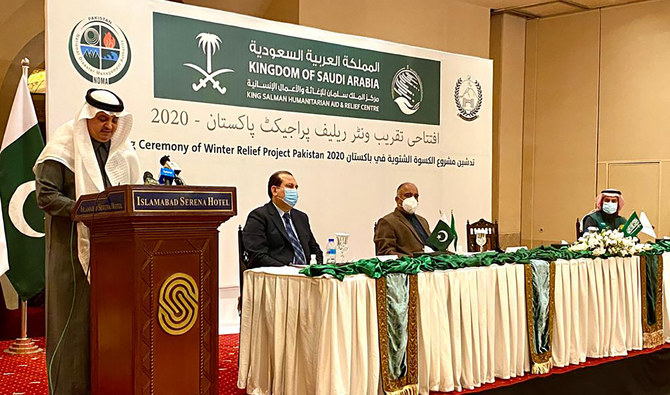
Saudi Ambassador Nawaf bin Said Al-Malki is accompanied by Khyber Pakhtunkhwa Governor Shah Farman and officials of King Salman Humanitarian Aid and Relief Center (KSRelief) during the launching ceremony of a $1.26 million winter relief program for Pakistan in Islamabad on Dec. 09, 2020. (AN photo)
Short Url
Updated 09 December 2020
Follow

KSRelief launches $1.26 million winter relief project for northwestern Pakistan

  • Aid will reach Pakistan's colder regions such Chitral, Swat and Shangla in Khyber Pakhtunkhwa province where winter is usually severe
  • High-level energy and foreign ministry Saudi delegation is going to visit Islamabad soon, Saudi ambassador to Pakistan said

ISLAMABAD: King Salman Humanitarian Aid and Relief Center (KSRelief) launched on Wednesday a $1.26 million winter relief project to help over 135,000 people northwestern Pakistan.

KSRelief provides humanitarian and development support to millions of beneficiaries in more than 49 countries. Pakistan is the fifth-largest recipient of assistance from the Saudi-based international agency and has received more than $120 million in aid since 2005.

“We are continuing our relief mission in Pakistan. This project comes under the umbrella of humanitarian projects by the Kingdom of Saudi Arabia, represented by KSRelief, to assist needy families living in the coldest areas in north of Pakistan,” Dr. Khalid Al-Othmani, director of KSRelief Pakistan, told Arab News at the project’s inauguration ceremony in Islamabad.

He said each relief package will comprise quilts, shawls, socks and warmers for families in Pakistan's colder regions such Chitral, Swat and Shangla in Khyber Pakhtunkhwa province where winter is usually severe.

KSRelief will collaborate with the National Disaster Management Authority and provincial government to distribute the aid.

“Under this winter relief project, 22,550 winter kits will be distributed among poor and deserving people living in Khyber Pakhtunkhwa,” Saudi Ambassador Nawaf bin Said Al-Malki told Arab News during the inauguration ceremony.

He added that since historic Saudi-Pakistani relations have become "deeper with the passage of time," a high-level Saudi delegation is going to visit Islamabad soon.

“High-level delegations are coming to Pakistan from the kingdom very soon. The delegation will consist of high officials of energy ministry, foreign ministry and others. A Pakistani delegation will also visit the kingdom after that. The bilateral relations will further strengthen through these visits," the ambassador said.

Pakistani officials welcomed the upcoming relief program as showing "special attachment" between the two countries.  

“These projects reflect special attachment between the two countries. This shows the care for Pakistanis from our Saudi brothers,” Khyber Pakhtunkhwa Governor Shah Farman told Arab News.

"The people of Saudi Arabia and Pakistan are very much connected both emotionally and religiously. They have special feeling for each other, particularly Pakistanis have very special feeling for that holy land."


Pakistan plans digital wheat tracking system, steps up Ramadan price monitoring

Updated 5 sec ago
Follow

Pakistan plans digital wheat tracking system, steps up Ramadan price monitoring

  • Government says adequate stocks available ahead of the upcoming harvesting season
  • It instructs provinces to prevent flour price spikes during the holy month of Ramadan

ISLAMABAD: Pakistan plans to introduce digital traceability and tighter supply chain monitoring in its wheat procurement system under a new long-term policy, the food security ministry said on Saturday, as authorities move to curb price volatility during Ramadan.

The announcement followed a meeting of the National Wheat Oversight Committee chaired by Federal Minister for National Food Security and Research Rana Tanveer Hussain to review procurement arrangements, stock availability and price stability measures ahead of the upcoming harvesting season.

The review comes after riverine floods during last year’s monsoon season damaged farmlands in parts of eastern Punjab, the country’s main wheat-producing region, raising concerns about crop output. Officials at the meeting, however, expressed satisfaction over existing wheat stocks, saying sufficient supplies were available across provinces to meet national consumption needs until the arrival of the new crop.

“The Federal Minister emphasized that the current procurement framework will remain applicable for one year,” the statement said. “He stated that the Federal Government is working on a comprehensive long-term wheat policy for the period 2026–2030, aimed at strengthening national food security through modern reforms.”

“He highlighted that the upcoming policy will focus on digital traceability mechanisms, improved supply chain monitoring, enhanced transparency, and sustained price stability, enabling better coordination between the federal and provincial governments,” the statement added.

The committee was informed that the illustrative wheat procurement price has been fixed at 3,500 rupees ($12.55) per 40 kilograms, and provinces have been asked to ensure smooth implementation of procurement operations.

Special emphasis was also placed on consumer protection during Ramadan.

“The Federal Minister directed all provinces to ensure strict market monitoring and take effective administrative measures to prevent any unnecessary increase in flour prices,” the statement continued.
