WASHINGTON: A key test of SpaceX’s Mars rocket Starship was automatically aborted on Tuesday just one second before liftoff, postponing the first high-altitude test of a rocket system that billionaire Elon Musk hopes will carry humans on the moon and eventually Mars.
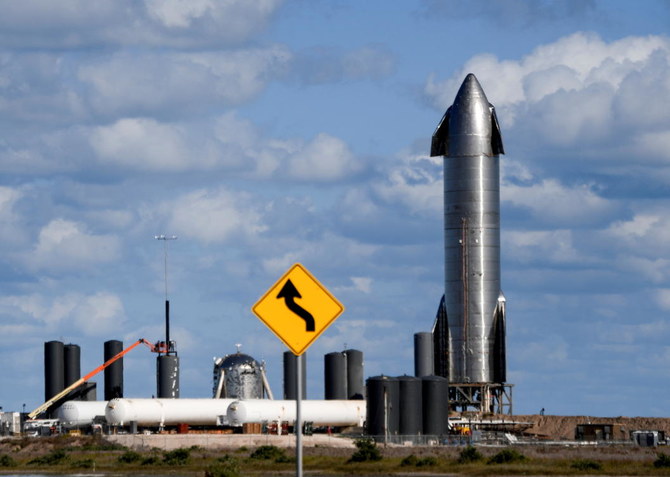
The 16-storey-tall Starship prototype was set for liftoff at 4:35p.m. local time from SpaceX’s Boca Chica, Texas, launch facilities for its first suborbital flight using three of its new Raptor rocket engines. The plan was to reach an altitude of more than 40,000 feet before attempting to land on a concrete slab near the launch site.
But an automatic “Raptor abort” was called just as the engines were set to ignite, as heard on a SpaceX live video feed.
Musk, SpaceX’s Chief Executive, had sought to tamp down expectations for the flight, predicting a 30 percent chance of meeting all test objectives if it cleared the pad.
“With a test such as this, success is not measured by completion of specific objectives but rather how much we can learn,” SpaceX said on its website Monday.
SpaceX, which said its test schedule is likely to change, has additional launch opportunities all day Wednesday and Thursday, according to US Federal Aviation Administration notices.
Starship, a rocket system standing 120.09-meter tall when mated with its super-heavy first-stage booster, is designed to carry satellites, humans and 100 tons of cargo to the moon and Mars.
It is the space company’s planned next-generation fully reusable launch vehicle, the center of Musk’s ambitions to make human space travel affordable.
SpaceX has carried out two hop tests this year using rudimentary, single-engine rocket prototypes at its Boca Chica launch site. Those prototypes launched about 500 feet into the air and landed on a concrete slab roughly a minute later.
A successful flight would be a major advance for Starship, putting to the test the rocket’s aerodynamic design at altitudes higher than commercial jetliners typically fly.
Such heights will test how Starship returns to its landing pad, free-falling in a horizontal position after reaching its target altitude and carrying out a “landing flip maneuver” mid-air, before touching down.
SpaceX had originally planned to fly Starship at an altitude of 50,000 feet, but changed the target to 41,000 feet in its launch application with the FAA last week, according to a person familiar with the filing.
SpaceX, which said its launch schedule is likely to change, has launch opportunities all day Wednesday and Thursday should Tuesday’s attempt be delayed, according to filings with the FAA.


Musk’s SpaceX scrubs key high-altitude Starship test
https://arab.news/n4yqe
Musk’s SpaceX scrubs key high-altitude Starship test

- The Starship prototype was set for liftoff at 4:35p.m. local time from SpaceX’s Boca Chica, Texas launch facilities
- SpaceX had originally planned to fly Starship at an altitude of 50,000 feet, but changed the target to 41,000 feet


Apple to update EU browser options, make more apps deletable
- iPhone maker came under pressure from regulators to make changes after the EU’s sweeping Digital Markets Act took effect on March 7
- Apple users will be able to select a default browser directly from the choice screen after going through a mandatory list of options
STOCKHOLM: Apple will change how users choose browser options in the European Union, add a dedicated section for changing default apps, and make more apps deletable, the company said on Thursday.
The iPhone maker came under pressure from regulators to make changes after the EU’s sweeping Digital Markets Act took effect on March 7, forcing big tech companies to offer mobile users the ability to select from a list of available web browsers on a “choice screen.”
The new rules require mobile software makers to show the choice screen where users can select a browser, search engine and virtual assistant as they set up their phones, which earlier came with preferred options from Apple and Google.
In an update later this year, Apple users will be able to select a default browser directly from the choice screen after going through a mandatory list of options.
A randomly ordered list of 12 browsers per EU country will be shown to the user with short descriptions, and the chosen one will be automatically downloaded, Apple said. The choice screen will also be available on iPads through an update later this year.
Apple released a previous update in response to the new rules in March, but browser companies criticized the design of its choice screen, and the Commission opened an investigation on March 25 saying it suspected that the measures fell short of effective compliance.
The company said it has been in dialogue with the European Commission and believes the new changes will address regulators’ concerns.
It also plans to introduce a dedicated area for default apps where a user will be able to set defaults for messaging, phone calls, spam filters, password managers and keyboards.
Users will also be able to delete certain Apple-made apps such as App Store, Messages, Camera, Photos and Safari. Only Settings and Phone apps would not be deletable.


