New Zealand’s Ardern apologizes as report into mosque attack faults focus on Islamist terror risks

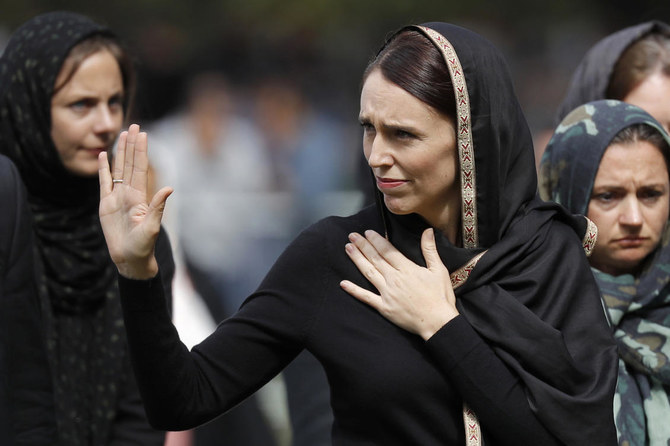
In this March 22, 2019, file photo, New Zealand Prime Minister Jacinda Ardern, center, waves as she leaves Friday prayers at Hagley Park in Christchurch, New Zealand. (AP)
Short Url
Updated 08 December 2020
Follow

New Zealand’s Ardern apologizes as report into mosque attack faults focus on Islamist terror risks

  • Report says no signs missed that would have prevented massacre
  • NZ govt accepts 44 recommendations, including monitoring hate crimes

WELLINGTON: New Zealand security agencies were almost exclusively focused on the perceived threat of Islamist terrorism before a white supremacist gunman killed 51 Muslim worshippers last year, a report into the country’s worst massacre found.
The Royal Commission of Inquiry also criticized police for failing to enforce proper checks when granting a firearms license to Australian gunman Brenton Tarrant, who released a racist manifesto shortly before the attack and streamed the shootings live on Facebook.
But despite the shortcomings, the report found no failings within government agencies that would have prevented the attack at two mosques in Christchurch on March 15, 2019.
“The commission made no findings that these issues would have stopped the attack. But these were both failings and for that I apologize,” Prime Minister Jacinda Ardern said after the report was released.
Tarrant was sentenced to life in prison without parole in August for the attack, which left dozens injured.
Ardern received global praise for her compassionate response to the attack and for swiftly banning the sale of the high-capacity semi-automatic weapons Tarrant used. She also launched a global movement against online extremism.
However, authorities were criticized for ignoring repeated warnings from the Muslim community that hate crimes against them were escalating.
The comprehensive 800-page independent report said there was an “inappropriate concentration of resources” on the threat of Islamist extremist terrorism.
Submissions to the commission by various Muslim organizations described how they felt they were targeted by security agencies while threats against them were not taken seriously.
“We find it concerning that the Commissioners found systemic failures and an inappropriate concentration of resources toward Islamic terrorism, and yet state that these would not have made a difference to the terrorist being detected prior to the event,” the Islamic Women’s Council said in a statement.
The royal commission report said there was no plausible way Tarrant’s plans could have been detected “except by chance.”
Other than an email Tarrant sent eight minutes before he opened fire, there was no other information available that could have alerted authorities to the attack, it said.
Gamal Fouda, the Imam of Al Noor mosque targeted by the shooter, said the report showed “institutional prejudice and unconscious bias” exists in government agencies.
The government accepted all 44 recommendations in the report, including establishing a new national intelligence and security agency, and appointing a minister to coordinate the government’s response.
The report found that despite having no history in New Zealand, Tarrant’s application for a firearms license was approved by the police.
The government said it would tighten firearm licensing laws, strengthen counter-terrorism laws, and make changes so police can better record and respond to hate crimes.
It recommended mandatory reporting of firearm injuries by health professionals, after it was revealed Tarrant was treated for injuries to his right eye and thigh after accidentally shooting himself while cleaning his gun a few months before the attack.
Health authorities also found that Tarrant took unprescribed steroids but they did not report the findings to the police either.
The report described Tarrant as “socially isolated” with few childhood friends but an avid Internet user and online gamer.
He frequented extreme right-wing discussion boards such as those on 4chan and 8chan but in an interview with the commission from his prison cell in Auckland Tarrant said Google-owned video sharing platform YouTube, was for him a far more significant source of information and inspiration.
Ardern said she planned to raise this “directly to the leadership of YouTube.”
Before arriving in New Zealand in August 2017, Tarrant traveled extensively, visiting dozens of countries between 2014 and 2017, mostly alone.
“The individual could present well and conducted himself in a way that did not attract suspicion. He was not identified as someone who posed a threat,” the report said.
Tarrant trained for the attack in New Zealand by developing expertise with guns at a rifle club, working out at a gym and taking steroids to bulk up, the report said.


Germany’s leader calls on US and Europe to ‘repair trans-Atlantic trust’

Updated 4 sec ago
Follow

Germany’s leader calls on US and Europe to ‘repair trans-Atlantic trust’

  • German Chancellor said Europe and US should conclude that 'we are stronger together'
  • Merz acknowledges rift in trans-Atlantic relations over the past year as he opens Munich Security Conference
MUNICH: German Chancellor Friedrich Merz called on Friday for the United States and Europe to “repair and revive trans-Atlantic trust together,” arguing that even the US isn’t powerful enough to go it alone in an increasingly tough world.
Merz called for a “new trans-Atlantic partnership,” acknowledging that “a divide, a deep rift” has opened up across the Atlantic as he opened the Munich Security Conference, an annual gathering of top global security figures including many European leaders and US Secretary of State Marco Rubio.
At last year’s conference, held a few weeks into US President Donald Trump’s second term, Vice President JD Vance stunned European leaders by lecturing them about the state of democracy and freedom of speech on the continent — a moment that set the tone for the last year.
A series of statements and moves from the Trump administration targeting allies followed, including Trump’s threat last month to impose new tariffs on several European countries in a bid to secure US control of Greenland, a semiautonomous territory of NATO ally Denmark. The president later dropped that threat.

‘Stronger together’

“The culture war of the MAGA movement in the US is not ours,” Merz said. “The freedom of the word ends here when this word is turned against human dignity and the constitution. And we don’t believe in tariffs and protectionism, but in free trade.”
He added that Europe would stand by climate agreements and the World Health Organization “because we are convinced that we will only solve global tasks together.”
But Merz said Europe and the US should conclude that “we are stronger together” in today’s world. He argued that the post-World War II world order “as imperfect as it was at its best times, no longer exists” today.
“In the era of great-power rivalry, even the United States will not be powerful enough to go it alone,” he said. “Dear friends, being a part of NATO is not only Europe’s competitive advantage. It’s also the United States’ competitive advantage, so let’s repair and revive trans-Atlantic trust together.”
The Europeans, Merz said, are doing their part.

A ‘shift in mindset’ in Europe

Since last year’s Munich conference, NATO allies have agreed under pressure from Trump to a large increase in their defense spending target.
NATO Secretary-General Mark Rutte said there has been a “shift in mindset,” with “Europe really stepping up, Europe taking more of a leadership role within NATO, Europe also taking more care of its own defense.”
With Rubio heading the US delegation this year, European leaders can hope for a less contentious approach more focused on traditional global security concerns.
Speaking as he introduced Merz, conference chairman Wolfgang Ischinger asked: “does the Trump administration truly believe that it needs allies and partners and if so ... is Washington actually prepared to treat allies as partners?”
Before departing for Germany on Thursday, Rubio had some reassuring words as he described Europe as important for Americans.
“We’re very tightly linked together with Europe,” he told reporters. “Most people in this country can trace both, either their cultural or their personal heritage, back to Europe. So, we just have to talk about that.”
But Rubio made clear it wouldn’t be business as it used to be, saying: “We live in a new era in geopolitics, and it’s going to require all of us to reexamine what that looks like.”
Mike Waltz, the US ambassador to the United Nations, told the conference that the US had been sustaining the financial burden of multilateralism for too long and Europeans need to do more.
“There is a cost to the status quo and the status quo was not sustainable any more,” Waltz said.
Merz said that Europe’s “excessive dependency” on the US was its own fault, but it is leaving that behind. “We won’t do this by writing off NATO — we will do it by building a strong, self-supporting European pillar in the alliance, in our own interest,” he said.
He acknowledged that Europe and the US will likely have to bridge more disagreements in the future than in the past, but “if we do this with new strength, respect and self-respect, that is to the advantage of both sides.”
Rubio arrived in Munich on Friday. He met Merz and Chinese Foreign Minister Wang Yi separately on the sidelines of the conference, and also had a meeting scheduled with Danish Prime Minister Mette Frederiksen and Greenlandic Prime Minister Jens-Frederik Nielsen. He is due to address the conference on Saturday morning.