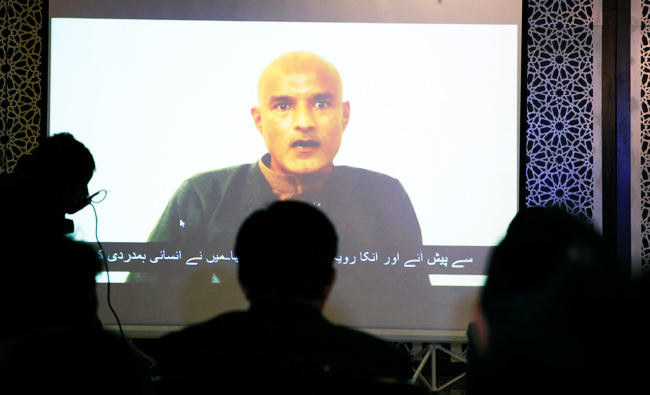
ISLAMABAD: Pakistan criticized the Indian Ministry of External Affairs (MEA) on Friday for its “incorrect and misleading assertions” about the legal proceedings in the case of an Indian naval official, Commander Kulbhushan Jadhav, who was captured in Balochistan in March 2016 on charges of spying and terrorism.
“It is evident that by casting aspersions on the Indian High Commission’s own legal Counsel, the Indian government is looking for an escape from the legal proceedings in Commander Jadhav case,” said the foreign office in its statement.
Jadhav was sentenced to death by a military court in Pakistan in April 2017, though the International Court of Justice issued a stay order within weeks and asked Pakistan to review his conviction and provide India consular access to him.
“The Government of India is reminded that in pursuance of the judgment of International Court of Justice (ICJ), Pakistan had invited the Indian High Commission to meet with Commander Jadhav and appoint a lawyer on his behalf so that proceedings to review and reconsider Commander Jadhav’s conviction could commence,” the foreign office added.
“However, during the course of diplomatic exchanges, the Indian High Commission refused to instruct a lawyer itself, as in their view this would amount to a waiver of India’s sovereign immunity,” it continued. “Resultantly, the government of Pakistan was constrained to initiate proceedings for appointment of a state counsel for Commander Jadhav.”
The foreign office also denied that Pakistan was trying to link Jadhav’s case with any other legal proceeding since the Indian authorities had accused Islamabad of linking it to another case involving an Indian national, Muhammad Ismail, who is currently in Pakistan’s custody.
The Indian High Commission has engaged a local lawyer, Shahnawaz Noon, to plead Ismail’s case, though it refused to do the same in the Jadhav case.
“Contrary to the false statement by the MEA, no attempt was made to link the cases of Commander Jadhav with another Indian prisoner Ismail. The two cases are and remain entirely distinct. Reference to the case of Mr. Ismail was only for purpose of showing the discrepancy and inconsistency in the Indian position,” the foreign office elaborated.
It also reminded the Indian authorities that Pakistan had provided consular access to the Indian High Commission twice in line with the ICJ judgment and taken all necessary steps for effective review and reconsideration in the case. The foreign office also noted that the offer of a third consular access was still on the table.
“The Indian side is once again urged to desist from the use of its usual diversionary and dilatory tactics and instead take practical steps so that legal proceedings could be duly concluded and full effect could be given to the judgment of ICJ,” said the official statement.
At a media briefing last week, Indian Ministry of External Affairs Spokesperson Anurag Srivastava claimed that its lawyer in Pakistan had overstepped his brief by suggesting that India’s Deputy High Commissioner Gaurav Ahluwalia wanted to explain New Delhi’s position in Jadhav’s case.
“Our Mission in Islamabad has written to Mr. Noon reiterating that he has no authority to represent Mr. Jadhav and has no basis to suggest that the Indian Cd’A would appear in the court,” Srivastava was reported as saying by Indian media.
He also maintained that Noon “appears to have acted under pressure from the Pakistani establishment to make such statements.”


![]()

Pakistan says New Delhi trying to 'escape' legal proceedings in Indian spy case
Short Url
https://arab.news/6ck7u
Pakistan says New Delhi trying to 'escape' legal proceedings in Indian spy case
- India accused Pakistan of linking Jadhav’s case to legal proceedings involving another one of its nationals
- Pakistan’s foreign office says the comparison was only made to show the ‘discrepancy and inconsistency in the Indian position’
Latest updates






© 2026 SAUDI RESEARCH & PUBLISHING COMPANY, All Rights Reserved And subject to Terms of Use Agreement.