

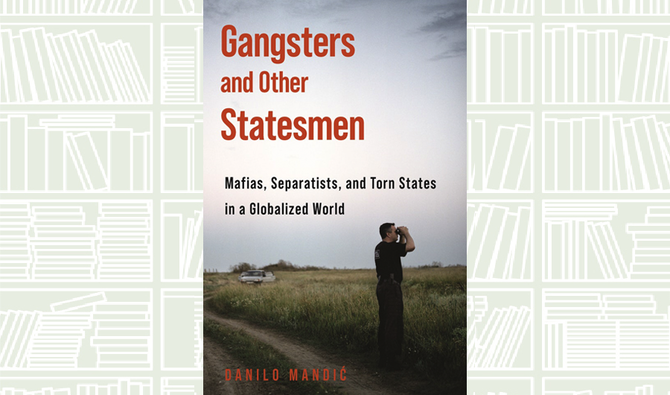
What We Are Reading Today: Gangsters and Other Statesmen by Danilo Mandic

Short Url
Updated 03 December 2020
Follow

What We Are Reading Today: Gangsters and Other Statesmen by Danilo Mandic

Separatism has been on the rise across the world since the end of the Cold War, dividing countries through political strife, ethnic conflict, and civil war, and redrawing the political map. Gangsters and Other Statesmen examines the role transnational mafias play in the success and failure of separatist movements, challenging conventional wisdom about the interrelation of organized crime with peacebuilding, nationalism, and state making.

Danilo Mandic conducted fieldwork in the disputed territories of Kosovo and South Ossetia, talking to mobsters, separatists, and policymakers in war zones and along major smuggling routes. In this timely and provocative book, he demonstrates how globalized mafias shape the politics of borders in torn states, shedding critical light on an autonomous nonstate actor that has been largely sidelined by considerations of geopolitics, state-centered agency, and ethnonationalism. Blending extensive archival sleuthing and original ethnographic data with insights from sociology and other disciplines, Mandic argues that organized crime can be a fateful determinant of state capacity, separatist success, and ethnic conflict.

Putting mafias at the center of global processes of separatism and territorial consolidation, Gangsters and Other Statesmen raises vital questions and urges reconsideration of a host of separatist cases in West Africa, the Middle East, and East Europe.


What We Are Reading Today: ‘Will the Future Like You?’

Photo/Supplied
Updated 56 sec ago
Follow

What We Are Reading Today: ‘Will the Future Like You?’

  • The book offers many insights from psychologists and leading experts on self-perception and similar fields to provide context and break up the anecdotal examples weaved within

Author: Patricia Martin

In “Will the Future Like You? Reflections on the Age of Hyper-Reinvention” by Patricia Martin, out in March from Karnac Books, an expert in identity and cultural change examines how constant connectivity and rapid technological shape-shifting are recalibrating our sense of self.

Drawing on a decade-long study, she identifies destabilizing forces— such as “persona fog,” chronic self-doubt and repeated life crossroads— that leave people feeling adrift.

Merging memoir, psychology and cultural analysis, the book takes us on an adventure where we explore how to thrive in the digital jungle that is the World Wide Web.

For a quarter of a century, Martin has worked with “influential brands” and nonprofits as a consultant. She hosts the popular podcast, “Jung in the World.”

In this book, Martin examines how constant connectivity and rapid technological change are reshaping our sense of identity.

In the past, technologies were adopted incrementally, but the dizzying speed at which social media skyrocketed in our feeds — and constant notifications from Snapchat, Facebook, Instagram and TikTok — is its own journey. It can almost give you motion — and emotional — sickness.

In 160 pages, she packs a lot in, but it is not dull or too heavy.

“Humans don’t surrender the need for meaning. But they might accept a synthetic substitution for it,” it reads in one part.

Clicks, likes and comments are insatiable currencies — the more you have them, the more you want them.

The book offers many insights from psychologists and leading experts on self-perception and similar fields to provide context and break up the anecdotal examples weaved within.

Influencer culture, which is valued at $250 billion according to The Washington Post, is a lucrative path, some making more than $50,000 annually just for posting images of their lives.

Martin also brings up the cautionary tale of a famous blogger dubbed by The New York Times as the original influencer, Heather Armstrong, who ran dooce.com, one of the most widely read early personal blogs beginning in the early 2000s.

Her confessional-style blog offered pieces of her trauma and drama weaved in with her joy. In 2023, she died by suicide at 47; her obituary was a reminder that the information made available to the public might not always find a peaceful home within us.

Now, the Internet users of today can be slightly smarter, and the manufactured authenticity is easier to spot. The staged, fake things make us watch, then turn away. The constant need to feed the feed is like a treadmill.

Who came first; the content creators or the content scrollers?

Of course, the whole artificial intelligence and deep fakes are highlighted, along with the numerous countable and uncountable effects they have had on our brains and hearts.

We are, in a way, crafting our own histories both individually and collectively in the digital sphere.

Which brings us back to the title of the book: “Will the Future Like You?” Perhaps the better question might be: Will our future like us?