

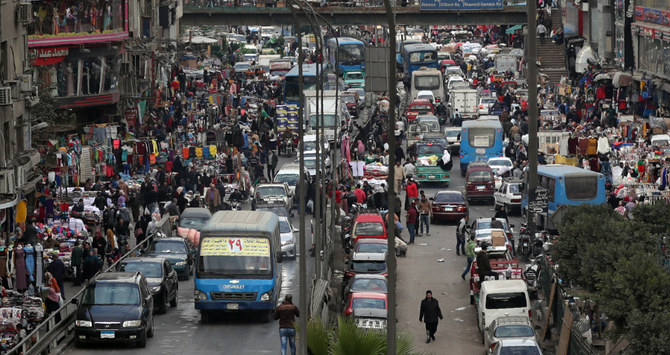
Egypt’s 14-fold population rise in 135 years a ‘national problem’: government minister

Plans in the pipeline included awareness campaigns on family sizes, food and water security, and sustainability. (AFP)
Short Url
Updated 03 December 2020
Follow

Egypt’s 14-fold population rise in 135 years a ‘national problem’: government minister

  • The rise had impacted on each individual’s share of education, health, and available resources, affecting overall demographics: minister

CAIRO: Egypt’s 14-fold population increase between 1882 and 2017 had created a “national problem” that required urgent attention, a government minister has said.

Deputy Minister of Health and Population Tarek Tawfik revealed that over the 135-year period the number of people living in the country had shot up from 6.7 million to 94.8 million.

The rise had impacted on each individual’s share of education, health, and available resources, affecting overall demographics, he added.

“(The population increase) is a national problem that needs to be solved through the collaboration of efforts between all the ministries, governmental, and non-governmental institutions, and the civil society,” Tawfik said.

He pointed out that the Egyptian National Population Council was currently drafting public policy documentation in collaboration with The American University in Cairo (AUC) aimed at resolving some of the country’s population-related issues.

Plans in the pipeline included awareness campaigns on family sizes, food and water security, and sustainability.

The council’s former rapporteur, Dr. Amr Hassan, said that a family planning project due to be launched early next year, would help to cut the birth rate in Egypt by 1 million.

Egyptian Minister of International Cooperation Dr. Rania Al-Mashat, US Agency for International Development (USAID) Mission Director Leslie Reed, AUC President Francis Joseph Ricciardone, and Tawfik recently launched the Strengthening Egypt’s Family Planning Program (SEFPP) youth competition, part of a $31 million initiative previously signed with the USAID to improve population health results.

Al-Mashat said that improving general healthcare, reproductive health, and family planning services were key to achieving economic empowerment for men and women.

She pointed out that the SEFPP youth competition was aimed at paving the way for the implementation of new and effective solutions to the issues and involved the Egyptian government, educational institutions and universities, youth, and civil society organizations represented by the USAID.

The program was designed to tackle the over-population problem through innovative techniques, developing youth ideas on family planning schemes, and raising awareness throughout the country.


Aleppo Citadel is a witness to the city’s great history and legacy

This aerial view shows the Citadel of Aleppo overlooking the northern Syrian city on December 11, 2024. (AFP)
Updated 11 sec ago
Follow

Aleppo Citadel is a witness to the city’s great history and legacy

  • Parts of military fortress date back nearly 2 millennia
  • Historian Abdullah Hajjar provides an extensive study

DAMASCUS: Towering above the old city, the Aleppo Citadel has stood for centuries as both a military stronghold and symbol of the location’s layered history.

After years of closure, neglect, and damage during the war, the Aleppo Citadel reopened to visitors on Sept. 27 following months of restoration.

The site has been listed as a UNESCO World Heritage landmark since 1986.

Rising around 38 meters above its surroundings, the fortress has played a central role in Aleppo’s political, military, and urban development.

Surrounded by a deep defensive moat, the citadel reflects advanced military engineering.

According to historian Abdullah Hajjar in his book “Archaeological Landmarks of Aleppo,” first published in 2010, the moat was excavated and reinforced during the reign of Ayyubid ruler Al-Zahir Ghazi.

At times it was 22 meters deep and about 30 meters wide, and filled with water to strengthen defenses.
Parts of the citadel date back nearly two millennia.

The lower section of its main entrance originates from the third century A.D., while the upper additions were made in the 15th century. Most of the towers and walls were built or expanded between the 13th and 16th centuries.

The citadel has repeatedly been damaged and rebuilt over the centuries. It was destroyed by the Sassanids in 540 A.D., but later restored.

Inside its walls, the citadel contains mosques, military structures, and residential buildings, offering a rare glimpse into daily life within a medieval fortress.

Among its landmarks are the Ibrahim Al-Khalil Mosque, the Great Mosque, defensive towers, barracks, and several historic houses.

Archaeological excavations have uncovered remains from multiple eras. This includes a ninth-century B.C. temple, Roman and Byzantine sarcophagi, and water cisterns dating to the reign of Byzantine Emperor Justinian, who rebuilt Aleppo’s fortifications in the sixth century against Persian invaders.

The citadel flourished during the Mamluk period, when it was restored by Sultan Baybars after the 1260 Battle of Ain Jalut.

Later inscriptions document victories by Mamluk rulers over Crusader and Mongol forces.

Under Ottoman rule, following the Battle of Marj Dabiq in 1516, the fortress gradually lost its military role and became an administrative and residential site.

The book outlines the various stages of restoration of the Aleppo Citadel over the centuries.

It highlights that Al-Zahir Ghazi, son of Saladdine Ayyubi, excavated the moat, reinforced the entrance with three wrought-iron gates, and built a large mosque within the fortress.

Later, Al-Zahir Baybars restored the citadel after the Mongol invasion, and in 1417, Sultan Al-Mu’ayyad Shaykh repaired its walls following their destruction by Timur in 1401.

The Aleppo Citadel has also survived powerful earthquakes, including a devastating quake in 1138 and another in 1822, each followed by major restoration efforts led by regional rulers of the time.

Beyond the citadel itself, Hajjar’s research documents Aleppo’s wider architectural heritage, including historic bathhouses and caravanserais that once supported the city’s role as a major trade center.