

Egyptian tourism records 21.6% decline, halting reform efforts

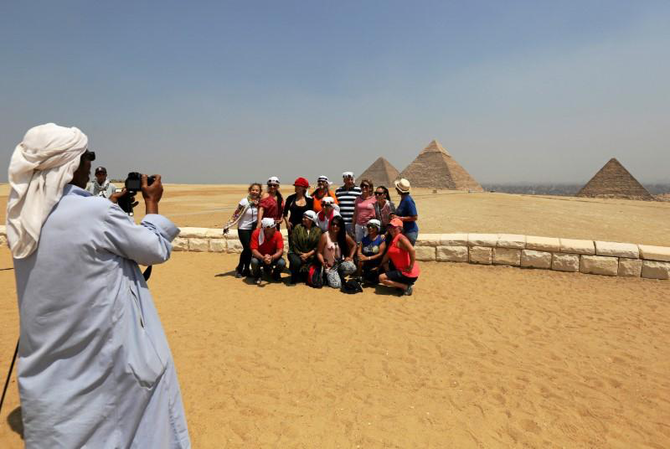
Tourists take a souvenir photo in front of the Great Giza pyramids on the outskirts of Cairo, Egypt. (Reuters/File)
Short Url
Updated 02 December 2020
Follow

Egyptian tourism records 21.6% decline, halting reform efforts

  • The repercussions of the outbreak negatively impacted Egypt’s revenues from tourism, which were expected to continue to reach historical levels

CAIRO: Egyptian tourism revenues have declined by 21.6 percent during the last fiscal year due to the coronavirus pandemic, the country’s central bank has said.

About 2.3 million Egyptian citizens also lost their jobs amid the pandemic during the fourth quarter of the fiscal year.

A report by the Central Bank of Egypt said that tourism and travel receipts recorded $9.85 billion in sales during the last fiscal year, compared to about $12.57 billion during the previous fiscal year, which was an all-time high.

The repercussions of the outbreak negatively impacted Egypt’s revenues from tourism, which were expected to continue to reach historical levels.

In January, Danielle Curtis, director of the Arabian Travel Market in the Middle East, said that tourism revenues in Egypt would jump to $29.7 billion over the next five years at a compound annual growth rate of 13 percent.

In a report for the Arabian Travel Market issued in January, Curtis said that Egypt is a major foreign market for Gulf Cooperation Council countries, as it received 1.84 million visitors from the region in 2019. The country is expected to achieve remarkable growth, bringing the total number of visitors arriving from the Gulf to 2.64 million by 2024, Curtis added.

Another report by financial group Hermes Holding issued in January predicted that Egyptian tourism revenues would exceed $20 billion annually in the next five years.

Hermes Holding cited great efforts by Egypt toward restoring its global tourism position, highlighting the reform strategy that the Ministry of Tourism has developed since 2018, which has contributed significantly to recovery efforts.

The Egyptian Ministry of Finance said that 28 percent of those who lost their jobs during the fourth quarter were in the wholesale and retail trade sector, 25 percent in the manufacturing sector, 21 percent in the food and accommodation services sector, 14 percent in the transportation and storage sector and 13 percent in the construction sector.

The unemployment rate reached its highest level in two years at 9.6 percent in the second quarter of 2020, compared to 7.7 percent in the first quarter.

The number of unemployed Egyptians during the fourth quarter of the fiscal year totaled 2.574 million compared to 2.236 million in the third quarter.

Egypt’s retail sector incurred the largest number of job losses during the pandemic, reporting 624,000. It was followed by the manufacturing sector with 569,000 jobs, the food, beverages and hospitality sector with 469,000 jobs, the transportation and storage sector with 309,000 jobs and the construction sector with 288,000 jobs.

However, the unemployment rate recorded a rebound from pre-pandemic levels in the first quarter of the new fiscal year, reaching 7.3 percent due to Egypt’s gradual easing of precautionary measures.


Closing Bell: Saudi benchmark index closes lower at 10,540 

Updated 24 December 2025
Follow

Closing Bell: Saudi benchmark index closes lower at 10,540 

RIYADH: Saudi equities ended Wednesday’s session lower, with the Tadawul All Share Index falling 55.13 points, or 0.52 percent, to close at 10,540.72. 

The sell-off was mirrored across other indices, with the MSCI Tadawul 30 Index retreating 5.79 points, or 0.41 percent, to close at 1,393.32, while the parallel market Nomu slipped 74.56 points, or 0.32 percent, to 23,193.21.  

Market breadth remained firmly negative, as decliners outpaced advancers, with 207 stocks ending the session lower against just 51 gainers on the main market. 

Trading activity moderated compared to recent sessions, with volumes reaching 123.5 million shares, while total traded value stood at SR2.72 billion ($725.2 million). 

On the sectoral and stock level, Al Moammar Information Systems Co. led the gainers after surging 9.96 percent to close at SR172.30, extending its rally following a series of contract announcements tied to data center and IT infrastructure projects.  

Al Masar Al Shamil Education Co. climbed 4.89 percent to SR27.48, while Naqi Water Co. advanced 3.36 percent to SR58.50. Al Yamamah Steel Industries Co. and Al-Jouf Agricultural Development Co. also posted solid gains, rising 3 percent and 2.86 percent, respectively. 

Losses, however, were concentrated in industrial names. Saudi Kayan Petrochemical Co. fell 3.67 percent to SR4.73, while Makkah Construction and Development Co. slid 3.44 percent to SR80.  

Saudi Tadawul Group Holding Co. retreated 3.28 percent to SR147.50, weighed down by broader market weakness, and Saudi Cable Co. declined 3.18 percent to SR143.  

Alkhaleej Training and Education Co. rounded out the top losers, shedding just over 3 percent. 

On the announcement front, BinDawood Holding announced the signing of a share purchase agreement to acquire 51 percent of Wonder Bakery LLC in the UAE for 96.9 million dirhams, marking a strategic expansion of its food manufacturing footprint beyond Saudi Arabia.   

The acquisition, which remains subject to regulatory approvals, is expected to support the group’s regional growth ambitions and strengthen supply chain integration.  

BinDawood shares closed at SR4.68, up 0.43 percent, reflecting a positive market reaction to the overseas expansion move.  

Meanwhile, Al Moammar Information Systems disclosed the contract sign-off for the renewal of IT systems support licenses with the Saudi Central Bank, valued at SR114.4 million, inclusive of VAT.   

The 36-month contract is expected to have a positive financial impact starting from fourth quarter of 2025, reinforcing MIS’s position as a key technology partner for critical government institutions. The stock surged to the session’s limit making it the top gainer. 

In a separate disclosure, Maharah Human Resources confirmed the completion of the sale of its entire stake in Care Shield Holding Co. through its subsidiary, Growth Avenue Investments, for a total consideration of SR434.3 million.  

The transaction involved the transfer of 41.36 percent of Care Shield’s share capital to Dallah Healthcare, with Maharah receiving the full cash proceeds.  

Despite the strategic divestment, Maharah shares closed lower, ending the session at SR6.12, down 1.29 percent.