GILGIT: Pakistan’s decision last week to free a popular political activist who was serving a life sentence in the country's semi-autonomous northern Gilgit-Baltistan area has been seen by observers as a “reconciliatory gesture” at a time when the administration of Prime Minister Imran Khan is gearing up to grant provincial status to, and uplift, the long-neglected region.
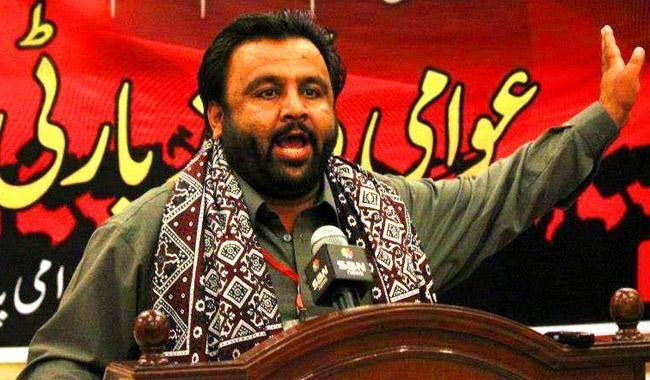
Baba Jan, a left-wing political activist from the Hunza Valley in Gilgit-Baltistan, which forms part of the disputed Kashmir region, was convicted under anti-terrorism laws in 2011 and lost an appeal against his life sentence in 2016. He was arrested for leading protests on behalf of his community over compensation for more than 6,000 people displaced by a devastating mountain landslide.
This October, thousands of people took part in a seven-day protest in Hunza asking for the release of Jan and other activists ahead of a legislative assembly election in Gilgit Baltistan on November 15. Jan was finally set free after the caretaker government struck a deal with the protesters that it would release 14 political prisoners by November 30 if they called off their sit-in.
Jan has vocally protested what he and supporters, as well as independent analysts, describe as political, constitutional and human rights violations in the region. The government denies this.
Observers have previously warned that Jan’s continued imprisonment was fuelling militancy and nationalist views in the region. His release, they say, has raised hope that the long suppressed and neglected region might see some improvements.
“Baba Jan 's sudden release showcases a grand reconciliation gesture from the government,” political observer and researcher Aziz Ali Dad of Hunza said. “Because Baba Jan was gaining more fame due to his imprisonment and grievances were gradually increasing among the public, so they released them [political prisoners] after election to get public sympathies as a good gesture.”
Analyst Afzal Shigri said it was a long-time demand of the people of the region that they get “constitutional rights” and the move to release the prisoners seemed to be a step in that direction.
Political analyst from Hunza, Amir Hussain, called the release of the prisoners, including Baba Jan, a “good gesture” from the federal government.
Gilgit-Baltistan, which borders Afghanistan and China, is the gateway of the $65 billion China-Pakistan Economic Corridor (CPEC) infrastructure plan, and Hussain said there might also now be Chinese pressure on Pakistan to “mainstream” the area, including by granting it provisional provincial status.
China denies it has ever interfered in Pakistan’s internal decisions.
Faizullah Faraq, a spokesperson for the Gilgit-Baltistan government, said the issue of Baba Jan and other political prisoners was a judicial matter and there had been no pressure from “external powers” to release them, and they had been freed as per a pact with protesters in October.
Gilgit-Baltistan, impoverished and remote, has never formally been part of Pakistan but rather of the larger Kashmir region that is also claimed by India.
Locals fought pro-India forces and opted to join Pakistan in 1948, a year after the partition of India after independence from British rule. But since then Gilgit-Baltistan has not been granted full inclusion by the Pakistani constitution, over fears doing so would jeopardize Islamabad’s international stance that all of Kashmir is disputed territory.
The local assembly, for which the November 15 elections were held, has few powers. Pakistan’s National Assembly and Senate have no representation from Gilgit-Baltistan, and the region receives only a fraction of the national budget. But Prime Minister Imran Khan has said recently his government will grant provisional provincial status to the region, giving it greater political representation.
Rights activists and reporters have also long spoken of human rights abuses in the region.
“Gilgit-Baltistan has erupted in protest a number of times over the last decade over a range of questions, including environmental issues, subsidies and autonomy,” an editorial in The News, a popular Pakistani Daily, said on Jan’s release.
“As the region has begun finding its political voice … there is now a need for a larger recognition that a return to the old status quo is not possible in Gilgit-Baltistan,” the editorial said. “A new consensus will need to be found in which the people of the region define their own needs and future. This will require activists like Baba Jan to be able to freely represent the voice of their people.”
On his part, Jan says him and other prisoners were “tortured and badly treated” while in jail.
“We were treated like professional culprits despite being political prisoners,” he told Arab News in an interview. “There were no facilities inside the jail for us.”
“Finally we were freed from the jail due to the public’s struggle and power,” he added. “And I want to thank all my well-wishers.”
But Arshad Wali, the deputy superintendent of Damas Jail in Gilgit-Baltistan where Jan was incarcerated from 2014 to 2020, rejected the claims the prisoners had been mistreated.
“In Damas jail, Baba Jan and other political prisoners were treated like common culprits,” he said, “as in GB there is no classification for political prisoners.”


![]()

Political prisoners' release in Pakistan’s north seen as ‘reconciliatory’ move ahead of provincial status plans
Short Url
https://arab.news/g3yfm
Political prisoners' release in Pakistan’s north seen as ‘reconciliatory’ move ahead of provincial status plans
- Left-wing activist Baba Jan and over a dozen other political prisoners were released last month
- Analysts say the releases have raised hope the long neglected region might see improvements
Latest updates


© 2026 SAUDI RESEARCH & PUBLISHING COMPANY, All Rights Reserved And subject to Terms of Use Agreement.