

Stock markets set for best month ever; gold and dollar pay the price

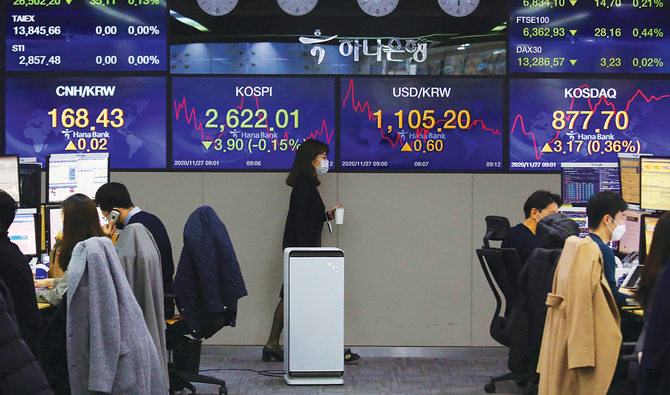
A currency trader passes by screens showing the Korea Composite Stock Price Index at the KEB Hana Bank headquarters in Seoul. (AP)
Short Url
Updated 01 December 2020
Follow

Stock markets set for best month ever; gold and dollar pay the price

  • November’s record 13 percent leap has added $6.7 trillion — or $155 million a minute — to the value of world equities

NEW YORK: World stock markets dipped on Monday to close a record-breaking month as the prospect of a vaccine-driven economic recovery next year and further stimulus measures by central banks eclipsed immediate concerns about the spiking coronavirus pandemic.

November’s record 13 percent leap has added $6.7 trillion — or $155 million a minute — to the value of world equities.

At the same time, oil, industrial commodities and other risk assets have surged, with emerging-market currencies posting their largest gains in almost two years, while safe-havens such as the dollar and gold slipped.

“It has been a very, very strong month for markets, especially on the equity side but also on the fixed income side too,” said Rabobank’s head of macro strategy, Elwin de Groot.

The positive developments on vaccines and the swiftness with which they are likely to be rolled out have been key drivers.

“And this market still remains very much supported by liquidity from the central banks,” De Groot said. With the European Central Bank set to provide more stimulus next month, “the market view seems to be, what can possibly go wrong?”

MSCI’s gauge of stocks across the globe shed 0.39 percent following modest declines in Asia and mixed trading in Europe. Many European markets are boasting their best month ever, with France up 21 percent and Italy almost 26 percent. The Nikkei’s 15 percent leap in Japan was its best month since 1994.

On Wall Street, the Dow Jones Industrial Average fell 190.36 points, or 0.64 percent, to 29,720.01, the S&P 500 lost 6.4 points, or 0.18 percent, to 3,631.95 and the Nasdaq Composite added 29.91 points, or 0.25 percent, to 12,235.76.

The surge in stocks has put competitive pressure on safe-haven bonds, but much of that has been cushioned by expectations of more asset buying by central banks.

US benchmark 10-year notes last fell 2/32 in price to yield 0.8471 percent, from 0.842 percent late on Friday.

“Markets are overbought and at risk of a short-term pause,” said Shane Oliver, head of investment strategy at AMP Capital.

“However, we are now in a seasonally strong time of year and investors are yet to fully discount the potential for a very strong recovery next year in growth and profits as stimulus combines with vaccines.”

Helping sentiment further on Monday was a survey showing that factory activity in China beat forecasts in November, and the country’s central bank surprised with an extra helping of cheap loans.

Moderna provided the regular Monday dose of vaccine news, saying it was applying for emergency use authorization from the US Food and Drug Administration and conditional approval from the EU.

Federal Reserve Chair Jerome Powell testifies to Congress on Tuesday amid speculation of further policy action at its next meeting in mid-December.

Against a basket of currencies, the dollar index was pinned at 91.704 after shedding 2.4 percent for the month to lows last seen in mid-2018.

One major casualty of the rush to risk has been gold, which was near a five-month trough at $1,769 an ounce, having shed 5.6 percent in November.

Oil, in contrast, has benefited nearly 30 percent from the prospect of a revival in demand should vaccines allow travel and transport to resume next year.


First EU–Saudi roundtable on critical raw materials reflects shared policy commitment

Updated 16 January 2026
Follow

First EU–Saudi roundtable on critical raw materials reflects shared policy commitment

RIYADH: The EU–Saudi Arabia Business and Investment Dialogue on Advancing Critical Raw Materials Value Chains, held in Riyadh as part of the Future Minerals Forum, brought together senior policymakers, industry leaders, and investors to advance strategic cooperation across critical raw materials value chains.

Organized under a Team Europe approach by the EU–GCC Cooperation on Green Transition Project, in coordination with the EU Delegation to Saudi Arabia, the European Chamber of Commerce in the Kingdom and in close cooperation with FMF, the dialogue provided a high-level platform to explore European actions under the EU Critical Raw Materials Act and ResourceEU alongside the Kingdom’s aspirations for minerals, industrial, and investment priorities.

This is in line with Saudi Vision 2030 and broader regional ambitions across the GCC, MENA, and Africa.

ResourceEU is the EU’s new strategic action plan, launched in late 2025, to secure a reliable supply of critical raw materials like lithium, rare earths, and cobalt, reducing dependency on single suppliers, such as China, by boosting domestic extraction, processing, recycling, stockpiling, and strategic partnerships with resource-rich nations.

The first ever EU–Saudi roundtable on critical raw materials was opened by the bloc’s Ambassador to the Kingdom, Christophe Farnaud, together with Saudi Deputy Minister for Mining Development Turki Al-Babtain, turning policy alignment into concrete cooperation.

Farnaud underlined the central role of international cooperation in the implementation of the EU’s critical raw materials policy framework.

“As the European Union advances the implementation of its Critical Raw Materials policy, international cooperation is indispensable to building secure, diversified, and sustainable value chains. Saudi Arabia is a key partner in this effort. This dialogue reflects our shared commitment to translate policy alignment into concrete business and investment cooperation that supports the green and digital transitions,” said the ambassador.

Discussions focused on strengthening resilient, diversified, and responsible CRM supply chains that are essential to the green and digital transitions.

Participants explored concrete opportunities for EU–Saudi cooperation across the full value chain, including exploration, mining, and processing and refining, as well as recycling, downstream manufacturing, and the mobilization of private investment and sustainable finance, underpinned by high environmental, social, and governance standards.

From the Saudi side, the dialogue was framed as a key contribution to the Kingdom’s industrial transformation and long-term economic diversification agenda under Vision 2030, with a strong focus on responsible resource development and global market integration.

“Developing globally competitive mineral hubs and sustainable value chains is a central pillar of Saudi Vision 2030 and the Kingdom’s industrial transformation. Our engagement with the European Union through this dialogue to strengthen upstream and downstream integration, attract high-quality investment, and advance responsible mining and processing. Enhanced cooperation with the EU, capitalizing on the demand dynamics of the EU Critical Raw Materials Act, will be key to delivering long-term value for both sides,” said Al-Babtain.

Valere Moutarlier, deputy director-general for European industry decarbonization, and directorate-general for the internal market, industry, entrepreneurship and SMEs at European Commission, said the EU Critical Raw Materials Act and ResourceEU provided a clear framework to strengthen Europe’s resilience while deepening its cooperation with international partners.

“Cooperation with Saudi Arabia is essential to advancing secure, sustainable, and diversified critical raw materials value chains. Dialogues such as this play a key role in translating policy ambitions into concrete industrial and investment cooperation,” she added.