

French youth of Arab origin mistrust secularism, national symbols, finds poll

1 / 2
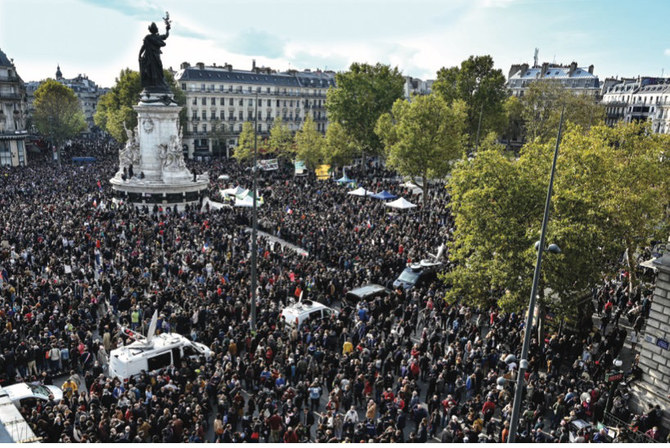
People gather on Place de la Republique in Paris in homage to slain history teacher Samuel Paty. Attitudes to secularism among young people of Arab origin in France differ from those of older age groups, a survey has shown. (AFP)
2 / 2
French police are seen at a migrants' makeshift camp set below the A1 highway in the north of Paris' popular suburb of Saint-Denis on November 17, 2020. (AFP)
Short Url
Updated 02 December 2020
Follow

French youth of Arab origin mistrust secularism, national symbols, finds poll

  • Arab News en Francais/YouGov survey of French citizens of Arab origin found a wide generational gap in attitudes to secular values
  • Older respondents identified more closely with French national symbols, but tended to feel stigmatized for their faith

LONDON: Young people of Arab origin in France are less likely to hold secular values and are more distrustful of national symbols than their elders, an Arab News en Francais survey conducted in partnership with British polling agency YouGov has found.

Attitudes to secularism appear to differ substantially among those aged between 18 and 24, which constituted 15 percent of the 958 people surveyed, compared with other age groups.

More than half (54 percent) of all those polled said they believe religion plays a negative role in politics, while a smaller 46 percent of 18-24-year-olds said this was the case.

Likewise, on the subject of laws restricting the wearing of religious clothing, 38 percent of all respondents said they favor such rules, while 29 percent of 18-24-year-olds approve.

Asked whether they would be prepared to defend the French model of secularism in their country of origin, 65 percent of respondents said they would compared with just 56 percent of 18-24-year-olds.

Even among the 25-34 age group, adherence to the values of secularism is noticeably stronger than among the younger cohort, with 55 percent saying religion plays a negative role in politics.

The trend generally continues with age. Among those over 45, about 50 percent said they are in favor of laws limiting the wearing of religious symbols.

Observers have asked whether such negative perceptions of secularism among young French citizens of Arab origin can be equated with growing radicalism.

Some scholars of Islam have established a link between countries which have adopted a more “incisive” secularism and the number of citizens who traveled to Syria to join Daesh.

William McCants and Christopher Meserole of the Brookings Institution believe the political culture of France and Belgium, where religious symbols are restricted, combined with massive unemployment and urbanization, contributed to radicalization.

IN NUMBERS

46% 18-24-year-olds say religion plays negative role in politics.

58% 18-24-year-olds would support home football side against France.

Other researchers say those who traveled to Syria came overwhelmingly from poor urban areas, where they faced discrimination in the job market, housing and police checks.

“Some young people feel they are viewed as sub-citizens, while media rhetoric gives credence to the idea that Muslims are ‘banding apart’,” said Elyamine Settoul, a lecturer at the National Conservatory of Arts and Crafts in Paris.

“This otherness between ‘them’ and ‘us’ represents a breeding ground for radicalization. Radical groups will not only sell them full citizenship but also compensate for all their deficiencies, whether they are identity based, affective or narcissistic.”

It is perhaps surprising, then, that just 47 percent of the 18-24 cohort surveyed by Arab News en Francais and YouGov believe their religion is perceived negatively in France — significantly lower than the overall average of 59 percent among all age groups.
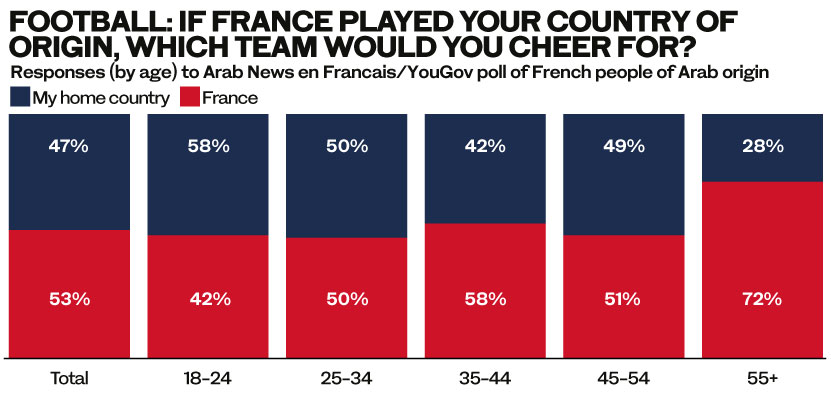
Few topics better reflect a community’s sense of national pride than an international football tournament. Dual identities often lead to the question: Should I support the national side from my place of origin or cheer for my adopted nation?

Once again, a generational split emerges. The survey found 58 percent of men aged 18-24 would support their country of origin against the French side compared with an average of 47 percent among all respondents.

If the French World Cup victory in 1998 is considered the peak of the country’s “black-blanc-beur” multiculturalism, then the 2001 friendly between France and Algeria must be considered its nadir, when Algerian fans invaded the pitch.

The Arab News en Francais/YouGov study found that support for the French national team tended to increase with age. About 58 percent of 35-44-year-olds and 50 percent of over-55s said they would support the French national side over their country of origin.

“Young people under 25 are still building their identity and tend to get closer to their country of origin at this age. They fully claim their belonging to the country of origin, but this remains like folklore, as they often do not know much about it,” Settoul said.

“Over time, the identity asserts itself: We integrate professionally, get married, buy property and no longer take the same positions.”


Filipino rescuers detect ‘signs of life’ in garbage avalanche that killed 4 and left dozens missing

Updated 4 sec ago
Follow

Filipino rescuers detect ‘signs of life’ in garbage avalanche that killed 4 and left dozens missing

  • Twelve workers have been rescued with injuries from the huge mound of garbage
  • “Authorities confirmed the presence of detected signs of life in specific areas, requiring continued careful excavation,” Cebu City Mayor Nestor Archival said

MANILA: Rescuers detected signs of life in an avalanche of garbage that killed at least four workers and left more than 30 others missing Thursday in a central Philippines landfill and plan to intensify search efforts, an official said Saturday.
Twelve workers have been rescued with injuries from the huge mound of garbage that collapsed among the low-slung buildings of a waste management facility in the village of Binaliw in Cebu City, authorities said.
Dozens of rescuers including police, firefighters and disaster-response personnel have raced against time to find more survivors in dangerous conditions in the rubble of twisted tin roofs, iron bars and combustible heaps of garbage and debris.
“Authorities confirmed the presence of detected signs of life in specific areas, requiring continued careful excavation and the deployment of a more advanced 50-ton crane, which is enroute with police escort,” Cebu City Mayor Nestor Archival said in a statement.
“Safety of responders remains paramount due to hazards such as unstable debris and acetylene risks, prompting adjustments to the security perimeter and controlled access,” Archival said.
The four dead, including an engineer and a female office worker, were all employees of the landfill and waste management facility with a staff of 110, according to the mayor and police.
The initial list of victims on Friday included two dead and 36 missing, which increased Saturday to four dead, according to Archival, who did not provide an updated nunber of people missing.
The cause of the collapse of the mountain of garbage remains unclear, but a survivor told The Associated Press on Friday that it happened in an instant without any warning despite fairly good weather at the time.
Jaylord Antigua, a 31-year-old office worker at the landfill, said the wall of garbage cascaded down and destroyed the administrative office he was in. He extricated himself with bruises on his face and arms by crawling in darkness in the rubble and debris.
“I saw a light and crawled toward it in a hurry, because I feared there will be more landslides,” Antigua said. “It was traumatic. I feared that it was my end, so this is my second life.”
It is unclear how the accident would affect garbage disposal in the landfill in Cebu, a bustling port city of nearly a million people that serves as a regional hub for trade, commerce and tourism.
Preparations “are also underway to manage the looming garbage collection issue,” Archival said in his statement without further details.
Such landfills and open dumpsites have long been a source of safety and health concerns throughout the Philippines, especially in areas close to poor communities where many residents scavenge for junk and leftover food in the garbage heaps.
In July 2000, a huge garbage mound in a shantytown in suburban Quezon City, part of metropolitan Manila, collapsed and ignited a fire after days of stormy weather.
The disaster left more than 200 people dead and many more missing, damaged scores of shanties and prompted a law requiring the closure of illegal dump sites nationwide, as well as improved and more sustainable waste management by authorities.