

Pakistan warns against landslides, avalanches next week amid rain and snowfall prediction

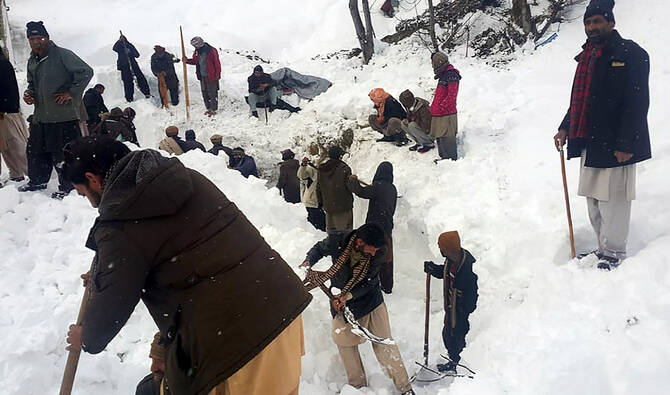
Local residents search for the avalanche victims in the snow in Neelum Valley, in Pakistan-administered Kashmir on January 15, 2020. (AFP/File)
Short Url
Updated 28 December 2025
Follow

Pakistan warns against landslides, avalanches next week amid rain and snowfall prediction

  • Westerly wave likely to approach western areas from Dec. 29, persist till Jan. 2, says Met Office
  • Pakistan advises tourists to exercise caution while traveling in northern areas during the period

ISLAMABAD: Pakistan’s Meteorological Department on Sunday warned against the possibility of landslides and avalanches in the country’s northern areas next week, as it forecast heavy rains and snowfall in hilly regions. 

The Met Office predicted that a westerly wave is likely to approach Pakistan’s western areas from Dec. 29 and strengthen from Dec. 30 onwards. This wave is expected to grip most upper and central parts of the country on Dec. 31 and persist in the upper areas till Jan. 2, the PMD said. 
 
“Possibility of landslides/avalanches in hilly areas of upper Khyber Pakhtunkhwa, Gilgit-Baltistan and Kashmir during the period,” the PMD warned. 

“Tourists are advised to remain extra cautious and avoid unnecessary traveling during the period.”

The advisory warned that rainfall with wind and thunderstorm and snowfall is likely in Punjab’s Murree and the Galliyat region from Dec. 30 to Jan. 2 with occasional gaps. It also warned of rain with wind, thunderstorms and moderate snowfall in the northern Gilgit-Baltistan and Kashmir regions during the same period.

The PMD warned of rain with wind and thunderstorms, with moderate to heavy snowfall in upper areas from Dec. 30 to Jan. 1 in the northwestern Khyber Pakhtunkhwa province. 

For Sindh and Balochistan provinces, the PMD warned that rain with wind and thunderstorms with snowfall were expected over hilly areas from Dec. 29-31. 

The PMD warned snowfall may cause road closures or slippery conditions in the northern areas of Naran, Kaghan, Dir, Swat, Kohistan, Mansehra, Abbottabad, Shangla, Astore, Hunza, Skardu, Murree, Galliyat and Neelum Valley from Dec. 30 to Jan. 2. 

“Fog condition is likely to subside in central/southern parts of Punjab and upper Sindh during the wet spell,” it said. 

“Daytime temperatures are likely to drop further in the coming week, particularly after the spell.”

Authorities in the past have urged people to avoid northern areas or exercise caution in travel when weather conditions are expected to deteriorate during the winter season. 

At least 21 people, including nine children, died in freezing temperatures after being stuck in their vehicles in the Pakistani hill station of Murree in January 2022 when roads became impassable due to heavy snow. 


ADB, Pakistan sign over $300 million agreements to undertake climate resilience initiatives

Updated 30 December 2025
Follow

ADB, Pakistan sign over $300 million agreements to undertake climate resilience initiatives

  • Pakistan ranks among nations most vulnerable to climate change and has seen erratic changes in weather patterns
  • The projects in Sindh and Punjab will restore nature-based coastal defenses and enhance agricultural productivity

ISLAMABAD: The Pakistani government and the Asian Development Bank (ADB) have signed more than $300 million agreements to undertake two major climate resilience initiatives, Pakistan’s Press Information Department (PID) said on Tuesday.

The projects include the Sindh Coastal Resilience Sector Project (SCRP), valued at Rs50.5 billion ($180.5 million), and the Punjab Climate-Resilient and Low-Carbon Agriculture Mechanization Project (PCRLCAMP), totaling Rs34.7 billion ($124 million).

Pakistan ranks among nations most vulnerable to climate change and has seen erratic changes in its weather patterns. In 2022, monsoon floods killed over 1,700 people, displaced another 33 million and caused over $30 billion losses, while another 1,037 people were killed in floods this year.

The South Asian country is ramping up climate resilience efforts, with support from the ADB and World Bank, and investing in climate-resilient infrastructure, particularly in vulnerable areas.

“Both sides expressed their commitment to effectively utilize the financing for successful and timely completion of the two initiatives,” the PID said in a statement.

The Sindh Coastal Resilience Project (SCRP) will promote integrated water resources and flood risk management, restore nature-based coastal defenses, and strengthen institutional and community capacity for strategic action planning, directly benefiting over 3.8 million people in Thatta, Sujawal, and Badin districts, according to ADB.

The Punjab project will enhance agricultural productivity and climate resilience across 30 districts, improving small farmers’ access to climate-smart machinery, introducing circular agriculture practices to reduce residue burning, establishing testing and training facilities, and empowering 15,000 women through skills development and livelihood diversification.

Earlier this month, the ADB also approved $381 million in financing for Pakistan’s Punjab province to modernize agriculture and strengthen education and health services, including concessional loans and grants for farm mechanization, Science, Technology, Engineering and Mathematics (STEM) education, and nursing sector reforms.