

LONDON: Young people of Arab origin in France are less likely to hold secular values and are more distrustful of national symbols than their elders, an Arab News en Francais survey conducted in partnership with British polling agency YouGov has found.
Attitudes to secularism appear to differ substantially among those aged between 18 and 24, which constituted 15 percent of the 958 people surveyed, compared with other age groups.
More than half (54 percent) of all those polled said they believe religion plays a negative role in politics, while a smaller 46 percent of 18-24-year-olds said this was the case.
Likewise, on the subject of laws restricting the wearing of religious clothing, 38 percent of all respondents said they favor such rules, while 29 percent of 18-24-year-olds approve.
Asked whether they would be prepared to defend the French model of secularism in their country of origin, 65 percent of respondents said they would compared with just 56 percent of 18-24-year-olds.
Even among the 25-34 age group, adherence to the values of secularism is noticeably stronger than among the younger cohort, with 55 percent saying religion plays a negative role in politics.
The trend generally continues with age. Among those over 45, about 50 percent said they are in favor of laws limiting the wearing of religious symbols.
Observers have asked whether such negative perceptions of secularism among young French citizens of Arab origin can be equated with growing radicalism.
Some scholars of Islam have established a link between countries which have adopted a more “incisive” secularism and the number of citizens who traveled to Syria to join Daesh.
William McCants and Christopher Meserole of the Brookings Institution believe the political culture of France and Belgium, where religious symbols are restricted, combined with massive unemployment and urbanization, contributed to radicalization.
IN NUMBERS
46% 18-24-year-olds say religion plays negative role in politics.
58% 18-24-year-olds would support home football side against France.
Other researchers say those who traveled to Syria came overwhelmingly from poor urban areas, where they faced discrimination in the job market, housing and police checks.
“Some young people feel they are viewed as sub-citizens, while media rhetoric gives credence to the idea that Muslims are ‘banding apart’,” said Elyamine Settoul, a lecturer at the National Conservatory of Arts and Crafts in Paris.
“This otherness between ‘them’ and ‘us’ represents a breeding ground for radicalization. Radical groups will not only sell them full citizenship but also compensate for all their deficiencies, whether they are identity based, affective or narcissistic.”
It is perhaps surprising, then, that just 47 percent of the 18-24 cohort surveyed by Arab News en Francais and YouGov believe their religion is perceived negatively in France — significantly lower than the overall average of 59 percent among all age groups.
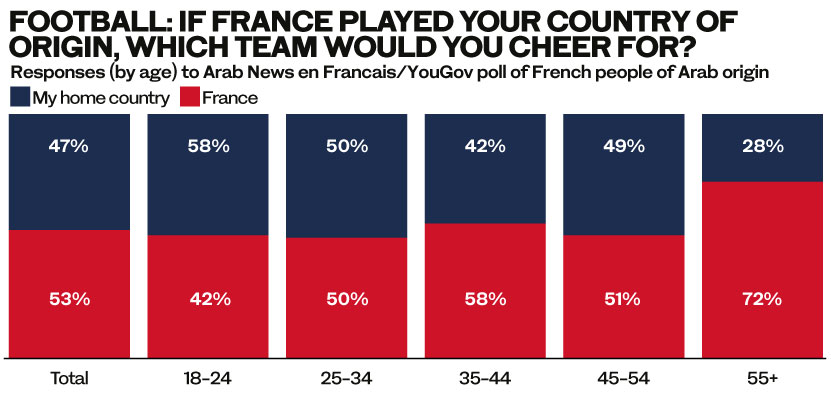
Few topics better reflect a community’s sense of national pride than an international football tournament. Dual identities often lead to the question: Should I support the national side from my place of origin or cheer for my adopted nation?
Once again, a generational split emerges. The survey found 58 percent of men aged 18-24 would support their country of origin against the French side compared with an average of 47 percent among all respondents.
If the French World Cup victory in 1998 is considered the peak of the country’s “black-blanc-beur” multiculturalism, then the 2001 friendly between France and Algeria must be considered its nadir, when Algerian fans invaded the pitch.
The Arab News en Francais/YouGov study found that support for the French national team tended to increase with age. About 58 percent of 35-44-year-olds and 50 percent of over-55s said they would support the French national side over their country of origin.
“Young people under 25 are still building their identity and tend to get closer to their country of origin at this age. They fully claim their belonging to the country of origin, but this remains like folklore, as they often do not know much about it,” Settoul said.
“Over time, the identity asserts itself: We integrate professionally, get married, buy property and no longer take the same positions.”