Gaza gets vital medical aid as hospitals struggle with rising infections

1 / 3
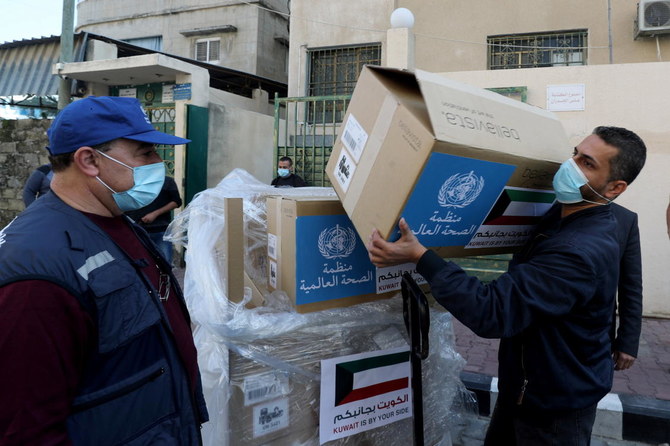
A worker unloads boxes containing ventilators delivered by the World Health Organization (WHO) and donated by Kuwait, in Gaza City November 29, 2020. (Reuters)
2 / 3
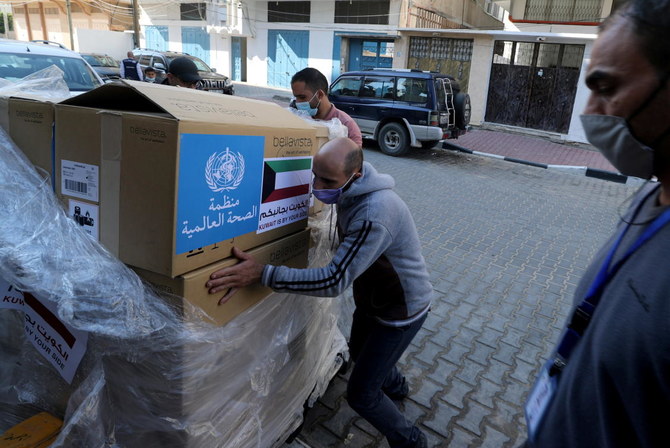
A worker unloads boxes containing ventilators delivered by the World Health Organization (WHO) and donated by Kuwait, in Gaza City November 29, 2020. (Reuters)
3 / 3
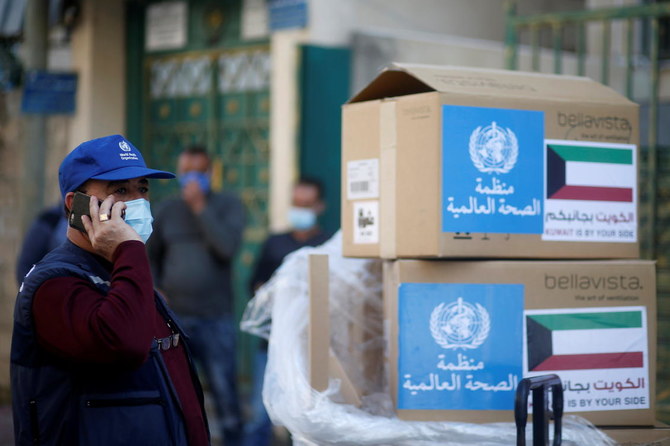
Abdelnaser Soboh, Emergency Health Lead in the World Health Organization's Gaza sub-office, stands next to boxes containing ventilators delivered by the World Health Organization (WHO) and donated by Kuwait, in Gaza City November 29, 2020. (Reuters)
Short Url
Updated 29 November 2020
Follow

Gaza gets vital medical aid as hospitals struggle with rising infections

GAZA: The World Health Organization delivered 15 ventilators to Gaza hospitals on Sunday amid a spike in COVID-19 infections that has tested the Palestinian territory’s under-developed health system.
The donation of the intensive care devices, funded by Kuwait, came a week after local and international public health advisers said hospitals in the enclave could soon become overwhelmed.
“These devices will help medical teams provide better service to patients, but it is not enough,” said Abdullatif AlHajj of Gaza’s health ministry.
AlHajj said hospitals had suffered acute shortages in oxygen essential in the treatment of COVID-19 patients.
Gaza has logged nearly 20,000 coronavirus cases and 97 deaths, mostly since August, amid concern of a wider outbreak in the densely populated enclave of 2 million people, many of whom live in poverty.
The Gaza Health Ministry said 342 COVID-19 patients, of whom 108 are in critical condition, are being treated in the territory’s hospitals, which have been able to expand their intensive care units to 150 beds over the past week.
It said more than half of the territory’s 150 ventilators are in use.
“The health system right now can hold on for a few weeks after the expansion of beds,” said Abdelnaser Soboh, emergency health lead in the World Health Organization’s Gaza sub-office.
Soboh said Gaza is also experiencing severe shortages of medications and disposable equipment needed to treat COVID-19 patients.
Palestinians in Hamas Islamist-run Gaza say 13 years of economic sanctions by Israel and its border blockade have crippled their economy and undermined the development of medical facilities, weakening their ability to tackle a pandemic.
Israel, which cites security concerns for the border restrictions it imposes along with neighboring Egypt, says it has not limited the transfer of medical supplies to Gaza to fight the pandemic.


UN rights chief Shocked by ‘unbearable’ Darfur atrocities

Updated 18 January 2026
Follow

UN rights chief Shocked by ‘unbearable’ Darfur atrocities

  • Mediation efforts have failed to produce a ceasefire, even after international outrage intensified last year with reports of mass killings, rape, and abductions during the RSF’s takeover of El-Fasher in Darfur

PORT SUDAN: Nearly three years of war have put the Sudanese people through “hell,” the UN’s rights chief said on Sunday, blasting the vast sums spent on advanced weaponry at the expense of humanitarian aid and the recruitment of child soldiers.
Since April 2023, Sudan has been gripped by a conflict between the army and the paramilitary Rapid Support Forces that has left tens of thousands of people dead and around 11 million displaced.
Speaking in Port Sudan during his first wartime visit, UN Human Rights commissioner Volker Turk said the population had endured “horror and hell,” calling it “despicable” that funds that “should be used to alleviate the suffering of the population” are instead spent on advanced weapons, particularly drones.
More than 21 million people are facing acute food insecurity, and two-thirds of Sudan’s population is in urgent need of humanitarian aid, according to the UN.
In addition to the world’s largest hunger and displacement crisis, Sudan is also facing “the increasing militarization of society by all parties to the conflict, including through the arming of civilians and recruitment and use of children,” Turk added.
He said he had heard testimony of “unbearable” atrocities from survivors of attacks in Darfur, and warned of similar crimes unfolding in the Kordofan region — the current epicenter of the fighting.
Testimony of these atrocities must be heard by “the commanders of this conflict and those who are arming, funding and profiting from this war,” he said.
Mediation efforts have failed to produce a ceasefire, even after international outrage intensified last year with reports of mass killings, rape, and abductions during the RSF’s takeover of El-Fasher in Darfur.
“We must ensure that the perpetrators of these horrific violations face justice regardless of the affiliation,” Turk said on Sunday, adding that repeated attacks on civilian infrastructure could constitute “war crimes.”
He called on both sides to “cease intolerable attacks against civilian objects that are indispensable to the civilian population, including markets, health facilities, schools and shelters.”
Turk again warned on Sunday that crimes similar to those seen in El-Fasher could recur in volatile Kordofan, where the RSF has advanced, besieging and attacking several key cities.
Hundreds of thousands face starvation across the region, where more than 65,000 people have been displaced since October, according to the latest UN figures.