

RCMP officer defends decision over Huawei CFO arrest

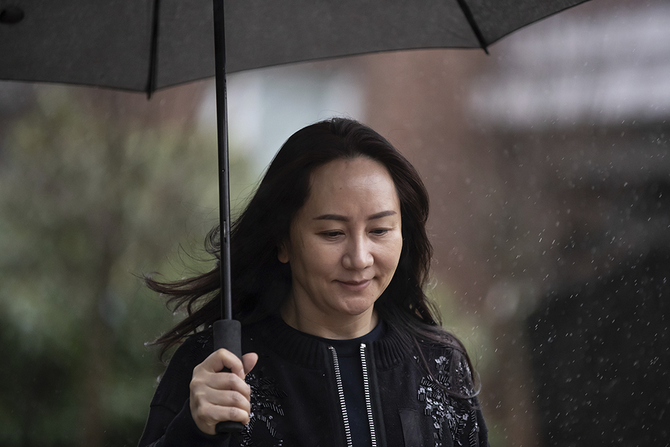
Chief Financial Officer of Huawei Meng Wanzhou leaves her home to attend a hearing at B.C. Supreme Court, in Vancouver, British Columbia on Tuesday, Nov. 24, 2020. (AP)
Short Url
Updated 29 November 2020
Follow

RCMP officer defends decision over Huawei CFO arrest

  • Meng Wanzhou was detained in 2018, accused of bank fraud by the US, allegedly misleading HSBC over dealings with Iran

VANCOUVER: A Canadian police officer stationed at Vancouver International Airport who rejected a plan to arrest Huawei Chief Financial Officer Meng Wanzhou on the plane she arrived on two years ago, testified that at the time he told other officers the best course was to allow border agents to interrogate Meng before arresting her.

The testimony from Ross Lundie, a sergeant with the Royal Canadian Mounted Police (RCMP) Vancouver International Airport detachment, came at the end of two weeks of witness cross-examination in Meng’s US extradition case.

Meng, 48, was arrested on a US warrant on charges of bank fraud for allegedly misleading HSBC about Huawei Technologies’ business dealings in Iran, causing the bank to break US sanctions.

She was arrested at the airport in December 2018 following a three-hour examination by officials with the Canada Border Services Agency (CBSA). The interrogation has become a flashpoint in the case to extradite Meng to the US.

Her lawyers allege that Canadian and US authorities conspired to use the additional investigative powers of the CBSA to interrogate Meng without a lawyer present. They further claim that the RCMP passed on identifying details of Meng’s electronic devices to US authorities, in violation of her civil rights.

As evidence, Meng’s lawyers have pointed out that the RCMP could have arrested Meng on the plane but instead chose to allow the CBSA to conduct an investigation first.

Lundie testified on Friday about his phone conversations with officers who had planned to arrest Meng on the plane she arrived on. Lundie said he told police that he did not think it was a good idea and  that the CBSA needed to be informed.

He told the court that problems can arise when police do not respect the authority of other partner agencies, and said the RCMP does not normally make arrests aboard planes “unless there’s fighting or something extreme going on.”

Friday marked the end of the second of three legs of witness testimony during which defense lawyers attempted to show that enough abuses of process took place during Meng’s detainment by Canadian authorities to invalidate the extradition. Witness hearing is to resume on Dec. 7.

Meng has said she is innocent and is fighting the extradition while under house arrest in Vancouver.

Prosecutors have argued that Meng’s investigation and arrest followed standard procedures.

On Wednesday the RCMP supervisor in charge of Meng’s arrest testified that she had relayed a suggestion from her superior to arrest Meng on the plane but that she did not think it was a good idea. She also testified that emails she reviewed did not show the RCMP passed serial numbers of Meng’s devices to the US Federal Bureau of Investigation.

Lundie testified Thursday that he had suggested the CBSA conduct its examination of Meng first.

Diplomatic relations between Ottawa and Beijing have deteriorated since Meng’s arrest. China arrested Canadian citizens Michael Spavor and Michael Kovrig on espionage charges days later.

Meng’s extradition hearing is expected to wrap up in April 2021.


First EU–Saudi roundtable on critical raw materials reflects shared policy commitment

Updated 16 January 2026
Follow

First EU–Saudi roundtable on critical raw materials reflects shared policy commitment

RIYADH: The EU–Saudi Arabia Business and Investment Dialogue on Advancing Critical Raw Materials Value Chains, held in Riyadh as part of the Future Minerals Forum, brought together senior policymakers, industry leaders, and investors to advance strategic cooperation across critical raw materials value chains.

Organized under a Team Europe approach by the EU–GCC Cooperation on Green Transition Project, in coordination with the EU Delegation to Saudi Arabia, the European Chamber of Commerce in the Kingdom and in close cooperation with FMF, the dialogue provided a high-level platform to explore European actions under the EU Critical Raw Materials Act and ResourceEU alongside the Kingdom’s aspirations for minerals, industrial, and investment priorities.

This is in line with Saudi Vision 2030 and broader regional ambitions across the GCC, MENA, and Africa.

ResourceEU is the EU’s new strategic action plan, launched in late 2025, to secure a reliable supply of critical raw materials like lithium, rare earths, and cobalt, reducing dependency on single suppliers, such as China, by boosting domestic extraction, processing, recycling, stockpiling, and strategic partnerships with resource-rich nations.

The first ever EU–Saudi roundtable on critical raw materials was opened by the bloc’s Ambassador to the Kingdom, Christophe Farnaud, together with Saudi Deputy Minister for Mining Development Turki Al-Babtain, turning policy alignment into concrete cooperation.

Farnaud underlined the central role of international cooperation in the implementation of the EU’s critical raw materials policy framework.

“As the European Union advances the implementation of its Critical Raw Materials policy, international cooperation is indispensable to building secure, diversified, and sustainable value chains. Saudi Arabia is a key partner in this effort. This dialogue reflects our shared commitment to translate policy alignment into concrete business and investment cooperation that supports the green and digital transitions,” said the ambassador.

Discussions focused on strengthening resilient, diversified, and responsible CRM supply chains that are essential to the green and digital transitions.

Participants explored concrete opportunities for EU–Saudi cooperation across the full value chain, including exploration, mining, and processing and refining, as well as recycling, downstream manufacturing, and the mobilization of private investment and sustainable finance, underpinned by high environmental, social, and governance standards.

From the Saudi side, the dialogue was framed as a key contribution to the Kingdom’s industrial transformation and long-term economic diversification agenda under Vision 2030, with a strong focus on responsible resource development and global market integration.

“Developing globally competitive mineral hubs and sustainable value chains is a central pillar of Saudi Vision 2030 and the Kingdom’s industrial transformation. Our engagement with the European Union through this dialogue to strengthen upstream and downstream integration, attract high-quality investment, and advance responsible mining and processing. Enhanced cooperation with the EU, capitalizing on the demand dynamics of the EU Critical Raw Materials Act, will be key to delivering long-term value for both sides,” said Al-Babtain.

Valere Moutarlier, deputy director-general for European industry decarbonization, and directorate-general for the internal market, industry, entrepreneurship and SMEs at European Commission, said the EU Critical Raw Materials Act and ResourceEU provided a clear framework to strengthen Europe’s resilience while deepening its cooperation with international partners.

“Cooperation with Saudi Arabia is essential to advancing secure, sustainable, and diversified critical raw materials value chains. Dialogues such as this play a key role in translating policy ambitions into concrete industrial and investment cooperation,” she added.