


TWITTER POLL: Trump did more for Middle East peace than predecessors, poll respondents say

Donald Trump helped to broker the Abrham Accord. (File/AFP)
Short Url
Updated 28 November 2020
Follow

TWITTER POLL: Trump did more for Middle East peace than predecessors, poll respondents say

  • Half of respondents say they believe Trump was good for peace in the Middle East
  • Barack Obama received less than 30 percent of the vote

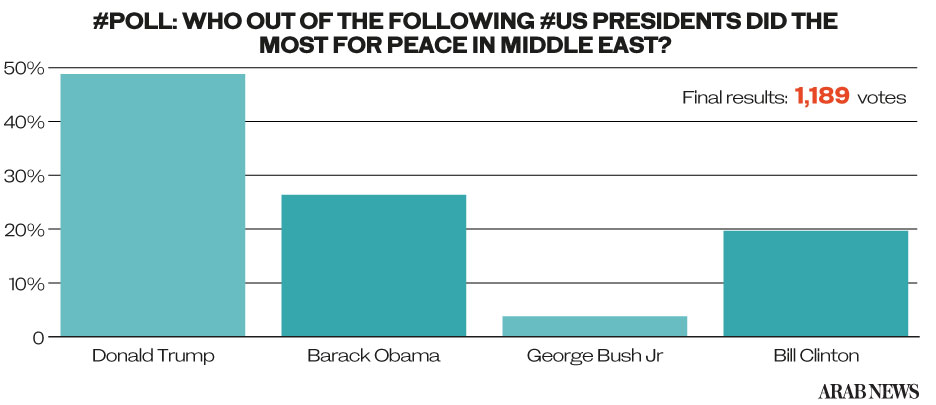
DUBAI: Nearly half of all respondents to an Arab News Twitter poll say they believe Donald Trump has done more for peace in the Middle East than the three presidents who served before him.

The poll, that received 1,189 votes saw Trump receive 49.7 percent of the vote, while Barack Obama scored 27.2 percent.

Bill Clinton received 19.9 percent of the vote while George W Bush got only 3.2 percent.
Trump ran his previous election campaign saying that he would no longer take America into any more wars that did not immediately impact the US – although he did order the assassination of top Iranian commander Qasem Soleimani in January, 2020.

But the outgoing US president has been widely praised for his work in brokering the Abraham Accord that brought the normalization of relations between Israel and the UAE and Bahrain.

Meanwhile Barack Obama was criticized for failing to bring troops back from Iraq and Afghanistan.

He was also criticized for his decision not to take military action against Syria in 2012 after the regime used chemical weapons against civilian populations.


In September 1993 Bill Clinton oversaw the signing of the Oslo Accords between Palestine Liberation Organization Chairman Yasser Arafat and the then Israeli Prime Minister Yitzhak Rabin.

The deal was hoped would see the Palestinians regain some of the land claimed by the Israelis, and also enabled them to become self-governing.

But the deal was short lived and less than a decade later the new Prime Minister Benjamin Netanyahu was refusing to concede any further territory.

In his last year in office Clinton came close to arranging a final peace settlement, but failed, largely Clinton said – because of Arafat’s reluctance.

The President has previously spoken of a telephone conversation he had with Arafat in his last three days in office in which Arafat told him: “You are a great man.”

Clinton said he replied: “ The hell I am. I’m a colossal failure and you made me one.”

Prior to his election after Clinton, George W Bush had voiced his desire to unseat Saddam Hussein as ruler of Iraq.

He followed through on this when he drew up the Axis of Evil – the countries that he deemed were a threat to America following the 9/11 terror attacks that saw two passenger jets flown into the World Trade Center towers in New York, and a third into the Pentagon, killing thousands.

Shortly after the attacks Bush ordered the invasion of Afghanistan in 2001 and then the invasion of Iraq in 2003.

In the latter Saddam Hussein was beaten and later captured. He was put on trial and sentenced to death by hanging – Iraq remains in a state of unrest.

Meanwhile in Afghanistan President Trump has ordered the withdrawal of even more troops after two decades of war.

Now take our new poll:


Three-year heatwave bleached half the planet’s coral reefs: study

Updated 10 February 2026
Follow

Three-year heatwave bleached half the planet’s coral reefs: study

PARIS: A study published on Tuesday showed that more than half of the world’s coral reefs were bleached between 2014-2017 — a record-setting episode now being eclipsed by another series of devastating heatwaves.
The analysis concluded that 51 percent of the world’s reefs endured moderate or worse bleaching while 15 percent experienced significant mortality over the three-year period known as the “Third Global Bleaching Event.”
It was “by far the most severe and widespread coral bleaching event on record,” said Sean Connolly, one the study’s authors and a senior scientist at the Panama-based Smithsonian Tropical Research Institute.
“And yet, reefs are currently experiencing an even more severe Fourth Event, which started in early 2023,” Connolly said in a statement.
When the sea overheats, corals eject the microscopic algae that provides their distinct color and food source.
Unless ocean temperatures return to more tolerable levels, bleached corals are unable to recover and eventually die of starvation.
“Our findings demonstrate that the impacts of ocean warming on coral reefs are accelerating, with the near certainty that ongoing warming will cause large-scale, possibly irreversible, degradation of these essential ecosystems,” said the study in the journal Nature Communications.
An international team of scientists analyzed data from more than 15,000 in-water and aerial surveys of reefs around the world over the 2014-2017 period.
They combined the data with satellite-based heat stress measurements and used statistical models to estimate how much bleaching occurred around the world.

No time to recover

The two previous global bleaching events, in 1998 and 2010, had lasted one year.
“2014-17 was the first record of a global coral bleaching event lasting much beyond a single year,” the study said.
“Ocean warming is increasing the frequency, extent, and severity of tropical-coral bleaching and mortality.”
Australia’s Great Barrier Reef, for instance, saw peak heat stress increase each year between 2014 and 2017.
“We are seeing that reefs don’t have time to recover properly before the next bleaching event occurs,” said Scott Heron, professor of physics at James Cook University in Australia.
A major scientific report last year warned that the world’s tropical coral reefs have likely reached a “tipping point” — a shift that could trigger massive and often permanent changes in the natural world.
The global scientific consensus is that most coral reefs would perish at warming of 1.5C above preindustrial levels — the ambitious, long-term limit countries agreed to pursue under the 2015 Paris climate accord.
Global temperatures exceeded 1.5C on average between 2023-2025, the European Union’s climate monitoring service, Copernicus, said last month.
“We are only just beginning to analyze bleaching and mortality observations from the current bleaching event,” Connolly told AFP.
“However the overall level of heat stress was extraordinarily high, especially in 2023-2024, comparable to or higher than what was observed in 2014-2017, at least in some regions,” he said.
He said the Pacific coastline of Panama experienced “dramatically worse heat stress than they had ever experienced before, and we observed considerable coral mortality.”