

Pakistan sends aid to Syria for a second time this month

Pakistani aid is received in Latakia Governorate on Wednesday, November 25, 2020. The Latakia Governorate has recently been hit by widespread wildfires. (Photo courtesy: Embassy of Pakistan in Damascus)
Short Url
Updated 27 November 2020
Follow

Pakistan sends aid to Syria for a second time this month

  • Five million Syrian pounds and school desks, chairs, clothing, food and stationery items given to Latakia Governorate
  • Earlier this month, Pakistan sent medical equipment and protective gear to Syria to help fight COVID-19 in the war-torn country

ISLAMABAD: Pakistan has given five million Syrian pounds as well as school desks, chairs, clothing, food and stationery items to Latakia Governorate, one of the 14 governorates of Syria, the Syrian Arab News Agency said.
Earlier this month, Pakistan had sent medical equipment and protective gear to Syria to help fight the COVID-19 pandemic in the war-torn country.
The Latakia Governorate has recently been hit by widespread wildfires.
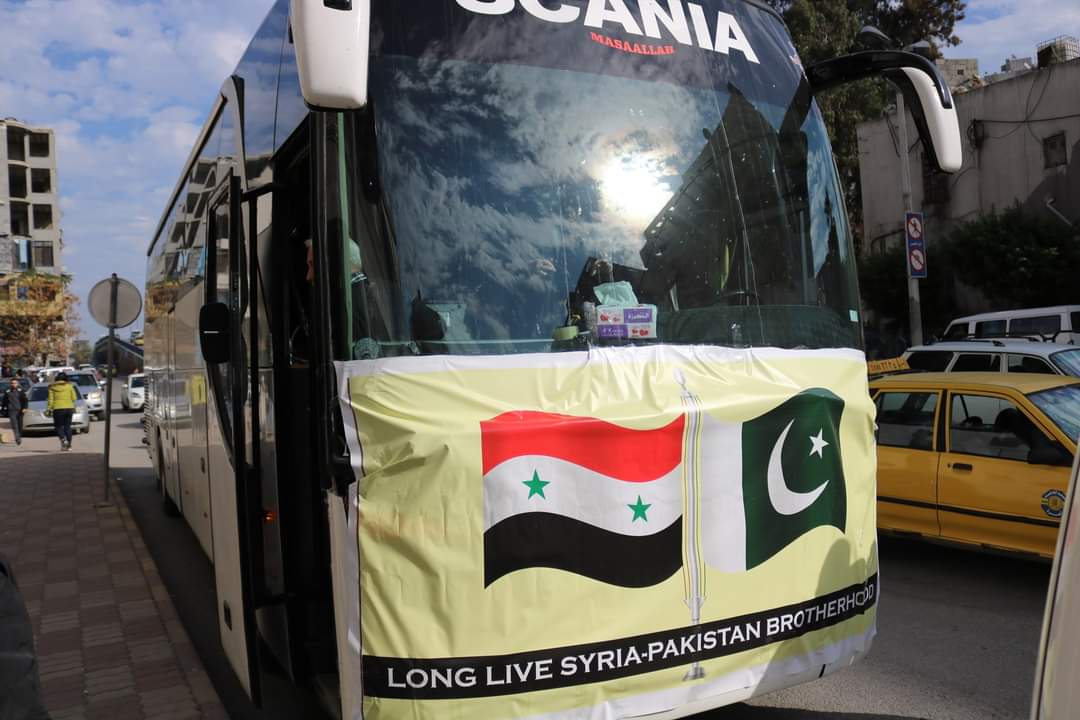


A bus is carrying Pakistani aid to Latakia Governorate on Wednesday, November 25, 2020. The Latakia Governorate has recently been hit by widespread wildfires. (Photo courtesy: Embassy of Pakistan in Damascus)

“The gift was presented by Ambassador of the Islamic Republic of Pakistan in Damascus, Saeed Muhammad Khan, after a campaign launched at the school in cooperation with the educational and administrative staff and under supervision from the Pakistani embassy to stand by citizens affected by the fires,” SANA said in a report.
“While receiving the gift, Governor of Lattakia, Ibrahim Khader Al-Salem, stressed that Pakistan has always stood by Syria and its rights … adding that this initiative reflects the depth of relations and friendship and amity that connect the two peoples and countries.”
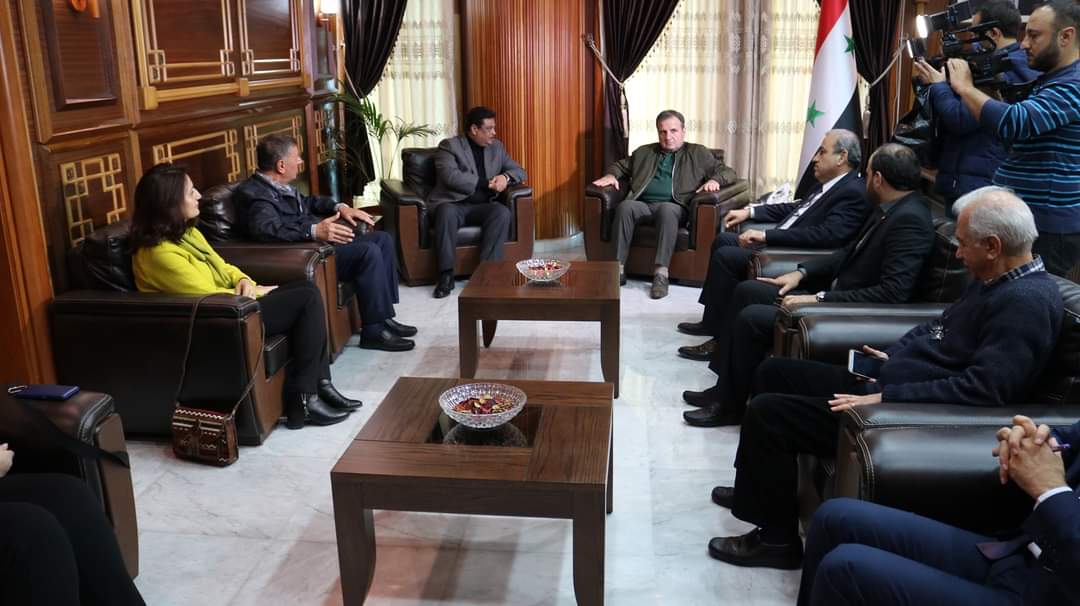


Pakistan's ambassador to Syria, Air Marshal (Retd.) Saeed Muhammad Khan, meets Latakia Governor Ibrahim Khader Salem on Wednesday, November 25, 2020. (Photo courtesy: Embassy of Pakistan in Damascus)

Syria has so far recorded over 7,000 cases, with 376 deaths. The United Nations has said the country is at high risk of a major outbreak because of a fragile health system devastated by a nine-year war and lack of sufficient equipment to detect the virus, alongside large numbers of vulnerable people.
The World Health Organization has warned that the country has a limited capacity to deal with a rapid spread of the virus.


Pakistan urges concessional finance for developing nations to boost clean energy security

Updated 6 sec ago
Follow

Pakistan urges concessional finance for developing nations to boost clean energy security

  • Pakistan has emerged as one of world’s fastest growing solar markets, with 12GWs of off-grid and 6GWs of net-metered capacity in 2025
  • PM’s aide says Islamabad remains committed to Paris Agreement, looks for continued support in building a resilient and low-carbon future

ISLAMABAD: Pakistan has urged international partners to scale up concessional financing for developing countries, the country’s Press Information Department (PID) said on Sunday, citing an aide to Prime Minister Shehbaz Sharif.

The call was made by Sharif’s coordinator on climate change, Romina Khurshid Alam, while delivering Pakistan’s national statement at the 16th International Renewable Energy Agency (IRENA) Assembly in Abu Dhabi.

Pakistan has emerged as one of the world’s fastest growing solar markets, with 12 gigawatts (GWs) of off-grid and over 6GWs of net-metered solar capacity by the end of 2025. Last fiscal year, renewables accounted for a historic 53 percent of total electricity generation, according to Alam.

The prime minister’s aide stressed that affordable funding for developing nations is critical to accelerating their transition to clean energy and strengthening energy security amid rising climate and economic challenges.

“Alam reaffirmed Pakistan’s target of achieving 60 percent renewables in the power mix by 2030,” the PID said in a statement.

“In her call to action, she urged IRENA and Member States to increase concessional finance for developing nations, treat technologies such as energy storage and green hydrogen as global public goods, and strengthen regional cooperation for shared energy security.”

IRENA is a global intergovernmental agency for energy transformation that serves as the principal platform for international cooperation, supports countries in their energy transition, and provides state of the art data and analyzes on technology, innovation, policy, finance and investment. Its membership comprises 170 countries and the European Union (EU).

The 16th session of the IRENA Assembly is taking place on Jan. 10-12 in Abu Dhabi and focuses on the theme of “Powering Humanity: Renewable Energy for Shared Prosperity.” The session has gathered global leaders and energy decision-makers to discuss strategies and underline necessary actions for the acceleration of renewable energy across countries, regions, and the world, driving economic inclusion, equity, and human well-being.

Alam shared that Pakistan is taking action against energy poverty through initiatives like the Punjab Solar Panel Scheme 2026, which provides free or subsidized systems to low-income households.

She highlighted how distributed solar kits have restored power and livelihoods in flood-affected communities and offer a replicable model for climate-resilient recovery.

“Pakistan remains fully committed to the Paris Agreement and looks to IRENA for continued technical and financial support in building a resilient, inclusive, and low-carbon future,” Alam said.

Adopted in 2015 to combat climate change, the Paris Agreement binds nations to hold “the increase in the global average temperature to well below 2°C above pre-industrial levels” and pursue efforts “to limit the temperature increase to 1.5°C above pre-industrial levels.”