PARIS: France will host a video conference with international partners on Dec. 2 to discuss humanitarian aid for financially-strapped Lebanon, three sources aware of the matter said on Thursday.
The meeting, in conjunction with the United Nations, will aim to have the highest-level representation possible with the objective of soliciting aid for Lebanon's debt-crushed economy.
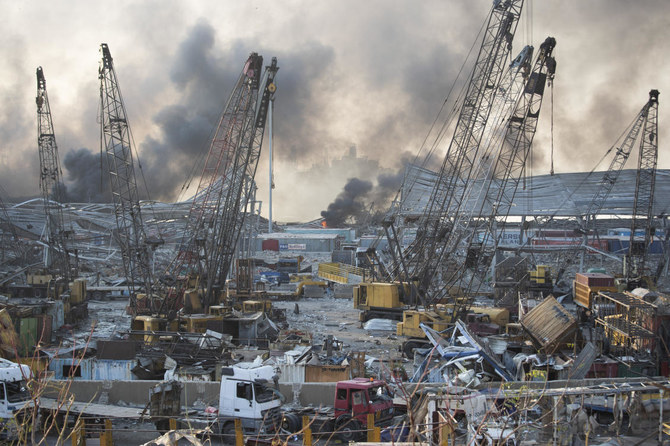
President Emmanuel Macron has vowed to push ahead with efforts to prevent Lebanon collapsing after a massive explosion in Beirut's port in August destroyed large areas of the city and compounded the country's political and financial crisis.
However, a French initiative to stabilize Lebanon and enable the release of billions of dollars of international aid to fix the economy has yet to bear fruit.
The sources said that given the worsening economic situation and the COVID-19 pandemic, France had decided to press ahead with the humanitarian conference.
"There isn’t huge appetite to help Lebanon from the international community, but relief should go directly to the people," said one person aware of the conference.
The French presidency did not immediately respond to a request for comment.
Conference details are still to be ironed out early next week, but it aims to attract as many senior government officials as possible.
Earlier in the day, restructuring consultancy Alvarez & Marsal (A&M) confirmed it had withdrawn from a forensic audit of Lebanon's central bank as it had not received the information required to carry out the task.
The decision, first announced by Lebanon's caretaker finance minister on Nov. 20, was a blow to Lebanon as the audit is a key demand of foreign donors to help it exit a financial meltdown, the country's worst crisis since its 1975-1990 civil war.

France to arrange aid conference for Lebanon by video on Dec. 2
https://arab.news/ystre
France to arrange aid conference for Lebanon by video on Dec. 2
- Macron has vowed to push ahead with efforts to prevent Lebanon collapsing after the Beirut explosion
- A French initiative to enable the release of billions of dollars of international aid to fix the economy has yet to bear fruit
First responders enter devastated Aleppo neighborhood after days of deadly fighting
- The US-backed SDF, which have played a key role in combating the Daesh group in large swaths of eastern Syria, are the largest force yet to be absorbed into Syria’s national army
ALEPPO, Syria: First responders on Sunday entered a contested neighborhood in Syria’ s northern city of Aleppo after days of deadly clashes between government forces and Kurdish-led forces. Syrian state media said the military was deployed in large numbers.
The clashes broke out Tuesday in the predominantly Kurdish neighborhoods of Sheikh Maqsoud, Achrafieh and Bani Zaid after the government and the Syrian Democratic Forces, the main Kurdish-led force in the country, failed to make progress on how to merge the SDF into the national army. Security forces captured Achrafieh and Bani Zaid.
The fighting between the two sides was the most intense since the fall of then-President Bashar Assad to insurgents in December 2024. At least 23 people were killed in five days of clashes and more than 140,000 were displaced amid shelling and drone strikes.
The US-backed SDF, which have played a key role in combating the Daesh group in large swaths of eastern Syria, are the largest force yet to be absorbed into Syria’s national army. Some of the factions that make up the army, however, were previously Turkish-backed insurgent groups that have a long history of clashing with Kurdish forces.
The Kurdish fighters have now evacuated from the Sheikh Maqsoud neighborhood to northeastern Syria, which is under the control of the SDF. However, they said in a statement they will continue to fight now that the wounded and civilians have been evacuated, in what they called a “partial ceasefire.”
The neighborhood appeared calm Sunday. The United Nations said it was trying to dispatch more convoys to the neighborhoods with food, fuel, blankets and other urgent supplies.
Government security forces brought journalists to tour the devastated area, showing them the damaged Khalid Al-Fajer Hospital and a military position belonging to the SDF’s security forces that government forces had targeted.
The SDF statement accused the government of targeting the hospital “dozens of times” before patients were evacuated. Damascus accused the Kurdish-led group of using the hospital and other civilian facilities as military positions.
On one street, Syrian Red Crescent first responders spoke to a resident surrounded by charred cars and badly damaged residential buildings.
Some residents told The Associated Press that SDF forces did not allow their cars through checkpoints to leave.
“We lived a night of horror. I still cannot believe that I am right here standing on my own two feet,” said Ahmad Shaikho. “So far the situation has been calm. There hasn’t been any gunfire.”
Syrian Civil Defense first responders have been disarming improvised mines that they say were left by the Kurdish forces as booby traps.
Residents who fled are not being allowed back into the neighborhood until all the mines are cleared. Some were reminded of the displacement during Syria’s long civil war.
“I want to go back to my home, I beg you,” said Hoda Alnasiri.


