



KARACHI: With the annual hunting season for the houbara bustard bird beginning in Pakistan next month, the country’s southern Sindh province has moved to regulate the practice of falconry, including that hunting parties that arrive mostly from Arab states pay $100,000 to hunt 100 of the rare desert birds over a ten-day period.
Every winter, thousands of the houbara bustard migrate from Central Asia to the warmth of Pakistani deserts in Sindh province. Their arrival sets off another migration, with scores of wealthy Gulf Arabs descending on Pakistan for falconry, the practice of hunting wild animals in their natural state or habitat, with the help of a trained bird of prey. Local communities also benefit from the hobby, the government argues, with hunters channeling cash — via hunting permit fees and jobs — into remote corners of the country where the bird is found.
In September this year, Sindh passed a new law, the Sindh Wildlife Protection, Preservation, Conservation and Management Act of 2020, to boost falconry and discourage “harmful” hunting practices, including banning hunting during the breeding season.
“Previously, there was no code of conduct explained in the old law; however, in the new law it is fully explained,” Javed Mahar, the conservator at the Sindh Wildlife Department, told Arab News.
Under the new law, a foreign dignitary or his state would be required to file a hunting permit request with the Pakistani foreign office, which would then be forwarded to the wildlife department.
The provincial wildlife department would issue hunting permits to foreign dignitaries only on the request of the ministry of foreign affairs, Mahar added: “A foreign hunting party will pay $100,000 for hunting 100 houbara bustards in ten days’ time.”
“Request is received by Government in writing, from dignitary or his State or forwarded through Ministry of Foreign Affairs, Government of Pakistan,” the new law reads.
The foreign office did not respond to repeated requests for comment.
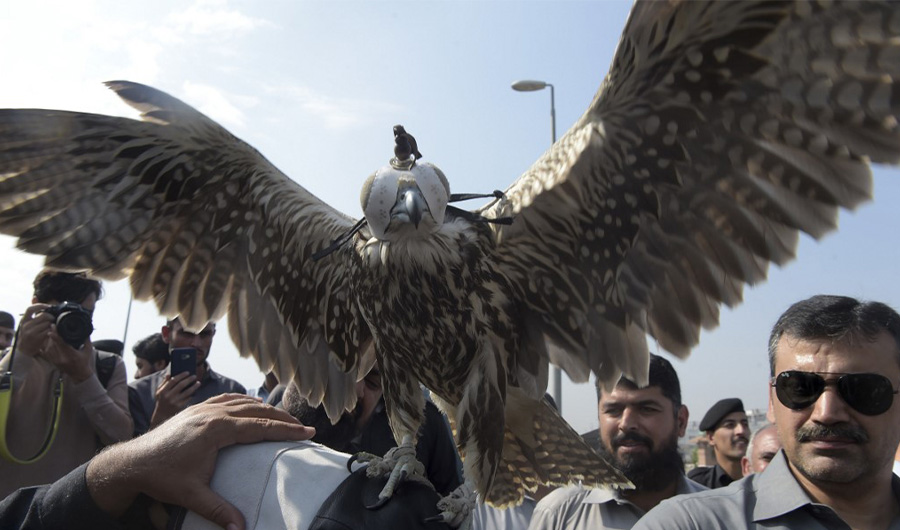
Wildlife officials release a falcon in Peshawar on October 23, 2019. (AFP/File)
In 2015, the Supreme Court placed a ban on hunting the houbara bustard. The government at the time, of Prime Minister Nawaz Sharif, asked the court to review the ban because it was damaging Pakistan’s relations with Gulf states, key investors in the country. It argued that sustainable hunting of the bustard was the best means of conservation.
The court lifted the ban in 2016.
But conservationists say the bird is at risk of extinction if hunting continues.
The International Union for Conservation of Nature lists the bustard as a vulnerable species with a global population of between 50,000 and 100,000. It has almost vanished on the Arabian peninsula.
But Pakistani officials say the new law will both boost diplomatic relations with Gulf states and set better hunting precedents.
“This healthy practice will help in boosting diplomatic relations,” Pakistan Falconry Association president Kamran Khan Yousafzai said. “It is good that falconry has been regulated in Sindh,” he added, saying the new regulations would help uplift local communities and conservation efforts.
“The pattern can be derived from markhor trophy hunting which diverts 70 percent of its earnings to uplift local communities and conservation whereas only 30 percent goes to the government,” he said, referring to hunting licenses auctioned each year for the rare long-horned goat native to Pakistan.
But the World Wide Fund Pakistan said hunting permits for the vulnerable houbara bustard should only be issued based on population viability confirmed through credible research.
“Global population of threatened Asian houbara bustard is continuously declining mainly due to poaching, hunting and habitat degradation,” Muhammad Jamshed Chaudhry, WWF Pakistan senior manager for research and conservation, said. “Without taking stringent measures to control these, new regulation law may not demonstrate any benefits to the species and communities.”


