US to sanction entities linked to Iran's missile program

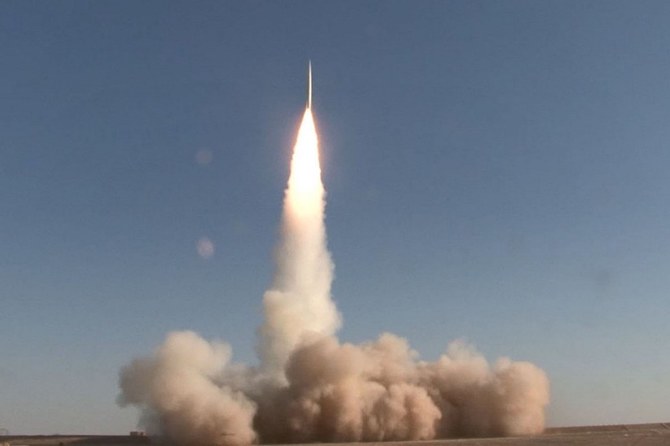
An Iranian missile being fired during air defence exercises last month. (AFP)
Short Url
Updated 25 November 2020
Follow

US to sanction entities linked to Iran's missile program

  • Envoy Elliott Abrams warns Abrams warns that Washington would continue to apply pressure on Iran
  • Entities in China and Russia accused of promoting Iran's missile program

WASHINGTON: The United States on Wednesday will impose Iran-related sanctions on four entities, US Special Envoy for Iran Elliott Abrams said, accusing the entities in China and Russia of activities promoting Iran's missile program.
Abrams warned that Washington would continue to apply pressure on Iran, with sanctions expected over the coming weeks and through December and January related to arms, weapons of mass destruction and human rights.
"We will have next week, and the week after, and the week after - all through December and January, there will be sanctions that deal with arms, that deal with weapons of mass destruction, that deal with human rights. ... So this will continue on for another couple of months, right until the end," Abrams said during a virtual Beirut Institute event.
Tensions between Washington and Tehran have risen since Trump two years ago abandoned the 2015 Iran nuclear deal struck by his predecessor, Barack Obama, and restored harsh economic sanctions designed to force Tehran into a wider negotiation on curbing its nuclear program, development of ballistic missiles and support for regional proxy forces.
President-elect Joe Biden, set to take office on Jan. 20, has said he will return the United States to the nuclear deal, if Iran resumes compliance.
Abrams on Wednesday said it would be wrong to assume that a new administration could reverse Iran policy like switching a light and that negotiations to return to the Iran nuclear deal would take many months. 


International law at ‘breaking point’ amid ‘epidemic’ of conflicts: Survey

Updated 02 February 2026
Follow

International law at ‘breaking point’ amid ‘epidemic’ of conflicts: Survey

  • Gaza war highlighted as one of the most concerning areas; atrocities in Sudan also noted
  • ‘Well over’ 100,000 civilians have been killed in past 18 months amid ‘rampant impunity’

LONDON: A new survey of 23 conflicts worldwide has said more than 100,000 civilians have been killed in the past 18 months, with adherence to international humanitarian law reaching “a critical breaking point.”

The “War Watch” survey highlighted the war in Gaza as one of the most concerning areas in an “epidemic” of violence, while also noting concerning levels of atrocities in Sudan.

Taken under the auspices of the Geneva Academy of International Humanitarian Law and Human Rights, the survey covers July 2024 to the end of 2025.

Lead author Stuart Casey-Maslen said: “Atrocity crimes are being repeated because past ones were tolerated. Our actions — or inaction — will determine whether international humanitarian law vanishes altogether.”

In Gaza, local authorities say 18,592 children and 12,400 women have been killed since Israel invaded the Palestinian enclave in October 2023. 

The report said Gaza’s overall population had declined by “about 254,000 people, a 10.6 percent decline compared with pre-conflict estimates,” making it one of the most deadly conflicts in the world. It noted that despite a ceasefire being agreed late last year, civilian casualties have continued.

In Sudan, after the fall of the city of El-Fasher to the Rapid Support Forces last October, widespread reports of survivors “being gang-raped by RSF fighters” — including in the presence of relatives — were recorded in numerous instances.

The survey said: “We do not know how many civilians have been killed in the conduct of hostilities during armed conflicts in 2024 and 2025, but we do know that the number is well over 100,000 in each of the two years.”

It added that “serious violations of international humanitarian law (IHL) were wrought … on a huge scale and with rampant impunity.” 

The report said IHL and the laws of armed conflict, established after the Second World War to protect civilians, must be upheld by every state under the Geneva Conventions “in all circumstances.”

It added: “Addressing widespread impunity for serious violations of international law should be treated as a policy priority.”

The report suggested several policy ideas to reduce the number of people suffering, including arms export bans for countries “where there is a clear risk that the arms or ammunition to be delivered will be used to commit or facilitate serious violations” of IHL.

It also proposed limiting the use of drones and artificial intelligence targeting in civilian areas, as well as unguided gravity bombs or inaccurate long-range artillery.

In addition, it called for “systematic prosecution of war crimes,” saying more political and financial support need to be given to the International Criminal Court by members of the international community.